
La Bibliothèque d'Applications présente des modèles construits avec COMSOL Multiphysics pour la simulation d'une grande variété d'applications, dans les domaines de l'électromagnétisme, de la mécanique des solides, de la mécanique des fluides et de la chimie. Vous pouvez télécharger ces modèles résolus avec leur documentation détaillée, comprenant les instructions de construction pas-à-pas, et vous en servir comme point de départ de votre travail de simulation. Utilisez l'outil de recherche rapide pour trouver les modèles et applications correspondant à votre domaine d'intérêt. Notez que de nombreux exemples présentés ici sont également accessibles via la Bibliothèques d'Applications intégrée au logiciel COMSOL Multiphysics® et disponible à partir du menu Fichier.
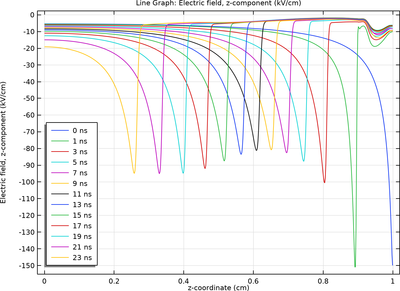
This model simulates the propagation of a positive streamer in a weak electric field where the process of photoionization is essential to provide seed electrons at the front of the streamer head. The simulated electric field and electron density as a function of time agree well with that ... En savoir plus
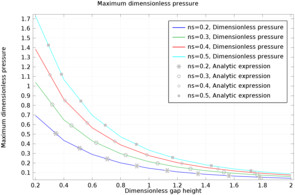
This benchmark model computes the load-carrying capacity of a one dimensional hydrodynamic step bearing. The results are compared with analytic expressions obtained by solving the Reynolds equations directly in this simple case. En savoir plus
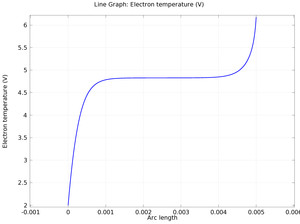
The Drift Diffusion interface solves a pair of reaction/advection/diffusion equations, one for the electron density and the other for the mean electron energy. This tutorial example computes the electron number density and mean electron energy in a drift tube. Electrons are released due ... En savoir plus

This model demonstrates how to set up a dynamic simulation that includes several contact interactions, including friction, using a single general contact pair. The dynamics is solved using explicit time stepping. En savoir plus
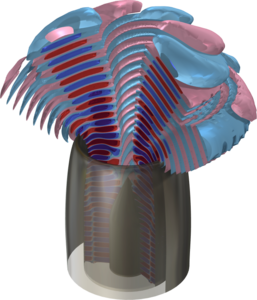
This model demonstrates two approaches to model the acoustics in a generic nacelle with an acoustic liner and a background flow. The first method uses the Compressible Potential Flow and the Linearized Potential Flow, Frequency Domain interfaces, while the second, more detailed approach, ... En savoir plus
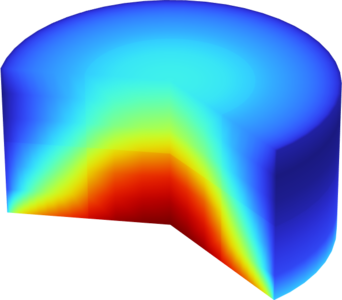
This model simulates a cylindrical furnace with isotropic scattering. It validates the use of the Discrete Ordinates Method for 2D axisymmetric cases, comparing the results with the highly accurate Monte Carlo method. The setup and reference Monte Carlo values are given in: R .P. Gupta, ... En savoir plus
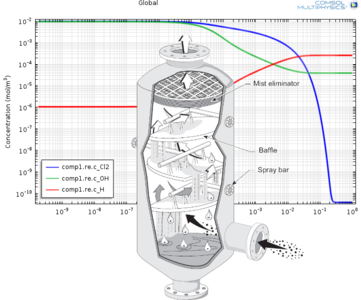
This example studies the kinetics of the neutralization of chlorine gas in water solution. The model assumes that the fluid volume is perfectly mixed and constant. This means that the chlorine has dissolved to an almost saturated state (1·10-2 mol/m3) and that the hydroxide has also ... En savoir plus

This example shows how to model carbonation, which is a type of sparging. Sparging is a mass transfer process between a gas and a liquid that is common in industry (such as beverage carbonation and photobioreactor applications) and at home (aquarium aeration). In the carbonation model, ... En savoir plus
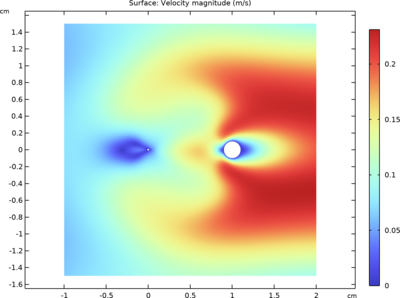
This model simulates the velocity of the ionic wind generated by a wire-to-wire corona discharge. Ionic wind, created by the movement of charged particles in an electric field, can be harnessed for various applications, including cooling electronic components and enhancing heat ... En savoir plus
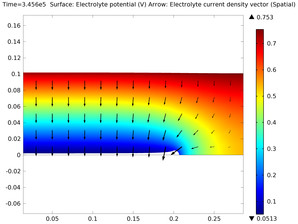
This example shows how to model secondary current distribution and electrode growth with a moving geometry. To avoid numerical instabilities, a seed layer is introduced in the initial geometry to obtain a right angle at the edge between the growing electrode and the insulator. En savoir plus


