
La Bibliothèque d'Applications présente des modèles construits avec COMSOL Multiphysics pour la simulation d'une grande variété d'applications, dans les domaines de l'électromagnétisme, de la mécanique des solides, de la mécanique des fluides et de la chimie. Vous pouvez télécharger ces modèles résolus avec leur documentation détaillée, comprenant les instructions de construction pas-à-pas, et vous en servir comme point de départ de votre travail de simulation. Utilisez l'outil de recherche rapide pour trouver les modèles et applications correspondant à votre domaine d'intérêt. Notez que de nombreux exemples présentés ici sont également accessibles via la Bibliothèques d'Applications intégrée au logiciel COMSOL Multiphysics® et disponible à partir du menu Fichier.

This model studies the heat conduction in a building structure separating two floors from the external environment. Four materials with distinct thermal conductivities k compose the structure. The exterior and interior boundaries are facing environments respectively at 0°C and 20°C. The ... En savoir plus
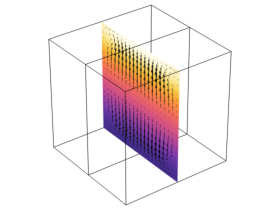
This example studies the stationary state of free convection in a cavity filled with water and bounded by two vertical plates. To generate the buoyancy flow, the plates are heated at different temperatures, bringing the regime close to the transition between laminar and turbulent. To ... En savoir plus
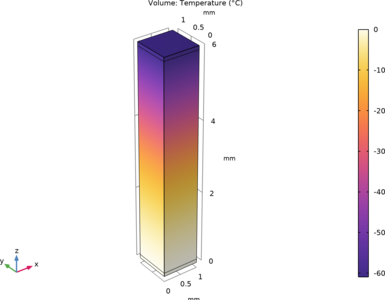
A thermoelectric leg is a fundamental component of a thermoelectric cooler (or heater). For example, a thermocouple is a thermoelectric module typically made of two thermoelectric legs: one made of p-type and of one n-type semiconductor material which are connected in series electrically ... En savoir plus
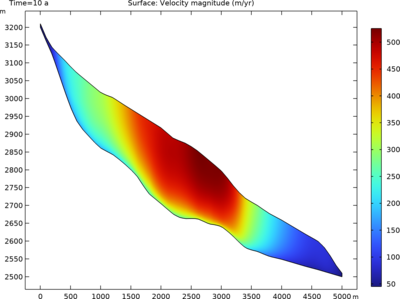
This example shows how to set up a glacier flow model in principle, containing several important aspects of glacier modeling: The creation of the 2D geometry, the modeling of non-Newtonian flow, and the implementation of basal sliding. In this example, two different glacier types, a cold ... En savoir plus
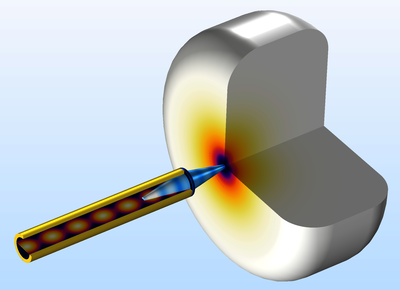
The response of a millimeter wave with frequencies of 35 GHz and 95 GHz is known to be very sensitive to water content. This model utilizes a low-power 35 GHz Ka-band millimeter wave and its reflectivity to moisture for noninvasive cancer diagnosis. Since skin tumors contain more ... En savoir plus
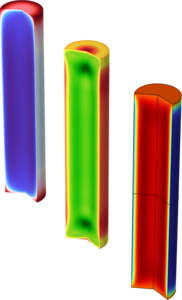
A steel billet is quenched in oil from its austenitic state. A 2D axisymmetric model is used to simulate the coupled problem of austenite decomposition, heat transfer, and solid mechanics. During the quenching process, the austenite decomposes into a combination of ferrite, pearlite, ... En savoir plus
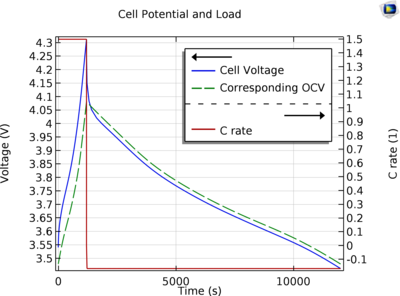
This app can be used as a design tool to develop an optimized battery configuration for a specific application. The application computes the capacity, energy efficiency, heat generation, and capacity losses due to parasitic reactions of a battery for a specific load cycle. Various ... En savoir plus
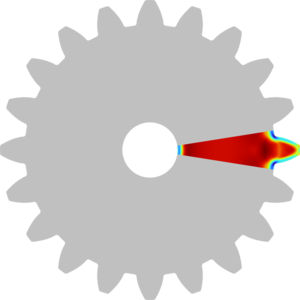
This model shows how to simulate carburization and quenching of a steel gear. Diffusion of carbon into the surface of the gear affects the onset of martensitic transformation. Residual stresses are computed, and it is shown that high residual compressive stresses appear at the root of ... En savoir plus
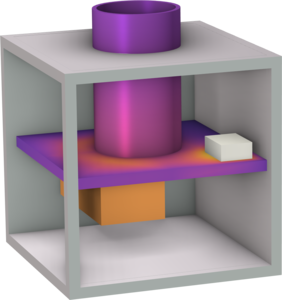
This model demonstrates how to compute satellite temperature over multiple orbit periods by coupling Orbital Thermal Loads to Heat Transfer in Solids. The direct solar, albedo, and Earth infrared thermal loads are computed over a single orbit, and are periodically repeated over multiple ... En savoir plus
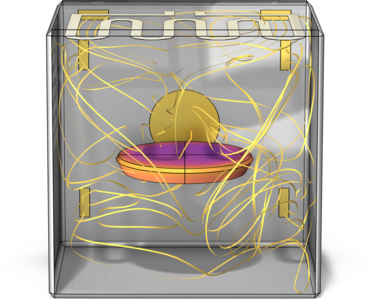
This example models the heating inside an oven with the Single Phase Flow, Heat Transfer and Surface-to-Surface Radiation interfaces. It accounts for conductive, convective and radiative heat transfer. Two computation approaches are set up: A one-way nonisothermal flow (one-way NITF) ... En savoir plus


