
La Bibliothèque d'Applications présente des modèles construits avec COMSOL Multiphysics pour la simulation d'une grande variété d'applications, dans les domaines de l'électromagnétisme, de la mécanique des solides, de la mécanique des fluides et de la chimie. Vous pouvez télécharger ces modèles résolus avec leur documentation détaillée, comprenant les instructions de construction pas-à-pas, et vous en servir comme point de départ de votre travail de simulation. Utilisez l'outil de recherche rapide pour trouver les modèles et applications correspondant à votre domaine d'intérêt. Notez que de nombreux exemples présentés ici sont également accessibles via la Bibliothèques d'Applications intégrée au logiciel COMSOL Multiphysics® et disponible à partir du menu Fichier.
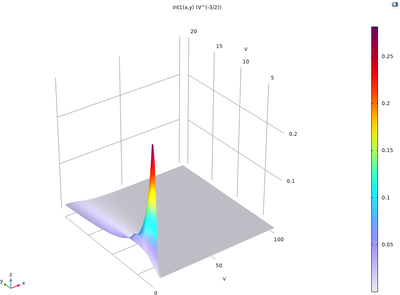
The model of 1D Dielectric Barrier Discharge (DBD) has been recomputed with the three different kinds of electron energy distribution functions (EEDFs): The Maxwellian function The Druyvesteyn function The computed EEDF based on the Boltzmann Equation, Two-Term Approximation ... En savoir plus
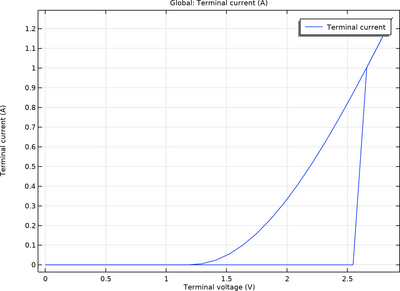
This model shows how to model a simple Shockley diode— a four-layer PNPN semiconductor device. The Shockley diode is also named as thyristor. In this model, the Analytic Doping Model node is utilized to define the doping profiles for each domain. A time-dependent study is employed to ... En savoir plus
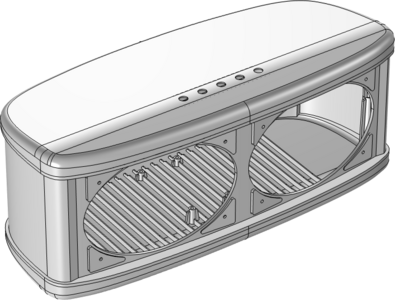
This tutorial demonstrates how to create domains for modeling inside and outside of an imported CAD assembly. You will also learn how to use the defeaturing tools for deleting details from the imported geometry. En savoir plus
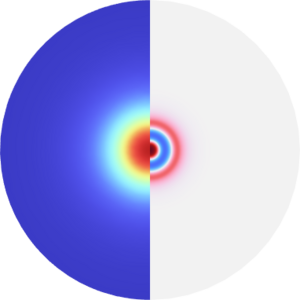
Stimulated Brillouin Scattering (SBS) describes a nonlinear interaction between light and sound. In optical fibers, SBS can be detrimental for power or communication purposes, but can be leveraged for sensing applications. The SBS gain spectrum quantifies the optic-acoustic mode ... En savoir plus

This example demonstrates an app that utilizes the LiveLink™ interface for Inventor® to run simulations on CAD designs. En savoir plus

This example demonstrates an app that utilizes the LiveLink™ interface for Solid Edge® to run simulations on CAD designs. En savoir plus
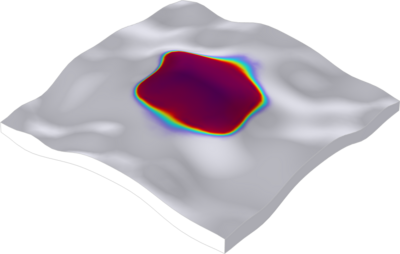
Modeling and simulation is useful for evaluating the feasibility of storing hydrogen underground. In this example of a geological formation, hydrogen is injected through an injection well at a rate of 1 kg/s over a period of 2 years, until it is ready to be extracted and discharged ... En savoir plus
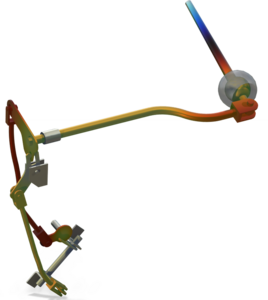
This model demonstrates the ability to simulate Multibody Dynamics in COMSOL. It comprises a multilink mechanism that is used in an antique automobile as a gearshift lever. It was created out of curiosity to find out how large forces are on the individual components. The model uses ... En savoir plus
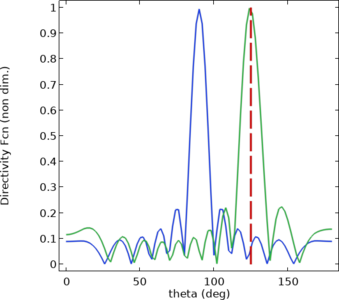
A line array of eleven spherical hydrophones embedded in a neoprene coating is modeled in 3D. The sensitivity of the array is analyzed with regard to varying angles of incidence of the background pressure field. The array directivity function is computed and compared to the analytical ... En savoir plus
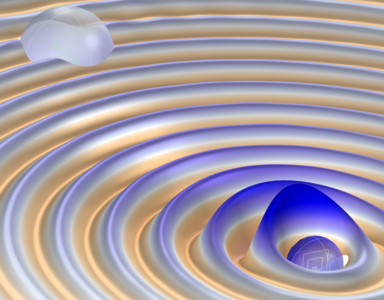
In this model, the transmitter (microstrip patch) and receiver (Yagi–Uda) antennas are modeled simultaneously in the FEM domain and are coupled with FEM–BEM coupling. The results are compared with the analytical Friis transmission formula. In detail, the emw and emw2 interfaces find out ... En savoir plus


