
La Bibliothèque d'Applications présente des modèles construits avec COMSOL Multiphysics pour la simulation d'une grande variété d'applications, dans les domaines de l'électromagnétisme, de la mécanique des solides, de la mécanique des fluides et de la chimie. Vous pouvez télécharger ces modèles résolus avec leur documentation détaillée, comprenant les instructions de construction pas-à-pas, et vous en servir comme point de départ de votre travail de simulation. Utilisez l'outil de recherche rapide pour trouver les modèles et applications correspondant à votre domaine d'intérêt. Notez que de nombreux exemples présentés ici sont également accessibles via la Bibliothèques d'Applications intégrée au logiciel COMSOL Multiphysics® et disponible à partir du menu Fichier.
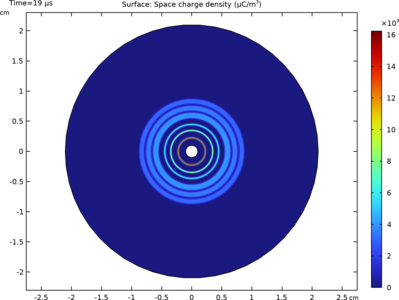
Usually limited to a specific region, corona discharges appear as a consistent luminosity. The attributes of steady glow corona discharges change depending on their polarity. Positive glow corona, also referred to as Hermstein's glow or ultra corona, presents a direct current (DC) aspect ... En savoir plus
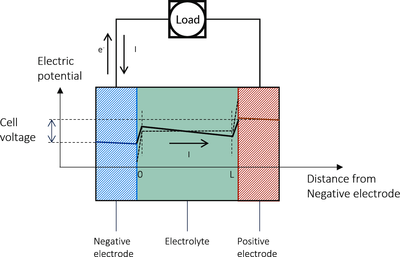
The purpose of this model is to visualize the electric potential in an electrochemical cell, for example a battery. This is done at OCV and during operation. In a battery, this would correspond to OCV, discharge, and recharge. The potential profile is explained both for cells with planar ... En savoir plus
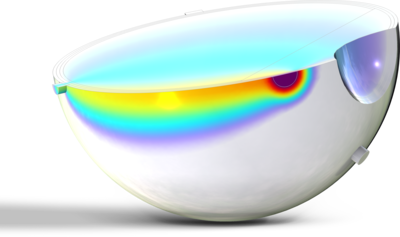
When evaluating the efficacy of treatments for ocular diseases, modeling and simulation can be used for pharmacokinetic analysis by visualizing drug concentration and how it spreads through the eye over time. In this simplified pharmacokinetic model of a human eye, a small patch is ... En savoir plus

Carbon corrosion is one of the important degradation mechanisms in a Polymer Electrolyte Membrane (PEM) fuel cells which predominantly occurs during start-up or shut down of the fuel cells. During carbon corrosion, carbon support to catalysts is compromised affecting the cell ... En savoir plus

This file shows how to create a surface of an irregular shape based on text, image, or elevation data. This approach is best suited for data where the height (or elevation) is a function of x- and y-coordinates. The data is of the Matterhorn, a European mountain located in the Alps. In ... En savoir plus
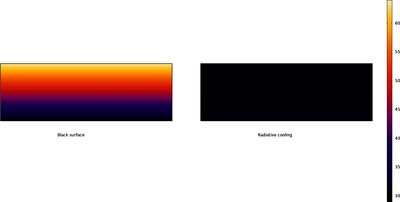
Because the atmosphere is nearly transparent to wavelengths in the range 8 to 13 µm (atmospheric window) for a clear sky, it is possible to cool down a surface even during a sunny day. This model compares the temperature distribution on a concrete block exposed to ambient and solar ... En savoir plus

This example exemplifies how curve fitting can be performed in COMSOL Multiphysics®, and how this can be applied to your modeling. A more detailed description of the phenomenon and the modeling process can be seen in the blog post "Curve Fitting of Experimental Data with COMSOL ... En savoir plus
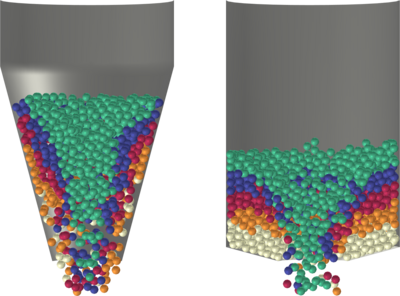
This model demonstrates the effect of the hopper design on the resulting flow patterns of the grains exiting the hopper. The flow changes from mass flow to funnel flow when the conical angle of the hopper is increased. En savoir plus
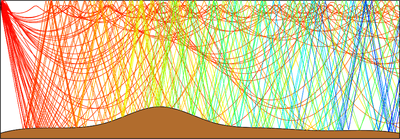
When computing ray intensity in 2D axisymmetric models, the wavefront associated with the propagating ray is treated as a spherical or ellipsoidal wave, instead of a cylindrical wave. This tutorial example illustrates how to set up several important features using the Ray Acoustics ... En savoir plus
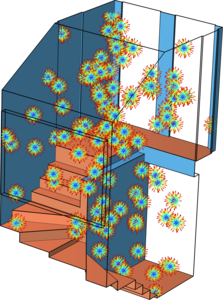
This model uses the Ray Acoustics interface to extract statistical information about a room. Two examples of rooms are analyzed: The staircase from the One-Family House Acoustics tutorial model A long corridor The models compute the mean free path as well as the reflection frequency ... En savoir plus


