
La Bibliothèque d'Applications présente des modèles construits avec COMSOL Multiphysics pour la simulation d'une grande variété d'applications, dans les domaines de l'électromagnétisme, de la mécanique des solides, de la mécanique des fluides et de la chimie. Vous pouvez télécharger ces modèles résolus avec leur documentation détaillée, comprenant les instructions de construction pas-à-pas, et vous en servir comme point de départ de votre travail de simulation. Utilisez l'outil de recherche rapide pour trouver les modèles et applications correspondant à votre domaine d'intérêt. Notez que de nombreux exemples présentés ici sont également accessibles via la Bibliothèques d'Applications intégrée au logiciel COMSOL Multiphysics® et disponible à partir du menu Fichier.
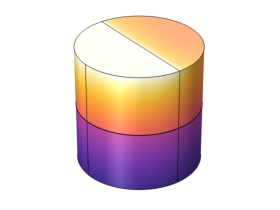
This example shows how to set up multiple sandwiched thin layers with different thermal conductivities in two different ways. First, the composite is modeled as a 3D object. In the second approach the Thin Layer boundary condition with the thermally thick option is used to avoid ... En savoir plus
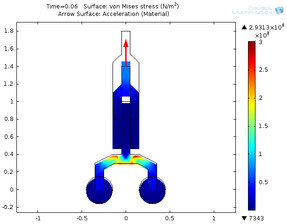
This model simulates the dynamics of the shock absorber used in a landing gear mechanism of an aircraft. It analyses the stresses, as well as the heat generated in the landing gear components due to the energy dissipated in the shock absorber. A prismatic joint, with spring and damper, ... En savoir plus
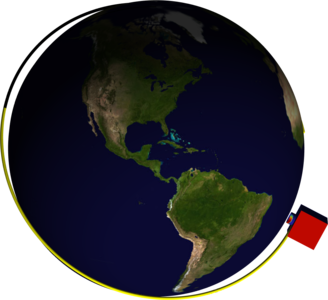
This model is an introduction to defining and verifying a satellite orbit, and computing the solar, albedo, and Earth infrared thermal loads. A 1U CubeSat is in a circular orbit at 400km altitude, inclination of 50°, and longitude of ascending node of 0°. The satellite is rotating slowly ... En savoir plus
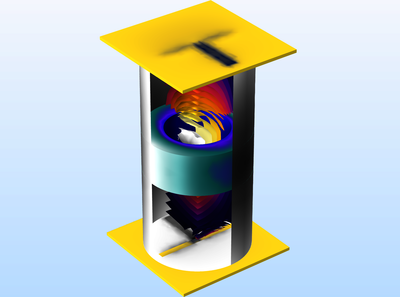
An evanescent-mode cavity filter is resonant at a frequency lower than its original fundamental mode frequency. Evanescent mode resonance can be realized by creating a discontinuity or reactance inside the cavity. The basic model was modified by the addition of a metal box at either end ... En savoir plus
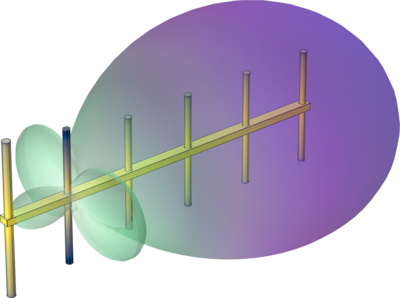
The Yagi–Uda antenna is designed for a specific Wi-Fi band and can reduce eavesdropping by directing signals with the help of directors. This antenna consists of one uniformly spaced reflector and four directors. Simulated results show a maximum 10 dBi gain and a front-to-back ratio of ... En savoir plus
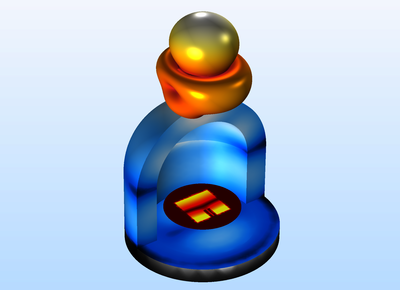
A radome minimizes losses and improves radiation characteristics of an antenna through its design. The structure can be optimized to minimize the transmission loss and also designed to improve radiation characteristics including antenna directivity and side lobes. Shown in the model is ... En savoir plus
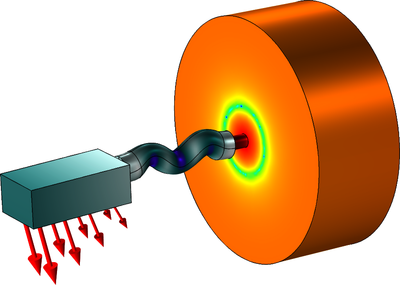
When simulations are involved in the development of mobile devices, consumer electronics, hearing aids, or headsets, it is necessary to consider how the transducers interact with the rest of the system. Here, we show an analysis of the interaction between a vibration isolation mounting ... En savoir plus
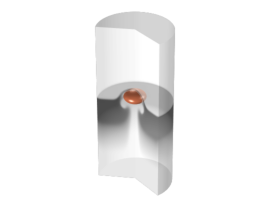
This example simulates an oil droplet rising through a suspension. The suspension is initially stratified, with a dense layer between two clear layers. The droplet is initially located in the bottom clear layer. The particles in the suspension start to sediment toward the bottom of the ... En savoir plus
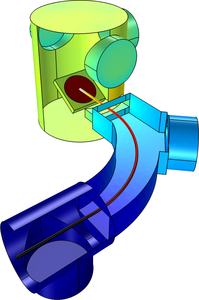
Ion implantation is used extensively in the semiconductor industry to implant dopants into wafers. Within an ion implanter, ions generated within an ion source are accelerated by an electric field to achieve the desired implant energy. Ions of the correct charge state are selected by ... En savoir plus
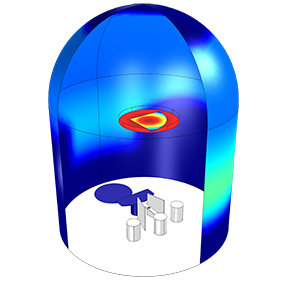
This model shows how to compute the thickness of a thermally evaporated gold film. The thickness of the deposited film is computed both on the walls of the chamber and on the sample. En savoir plus


