
La Bibliothèque d'Applications présente des modèles construits avec COMSOL Multiphysics pour la simulation d'une grande variété d'applications, dans les domaines de l'électromagnétisme, de la mécanique des solides, de la mécanique des fluides et de la chimie. Vous pouvez télécharger ces modèles résolus avec leur documentation détaillée, comprenant les instructions de construction pas-à-pas, et vous en servir comme point de départ de votre travail de simulation. Utilisez l'outil de recherche rapide pour trouver les modèles et applications correspondant à votre domaine d'intérêt. Notez que de nombreux exemples présentés ici sont également accessibles via la Bibliothèques d'Applications intégrée au logiciel COMSOL Multiphysics® et disponible à partir du menu Fichier.

The Monte Carlo simulation of flow in a turbomolecular pump can be greatly simplified if the mean radius of the blades is much greater than the spacing between them. Under these conditions, the rotating blades of the pump can be approximated as an infinite row of blades having only ... En savoir plus
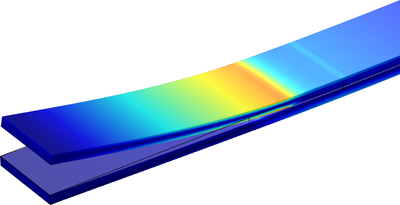
Interfacial failure by delamination or debonding can be simulated with a Cohesive Zone Model (CZM). This example shows the implementation of a CZM with a bilinear traction-separation law. It is used to predict the mixed-mode softening onset and delamination propagation in a composite ... En savoir plus
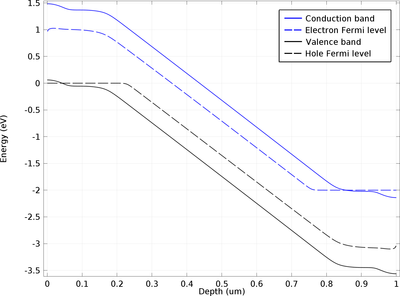
This simple model demonstrates how to use the Semiconductor Optoelectronics interfaces to model a simple GaAs PIN diode structure. Both the stimulated and spontaneous emission in the semiconductor are accounted for. The corresponding absorption of the light and the associated change in ... En savoir plus
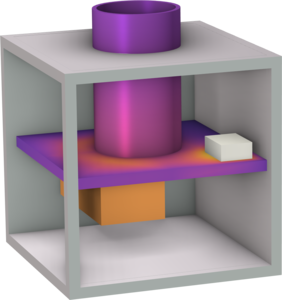
This model demonstrates how to compute satellite temperature over multiple orbit periods by coupling Orbital Thermal Loads to Heat Transfer in Solids. The direct solar, albedo, and Earth infrared thermal loads are computed over a single orbit, and are periodically repeated over multiple ... En savoir plus
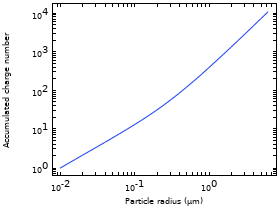
This model computes the fluid flow, charge transport and electric potential in an electrostatic precipitator. Based on the resulting fields, particles of different diameter are fed into the device and the transmission probability is computed. As expected, the separation efficiency shows ... En savoir plus
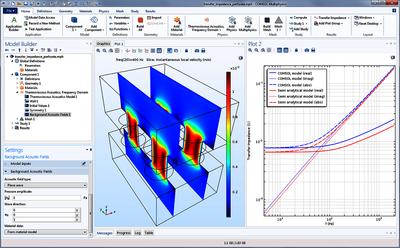
Perforates are plates with a distribution of small perforations or holes. They are used in muffler systems, sound absorbing panels, and in many other places as liners, where it is important to control attenuation precisely. As the perforations become smaller and smaller, viscous and ... En savoir plus
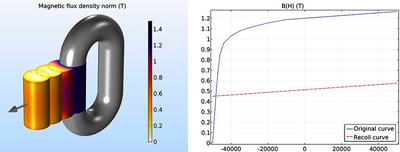
Soft permanent magnets like AlNiCo are easily demagnetized if handled incorrectly. This is a demonstration of how to model the self-demagnetization of a cylindrical AlNiCo magnet when moved out of its associated/protective magnetic circuit. The modeling is performed in three steps: The ... En savoir plus
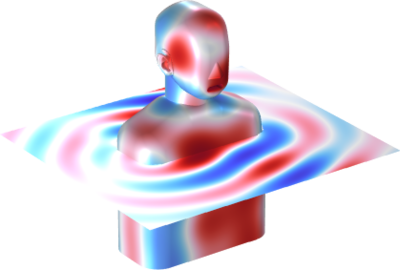
In this model, we use the Pressure Acoustics, Boundary Elements physics interface to analyze the acoustics of a generic head and torso simulator. This is a manikin head used to do standardized measurements for hearing aids, mobile phones, and headphones. The model showcases some ... En savoir plus
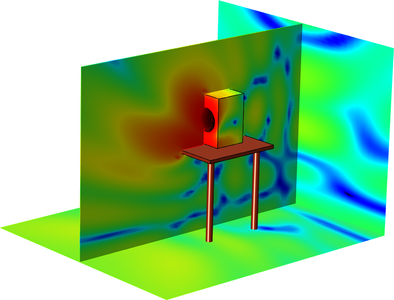
In this tutorial, the acoustic radiation pattern from a small generic loudspeaker is analyzed using the boundary element method (BEM). The loudspeaker is located on a small table above the floor and at a given distance from a wall. The model is set up using the Pressure Acoustics, ... En savoir plus
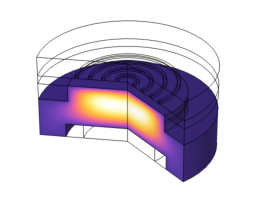
This tutorial model solves for an inductively coupled plasma reactor with RF bias (also known as ICP/CCP reactors) in a mixture of argon/chlorine. The model computes the fluid flow and gas heating. Important aspects and strategies for modeling electronegative discharges are discussed. En savoir plus


