
La Bibliothèque d'Applications présente des modèles construits avec COMSOL Multiphysics pour la simulation d'une grande variété d'applications, dans les domaines de l'électromagnétisme, de la mécanique des solides, de la mécanique des fluides et de la chimie. Vous pouvez télécharger ces modèles résolus avec leur documentation détaillée, comprenant les instructions de construction pas-à-pas, et vous en servir comme point de départ de votre travail de simulation. Utilisez l'outil de recherche rapide pour trouver les modèles et applications correspondant à votre domaine d'intérêt. Notez que de nombreux exemples présentés ici sont également accessibles via la Bibliothèques d'Applications intégrée au logiciel COMSOL Multiphysics® et disponible à partir du menu Fichier.

This application generates both random and deterministic microstructures from imported CAD models or predefined primitive objects. Structures can be created using Gaussian random fields, random particles, periodic geometries such as gyroids and other TPMS structures, or combinations ... En savoir plus
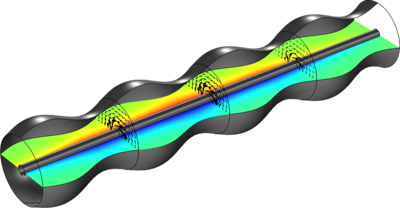
This example exemplifies how to model the impedance of a waveguide of varying cross sectional area. A more detailed description of the phenomenon and the modeling process can be seen in the blog post "Computing the Impedance of a Corrugated Waveguide". En savoir plus

This tutorial shows how to model an arbitrary surface acoustic wave (SAW) delay line. The design parameters are arbitrary in the sense that the outputs are far from optimal from a practical standpoint. The aim is to show how a SAW device can be set up in the software: how to define the ... En savoir plus

In this model, we use the Bioheat Transfer interface to solve the Pennes bioheat transfer equation. The problem is in 1D and formulated to be dimensionless. The results are compared against analytical solutions derived in a journal paper (Ref. 1). A mesh convergence study shows that the ... En savoir plus
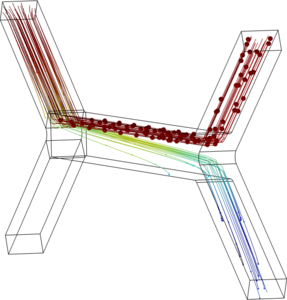
This model demonstrates continuous magnetophoretic separation of particles in a 3D microfluidic Y-channel using a permanent magnet. Separation is achieved through the balance between the magnetophoretic force and hydrodynamic drag. En savoir plus
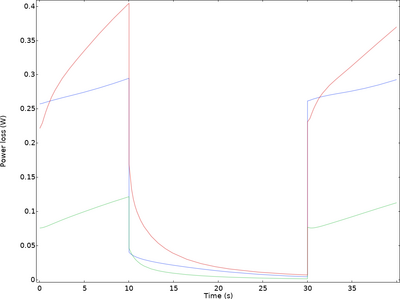
This example computes the power losses in a lithium-ion battery when exposed to high current pulses in a hybrid pulse power characterization (HPPC) test. Power loss contributions stemming from different phenomena are analyzed, as well as the total power losses pertaining to the ... En savoir plus
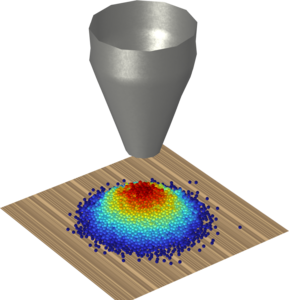
This example uses the Granular Flow interface to model the fixed funnel method for calculating the angle of repose, where a funnel is kept at a fixed height. The funnel is first filled with grains which are subsequently released and collected as a heap. The resultant heap is then ... En savoir plus
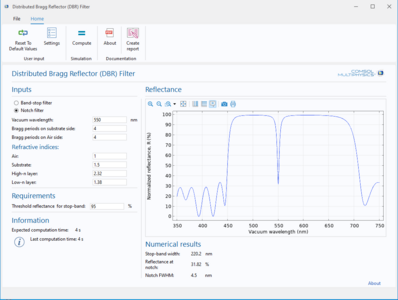
A distributed Bragg reflector (DBR) is a periodic structure formed from alternating dielectric layers that can be used to achieve nearly total reflection within a range of frequencies. The main advantage of DBRs over ordinary metallic mirrors is that DBRs can be engineered to have custom ... En savoir plus
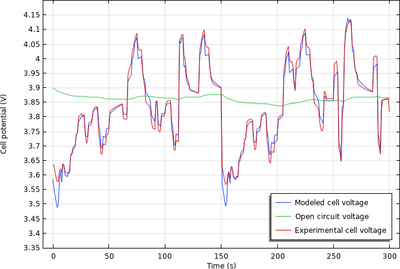
This tutorial uses an equivalent circuit approach for modeling the performance of a lithium-ion battery, requiring no knowledge about the internal chemistry or structure of the battery. A 0D equivalent circuit battery model is defined based on a resistor connected in series with a ... En savoir plus
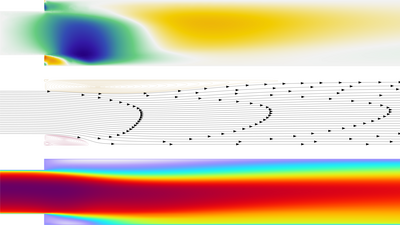
The Turbulent flow, Elliptic Blending R-ε interface is used to analyze fully developed turbulent flow in a spanwise rotating channel. Due to the influence of the Coriolis force on turbulence, profiles of the flow variables are skewed at moderate rotation rates. An asymmetry between the ... En savoir plus


