
La Bibliothèque d'Applications présente des modèles construits avec COMSOL Multiphysics pour la simulation d'une grande variété d'applications, dans les domaines de l'électromagnétisme, de la mécanique des solides, de la mécanique des fluides et de la chimie. Vous pouvez télécharger ces modèles résolus avec leur documentation détaillée, comprenant les instructions de construction pas-à-pas, et vous en servir comme point de départ de votre travail de simulation. Utilisez l'outil de recherche rapide pour trouver les modèles et applications correspondant à votre domaine d'intérêt. Notez que de nombreux exemples présentés ici sont également accessibles via la Bibliothèques d'Applications intégrée au logiciel COMSOL Multiphysics® et disponible à partir du menu Fichier.

This model demonstrates the filtration of grains of three different sizes as they pass through two vibrating sieves of different hole sizes. En savoir plus
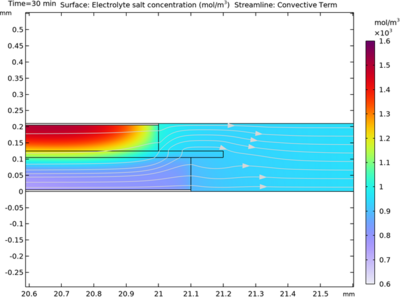
The electrodes of a lithium-ion battery are porous and consist of an active solid electrode material, a binder, and pores filled with a liquid electrolyte. Expansion of the active material due to lithium intercalation changes the volume fraction of electrolyte-filled pores in the ... En savoir plus

This example model demonstrates four different approaches for computing the integrals of fields over arbitrarily placed geometries that can be re-positioned without having to re-solve the model. This approach is also useful if you want to integrate the results of a model over different ... En savoir plus
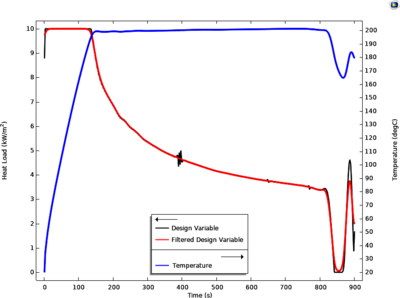
This model demonstrates how to use a space-time formulation to optimize a heating profile over time. Get an overview in the accompanying blog post Equation-Based Modeling with a Space-Time Discretization. En savoir plus

The model remove details example v63.mph illustrates how to manually add the Remove Details operation and virtual operations to find and remove small details from a model geometry. In the model geometry cleanup example v63.mph, the automatic Geometry Cleanup added Remove Details ... En savoir plus

This is a demo model to show how to model connections in a mechanical system using Multibody Dynamics interface. In this model, pantograph mechanism is modeled. The purpose of this mechanism is to produce an identical, either enlarged or miniaturized, copy of an existing drawing. En savoir plus

In semiconductor manufacturing, vacuum chucks are used to rapidly and contamination-free adsorb and secure wafers before processes such as transfer, lithography, and inspection. Traditional empirical design makes it difficult to quantify the effects of groove shape, size, distribution, ... En savoir plus
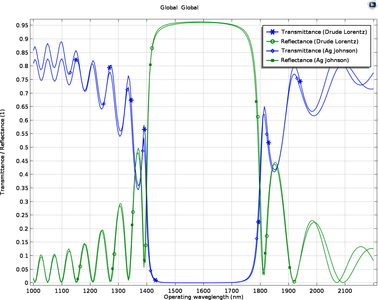
This example of a plasmonic waveguide filter shows that the waveguide rejects the electromagnetic radiation of the wavelength between 1.4 um and 1.6 um, but allows the rest of the wavelength. The silver material can be modeled using the Drude-Lorentz approximation, with ε∞ = 3.7, ωp = 13 ... En savoir plus

This model demonstrates how to solve an ordinary differential equation for the motion of a spacecraft about a planet. In addition to computing the path, it is possible to use several results presentation features to make interesting visualizations. For a full description of this model, ... En savoir plus
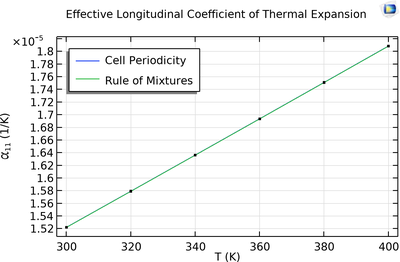
The homogenized material properties of a composite are computed based on the temperature-dependent properties of matrix and fiber. The homogenized parameters are compared to the analytical values derived from the rule of mixtures. This is an extension of model https://www.comsol.com ... En savoir plus


