
La Bibliothèque d'Applications présente des modèles construits avec COMSOL Multiphysics pour la simulation d'une grande variété d'applications, dans les domaines de l'électromagnétisme, de la mécanique des solides, de la mécanique des fluides et de la chimie. Vous pouvez télécharger ces modèles résolus avec leur documentation détaillée, comprenant les instructions de construction pas-à-pas, et vous en servir comme point de départ de votre travail de simulation. Utilisez l'outil de recherche rapide pour trouver les modèles et applications correspondant à votre domaine d'intérêt. Notez que de nombreux exemples présentés ici sont également accessibles via la Bibliothèques d'Applications intégrée au logiciel COMSOL Multiphysics® et disponible à partir du menu Fichier.

This example exemplifies how to model a Koch snowflake using the Application Builder. A more detailed description of the phenomenon and the modeling process can be seen in the blog post "Using the Application Builder to Create a Koch Snowflake". En savoir plus

Electrode balancing is an important factor in the design of lithium-ion batteries. In this model, use the experimental open-circuit voltage of a cell and some basic assumptions, followed by an optimization solver, to find a proper electrode balancing. Get more details in this ... En savoir plus
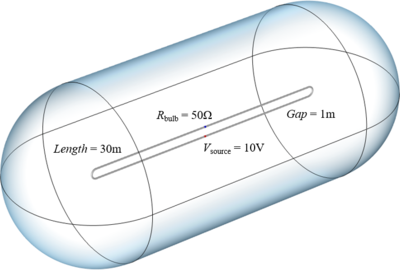
This model is used to demonstrate the solution to a classic brainteaser in electromagnetics. A long loop of wire is connected to a source and a receiver, which are placed 1 meter apart. The objective of the model is to compute how long it takes for the receiver to sense when the source ... En savoir plus
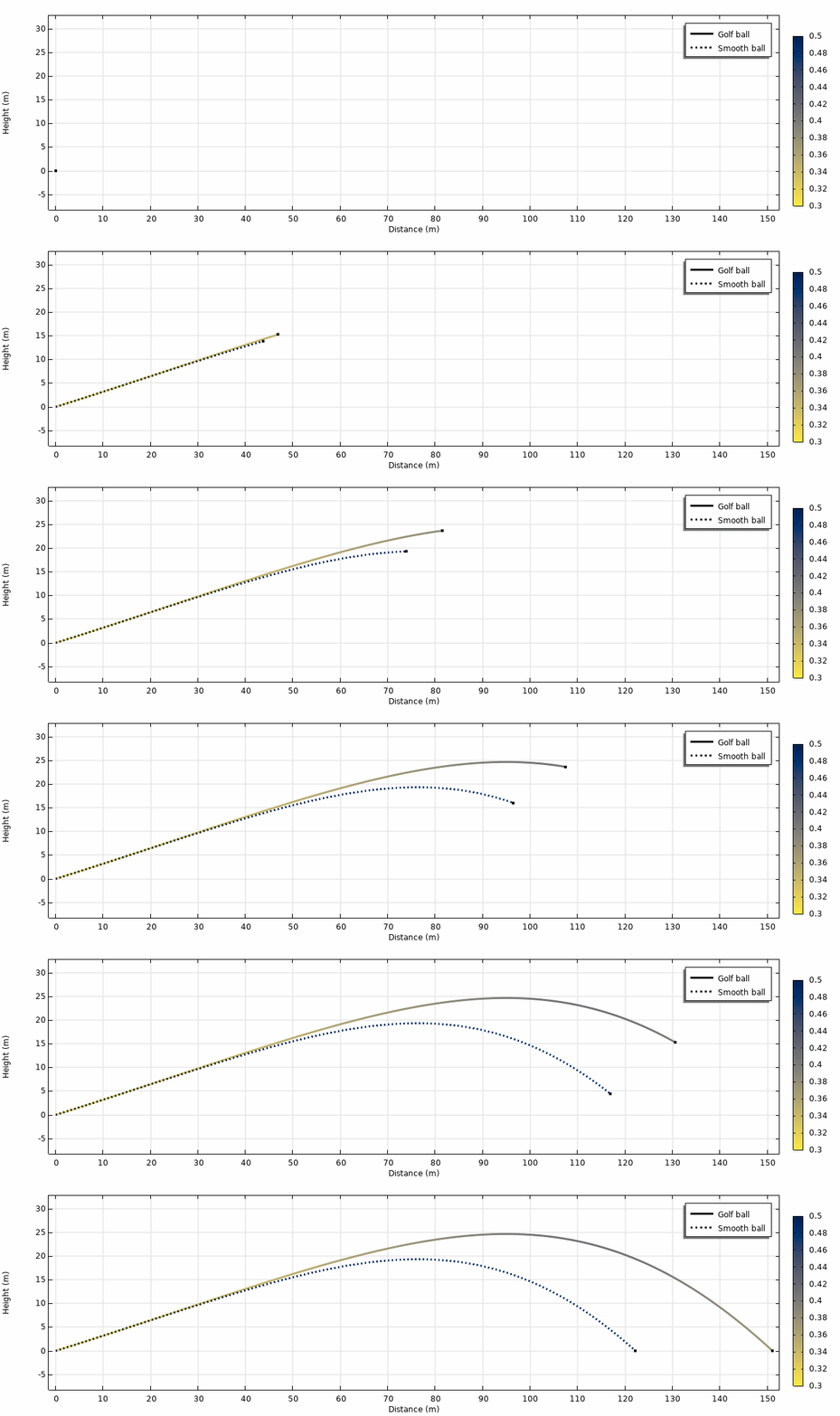
This model is used in the blog post "Why Do Golf Balls Have Dimples?". The trajectory of a golf ball is compared to the trajectory of a smooth ball using the Events interface and a system of ODEs in a 0D component. En savoir plus
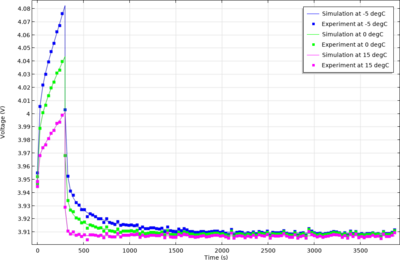
Galvanostatic Intermittent Titration Technique (GITT) is commonly used to estimate the solid-phase lithium diffusion coefficient in electrode particles. In this example, a half-cell model is built using the Lithium-Ion Battery interface, and imported synthetic voltage datasets at ... En savoir plus

When you are working with foreign CAD or ECAD data, such as files in the STEP, GDS, or IGES file formats, or any of the other supported formats, you may think that you need to re-import a new CAD file and start your modeling over from scratch if you want to study a change in size or ... En savoir plus

This example demonstrates the optimization of fiber orientation in a variable angle tow (VAT) laminate to maximize stiffness under prescribed loading and boundary conditions. The composite laminate consists of a single layer of carbon–PEEK composite with transversely isotropic material ... En savoir plus

This example shows how to create a time-limited and hardware-locked application. It is associated with the section "Time-Limited and Hardware-Locked Applications" in the Application Programming Guide En savoir plus

This parametrized model can be used to simulate the hopping hoop problem. A rolling ring with a point mass on the perimeter can, under certain conditions, jump up from the surface on which it is rolling. A more detailed description of this model can be found in the blog post "The ... En savoir plus
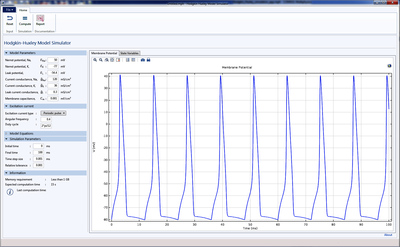
This app allows you to simulate the action potential in a cell's membrane using the Hodgkin-Huxley model. As it is presented in the form of a simulation app, you can change the input parameters for potential, conductance, and membrane capacitance to study their effects on the dynamics ... En savoir plus


