
La Bibliothèque d'Applications présente des modèles construits avec COMSOL Multiphysics pour la simulation d'une grande variété d'applications, dans les domaines de l'électromagnétisme, de la mécanique des solides, de la mécanique des fluides et de la chimie. Vous pouvez télécharger ces modèles résolus avec leur documentation détaillée, comprenant les instructions de construction pas-à-pas, et vous en servir comme point de départ de votre travail de simulation. Utilisez l'outil de recherche rapide pour trouver les modèles et applications correspondant à votre domaine d'intérêt. Notez que de nombreux exemples présentés ici sont également accessibles via la Bibliothèques d'Applications intégrée au logiciel COMSOL Multiphysics® et disponible à partir du menu Fichier.
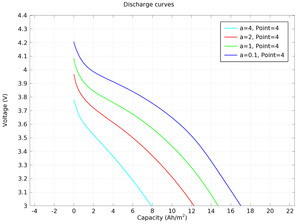
This model demonstrates the Lithium-Ion Battery interface for studying the discharge and charge of a lithium-ion battery for a given set of material properties. The geometry is in one dimension and the model is isothermal. Battery developers can use the model to investigate the influence ... En savoir plus
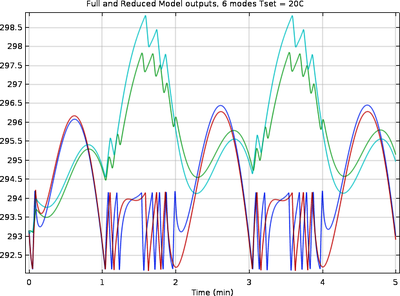
Large FEM simulations can be costly and, if repeated simulations are needed, it can be beneficial to use reduced-order models (ROMs). ROMs are typically valid only in the vicinity of their design conditions and have lower accuracy, but the simulation time is significantly shorter. The ... En savoir plus
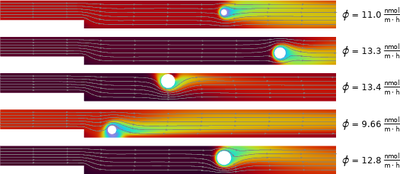
This tutorial illustrates how to use the Uncertainty Quantification (UQ) functionality to answer questions regarding sensitivity and reliability of a flow reactor with thermal decomposition. The tutorial investigates what uncertainties in parameters dominates the survival of a nutrient ... En savoir plus
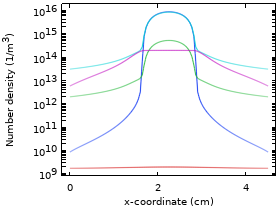
This tutorial model solves for a one-dimensional capacitively coupled plasma reactor in a mixture of argon/oxygen. Important aspects and strategies for modeling electronegative discharges are discussed. En savoir plus
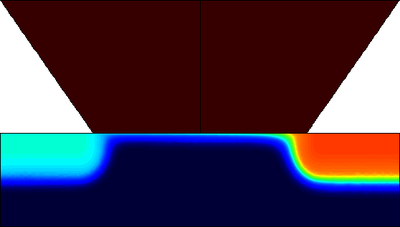
An ion-sensitive field-effect transistor (ISFET) is constructed by replacing the gate contact of a MOSFET with an electrolyte of interest. The concentration of a specific ionic species in the electrolyte can be determined by measuring the change in the gate voltage due to the interaction ... En savoir plus
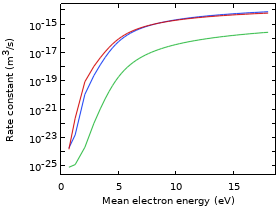
This model solves the Boltzmann equation in the two-term approximation for a background of molecular and atomic hydrogen. Electron mobility and source terms are computed by suitable integration of the electron energy distribution function over electron impact cross sections. En savoir plus
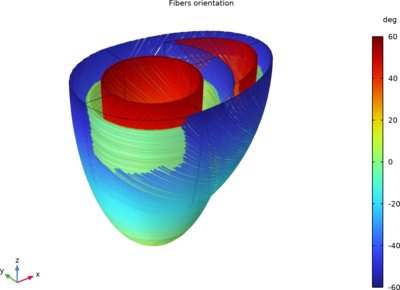
The standard biventricular cardiac model is used to show how to set up fiber directions in a complex geometry. The fibers are then used to model the large deformation of the myocardium with the Holzapfel-Gasser-Ogden anisotropic material model. The Aliev-Panfilov equations are included ... En savoir plus
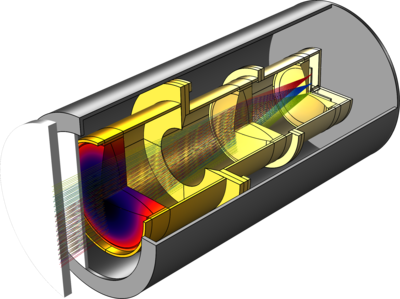
This model demonstrates an integrated structural-thermal-optical performance (STOP) analysis of an optical system. The Petzval Lens tutoral is used as the basis for this model, together with a simple barrel geometry The isothermal model performs a Parametric Sweep over several uniform ... En savoir plus
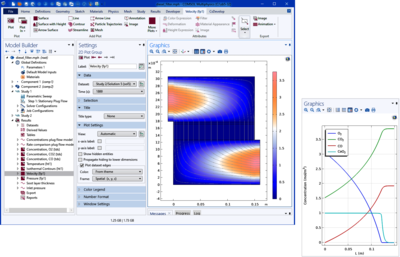
In this tutorial, a filter system for a diesel engine is modeled, including a soot layer development and oxidization. The build-up of the layer is held in check by both catalytic and non-catalytic reactions, where carbon is oxidized to carbon monoxide and carbon dioxide, which in turn ... En savoir plus
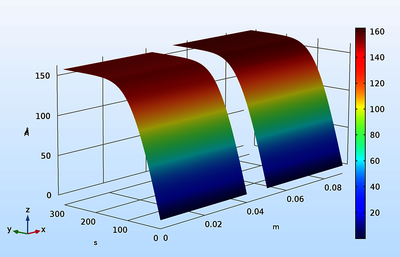
Surface chemistry is often an overlooked aspect of reacting flow modeling. This tutorial model shows how surface reactions and species can be added to study processes like chemical vapor deposition (CVD). The tutorial then models silicon growth on a wafer. Initially, the example uses a ... En savoir plus