
La Bibliothèque d'Applications présente des modèles construits avec COMSOL Multiphysics pour la simulation d'une grande variété d'applications, dans les domaines de l'électromagnétisme, de la mécanique des solides, de la mécanique des fluides et de la chimie. Vous pouvez télécharger ces modèles résolus avec leur documentation détaillée, comprenant les instructions de construction pas-à-pas, et vous en servir comme point de départ de votre travail de simulation. Utilisez l'outil de recherche rapide pour trouver les modèles et applications correspondant à votre domaine d'intérêt. Notez que de nombreux exemples présentés ici sont également accessibles via la Bibliothèques d'Applications intégrée au logiciel COMSOL Multiphysics® et disponible à partir du menu Fichier.
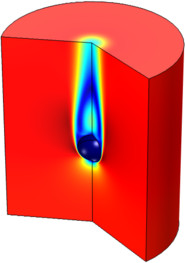
The first stop for polluted water entering a water work is normally a large tank, where large particles are left to settle. Generally, gravity settling is an economical method of separating particles. If the fluid in the tank is moving at a controlled low velocity, the particles can be ... En savoir plus
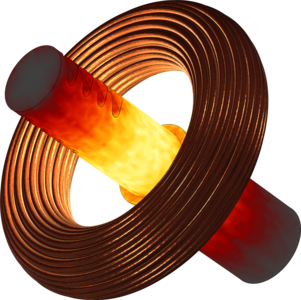
Induction heating is used for various metallurgical processes such as hardening. Here the 3D induction heating of a mechanical joint passing through an induction heating coil is simulated. Curie point effects and temperature dependent resistivity in the iron are taken into account. To ... En savoir plus
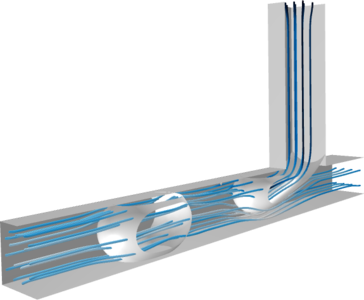
Emulsions consist of small liquid droplets immersed in an immiscible liquid and widely occur in the production of food, cosmetics, fine chemicals, and pharmaceutical products. The quality of the product is typically dependent on the size of the droplets. Simulating these processes can ... En savoir plus
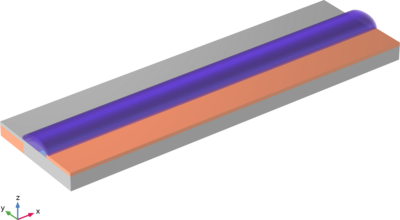
This model demonstrates the simulation of surface dielectric barrier discharges (DBDs) using the Electric Discharge interface. The formulation incorporates a comprehensive set of physical processes, including charge transport, impact ionization, electron attachment, recombination, and ... En savoir plus
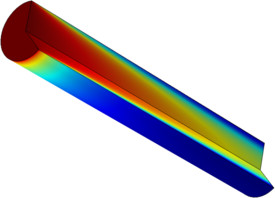
Chemical engineering students can model a nonideal tubular reactor, including radial and axial variations in temperature and composition, and investigate the impact of different operating conditions with this easy-to-use app. The process described by the Tubular Reactor with ... En savoir plus
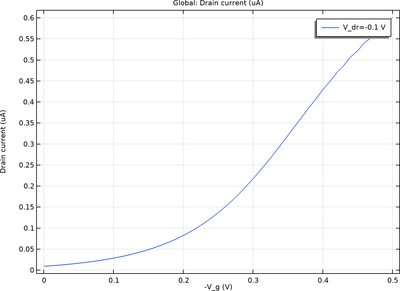
This model shows how to model an electrolyte-gated organic field-effect transistor based on a general drift–diffusion model. The model uses the Transport of Charge Carriers interface and the Electrostatics interface. The transistor characteristics are visualized. Formation of the EDLs in ... En savoir plus
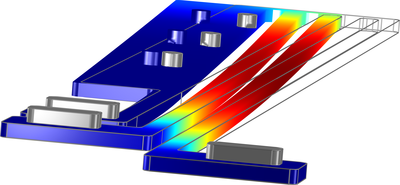
A model of a thermal microactuator requires the coupled simulation of electric current conduction with heat generation, heat conduction, and structural stresses and strains due to thermal expansion. The purpose of this model is to demonstrate how to access the cluster computing ... En savoir plus
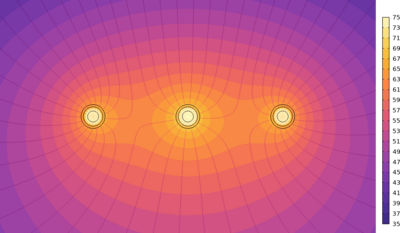
This model evaluates the temperature distribution in 3 buried cables in a situation where the soil surface temperature is known. The temperature profile obtained with a thermal circuit approach for the cables is compared with a FEM approach. The thermal circuit properties are established ... En savoir plus
Oxide jacking is the process by which reinforced concrete cracks, due to the corrosion of the reinforcing rebar rods. The corrosion process causes growth of an oxide layer on the rebar, which in turn causes internal stresses in the concrete. If the corrosion process is allowed to ... En savoir plus

Crystallization is an important separation process in the chemical industry. It is used for the production of pharmaceuticals and industrial chemicals. It can also be used in resource recovery as a way of separating valuable materials from waste. This model solves a discretized ... En savoir plus


