
La Bibliothèque d'Applications présente des modèles construits avec COMSOL Multiphysics pour la simulation d'une grande variété d'applications, dans les domaines de l'électromagnétisme, de la mécanique des solides, de la mécanique des fluides et de la chimie. Vous pouvez télécharger ces modèles résolus avec leur documentation détaillée, comprenant les instructions de construction pas-à-pas, et vous en servir comme point de départ de votre travail de simulation. Utilisez l'outil de recherche rapide pour trouver les modèles et applications correspondant à votre domaine d'intérêt. Notez que de nombreux exemples présentés ici sont également accessibles via la Bibliothèques d'Applications intégrée au logiciel COMSOL Multiphysics® et disponible à partir du menu Fichier.
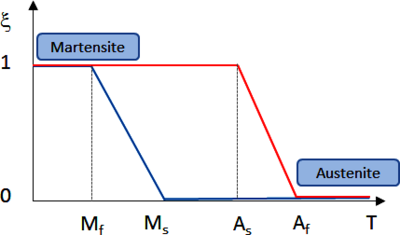
The model includes a compilation of benchmark examples included in the text book: Shape Memory Alloys: Modeling and Engineering Applications. D. Lagoudas Ed. Springer 2008. The model shows the thermomechanical properties of a NiTi alloy sample subjected to uniaxial tension-compression ... En savoir plus
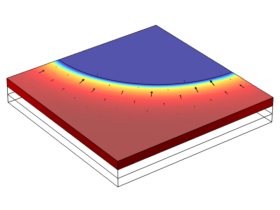
This example extends the Fuel Cell Cathode tutorial to also include liquid water transport in the oxygen electrode. Liquid water is produced using a user-defined expression for vapor condensation, depending on the relative humidity level in the gas phase. An experimental capillary ... En savoir plus
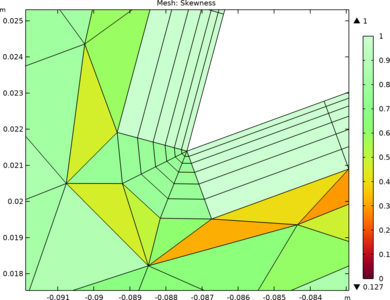
Tutorials in this series deal with creating and manipulation of boundary layer meshes. In these tutorials you will learn how to set up a boundary layer mesh and modify the settings for an automatically created boundary layer mesh. For physics-controlled meshing a boundary layer mesh is ... En savoir plus

A 2D model of a steel bar is used to simulate oil quenching from an austenitic state. Both diffusive and displacive phase transformations are used, and the phase composition is computed in the radial direction of the bar. En savoir plus
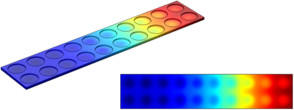
In small PEM fuel cell systems (in the sub-100 W range) no active devices for cooling or air transport are normally used. This is due to the desire to minimize parasitic power losses from pumps and fans, and to reduce the system complexity, size, and cost. The reactants at the cathode ... En savoir plus
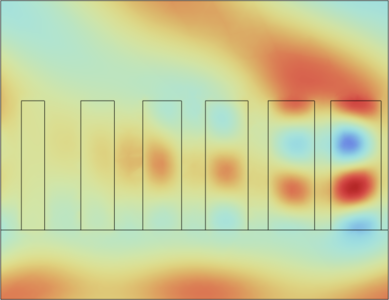
This model demonstrates how to simulate a metasurface beam deflector that uses anomalous refraction. The structure itself is a repeated array of six posts (so-called meta elements). The periodicity of the individual posts is 500 nm, so the full structure of six posts is 3 um wide. The ... En savoir plus
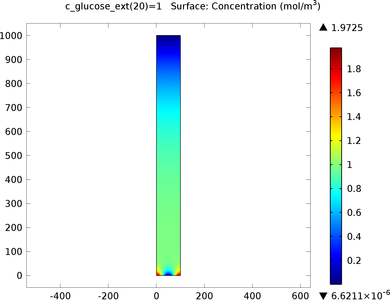
Electrochemical glucose sensors use amperometric methods to measure the concentration of glucose in a sample. This example models the diffusion of glucose and ferri/ferrocyanide redox mediators in a unit cell of electrolyte above an interdigitated electrode. The sensor gives a linear ... En savoir plus
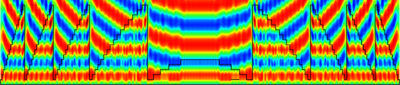
This model simulates a 16-level, first-order, focusing Fresnel lens with 50 µm diameter and 150 µm focal length. In one simulation, the Electromagnetic Waves, Frequency Domain interface computes the electric field in the Fresnel lens and the surrounding air domain extended to the focal ... En savoir plus
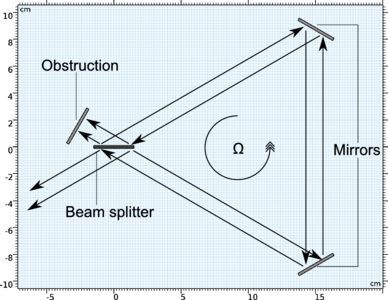
This is a model of a simple Sagnac interferometer consisting of two mirrors and a beam splitter arranged in a triangle. The entire modeling domain rotates; as a result, the rays propagating in opposite directions in the triangle have different optical path lengths due to the Sagnac ... En savoir plus
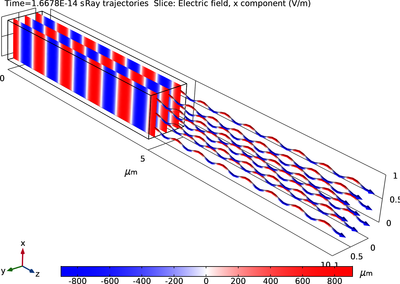
This tutorial shows how to set up a ray release based on the incident electric field at a boundary. First the Electomagnetic Waves, Frequency Domain interface is used to solve for the electric field of a plane wave. Then rays are released with initial intensity and polarization matching ... En savoir plus


