
La Bibliothèque d'Applications présente des modèles construits avec COMSOL Multiphysics pour la simulation d'une grande variété d'applications, dans les domaines de l'électromagnétisme, de la mécanique des solides, de la mécanique des fluides et de la chimie. Vous pouvez télécharger ces modèles résolus avec leur documentation détaillée, comprenant les instructions de construction pas-à-pas, et vous en servir comme point de départ de votre travail de simulation. Utilisez l'outil de recherche rapide pour trouver les modèles et applications correspondant à votre domaine d'intérêt. Notez que de nombreux exemples présentés ici sont également accessibles via la Bibliothèques d'Applications intégrée au logiciel COMSOL Multiphysics® et disponible à partir du menu Fichier.
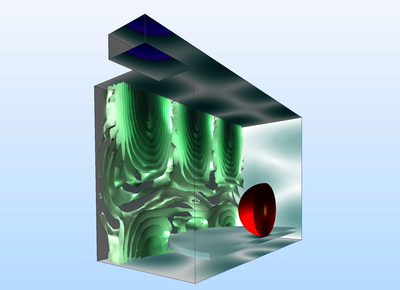
This is a model of the heating process in a microwave oven. The distributed heat source is computed in a stationary, frequency-domain electromagnetic analysis. This is followed by a transient heat transfer simulation showing how the heat redistributes in the food. En savoir plus
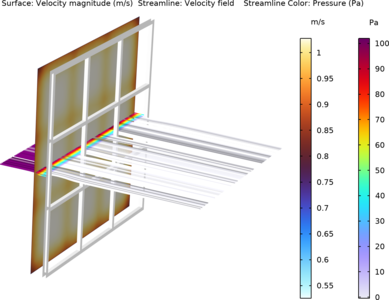
This example demonstrates simulation of a turbulent flow in a geometry with an air filter. Porous material of the filter induces an abrupt pressure drop and drastic increase of turbulence level inside the filter. En savoir plus
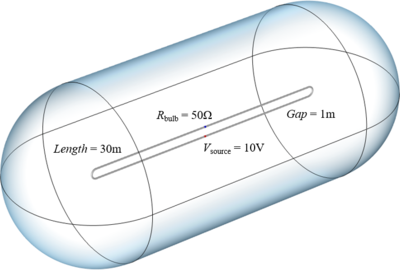
This model is used to demonstrate the solution to a classic brainteaser in electromagnetics. A long loop of wire is connected to a source and a receiver, which are placed 1 meter apart. The objective of the model is to compute how long it takes for the receiver to sense when the source ... En savoir plus
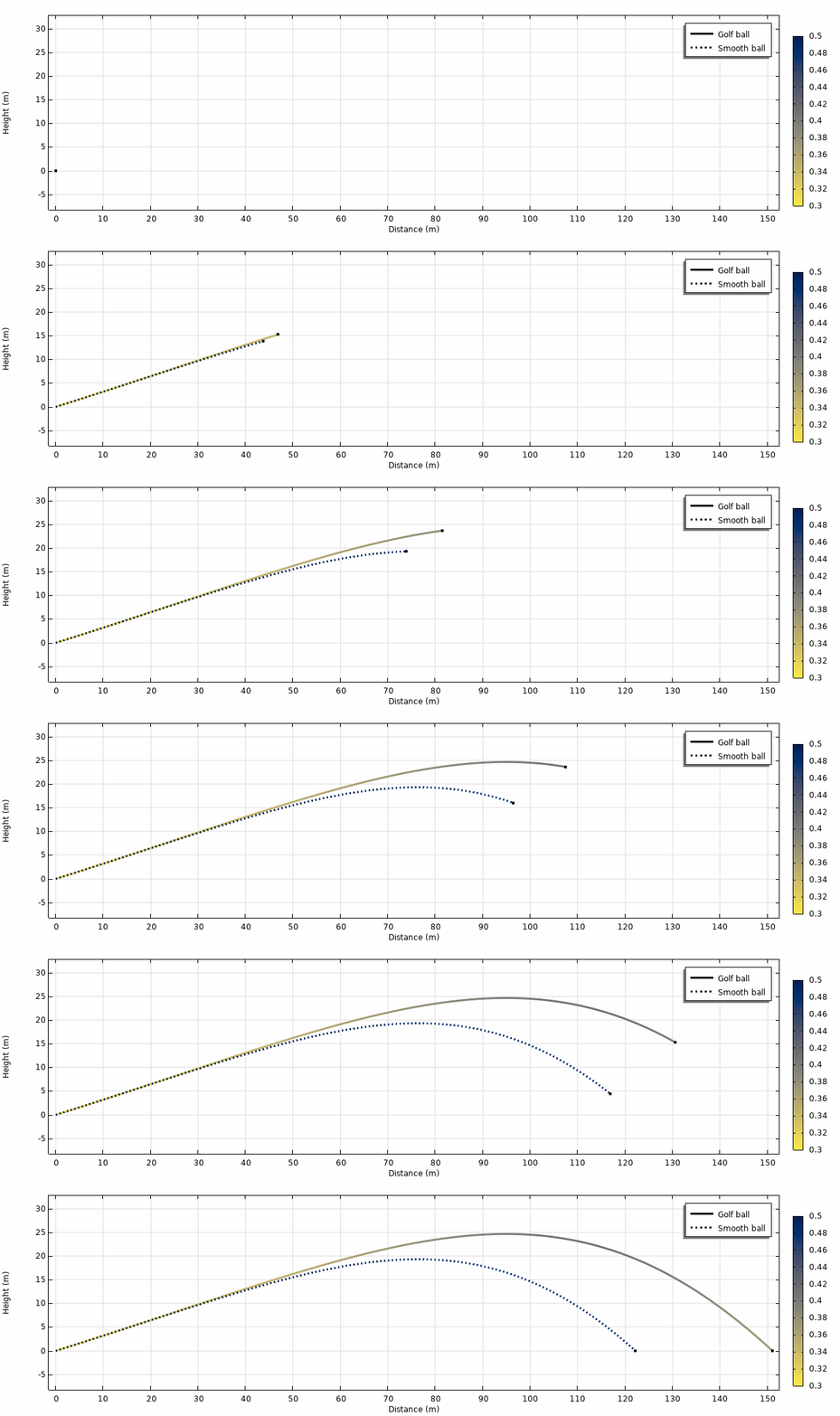
This model is used in the blog post "Why Do Golf Balls Have Dimples?". The trajectory of a golf ball is compared to the trajectory of a smooth ball using the Events interface and a system of ODEs in a 0D component. En savoir plus
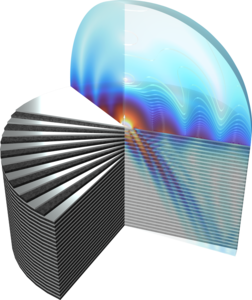
The modal dispersion in a metamaterial can be engineered by changing the type of material and dimension of the composing unit cells. For instance, a periodically organized subwavelength metal–dielectric layered metamaterial exhibits an anisotropic dispersion characteristic in the ... En savoir plus
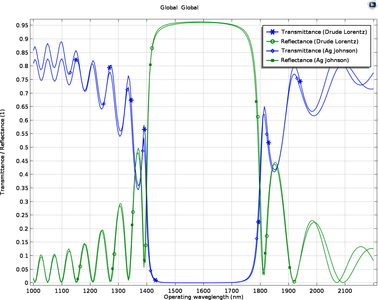
This example of a plasmonic waveguide filter shows that the waveguide rejects the electromagnetic radiation of the wavelength between 1.4 um and 1.6 um, but allows the rest of the wavelength. The silver material can be modeled using the Drude-Lorentz approximation, with ε∞ = 3.7, ωp = 13 ... En savoir plus
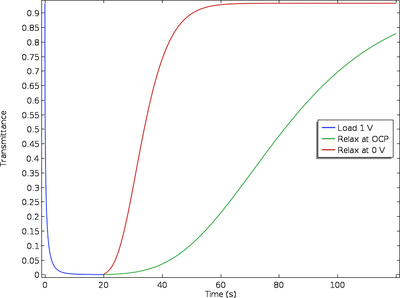
Electrochromic devices (ECDs) may be employed in ”smart” windows, for instance in buildings or motor cycle visors, where the transparency of the device can be controlled by applying a voltage. ECDs make use of the fact that the absorbance of visual light for a chemical species in a ... En savoir plus
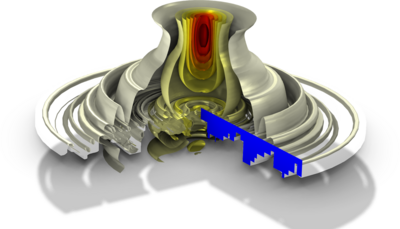
This model demonstrates how to use topology optimization with milling constraints to design a metalens that focuses a single wavelength to a point. This involves transferring the optimized results to another component so the result can be verified using an explicit geometry ... En savoir plus
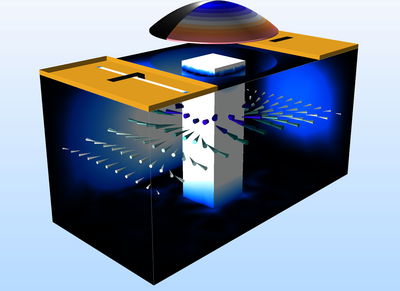
An evanescent mode cavity filter can be realized by adding a structure inside of the cavity. This structure changes the resonant frequency lower than the dominant mode of the unfilled cavity. A piezo actuator is used to control the size of a small air gap which provides the tunability of ... En savoir plus
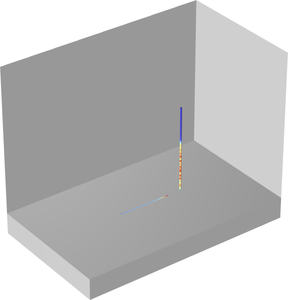
This model computes the lightning-induced voltage on an overhead line positioned above a lossy ground. It includes parameters like the inclination angle of lightning channels and soil conductivity, enabling straightforward analysis of their impacts. The calculated induced voltage aligns ... En savoir plus