
La Bibliothèque d'Applications présente des modèles construits avec COMSOL Multiphysics pour la simulation d'une grande variété d'applications, dans les domaines de l'électromagnétisme, de la mécanique des solides, de la mécanique des fluides et de la chimie. Vous pouvez télécharger ces modèles résolus avec leur documentation détaillée, comprenant les instructions de construction pas-à-pas, et vous en servir comme point de départ de votre travail de simulation. Utilisez l'outil de recherche rapide pour trouver les modèles et applications correspondant à votre domaine d'intérêt. Notez que de nombreux exemples présentés ici sont également accessibles via la Bibliothèques d'Applications intégrée au logiciel COMSOL Multiphysics® et disponible à partir du menu Fichier.
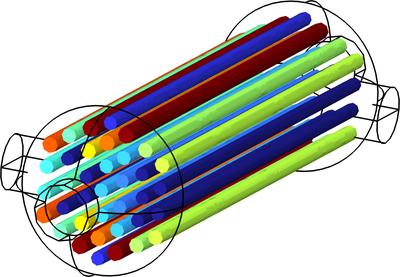
Commercial heat exchangers often feature a complex design. It is significantly easier to build a design with new CAD parameters than to build designs with novel topologies. This model demonstrate how to optimize the size and position of the tubes in a tube and shell heat exchanger. It is ... En savoir plus
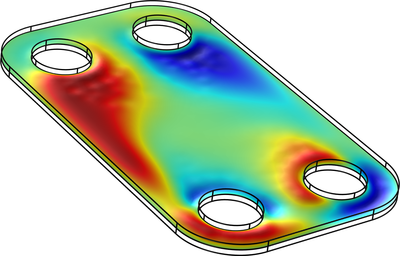
This model demonstrates how to use the built-in shape optimization functionality to improve the performance of a plate heat exchanger. The optimization reduces the path immediately in front of the inlets and outlets to increase the length of typical streamlines. This leads to a improved ... En savoir plus
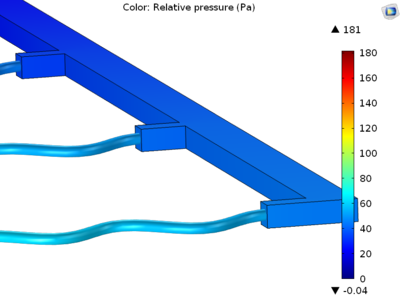
This example models flow in a microchannel heat exchanger by coupling a Laminar Flow interface in 3D to a Pipe Flow interface. By the use of the Pipe Flow interface to model the flow in the microchannels the problem size is significantly reduced. This model showcases the Pipe Connection ... En savoir plus
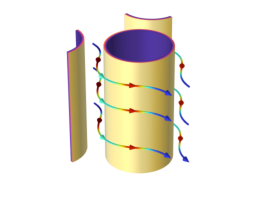
This model studies a part of a shell-and-tube heat exchanger where hot water enters from above. The cooling medium flows through the tubes that, in this model, impose a constant temperature at the walls. Furthermore, the tubes are assumed to be made of stainless steel and the heat flux ... En savoir plus
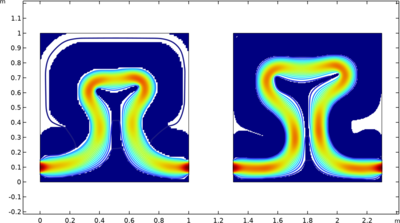
This model demonstrates topology optimization of a 2D heat exchanger with laminar flow. The flow is pressure driven and the objective is to maximize the heat transfer. The density method is used with the (now) classical approach of a single design variable and two flow interfaces. ... En savoir plus
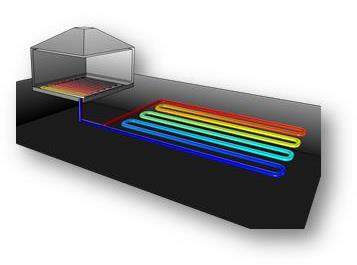
Geothermal heating is an environmentally friendly and energy-efficient method to supply modern and well insulated houses with heat. Heat exchangers placed at a sufficient depth in the ground below the house utilize subsurface heat, where temperatures are almost constant throughout the ... En savoir plus
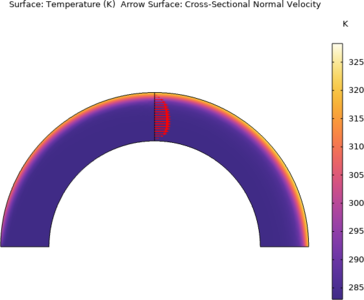
This tutorial illustrates how to use built-in variables and operators, for the evaluation of the bulk temperature along a geometry like a channel, a pipe or a chimney, in a nonisothermal flow in 2D and 3D. The bulk temperature may be needed to compute the heat transfer coefficient for an ... En savoir plus
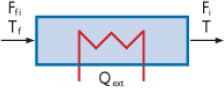
This example considers the thermal cracking of acetone, which is a key step in the production of acetic anhydride. The gas phase reaction takes place under nonisothermal conditions in a plug-flow reactor. As the cracking chemistry is endothermic, control over the temperature in the ... En savoir plus
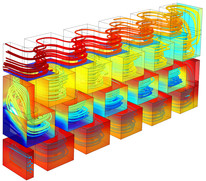
Plate reactors running under continuous conditions have emerged as candidates to replace batch reactors, primarily in fine chemicals and pharmaceuticals production. One of the advantages of the plate reactor design is that it allows for efficient temperature control of the reacting ... En savoir plus
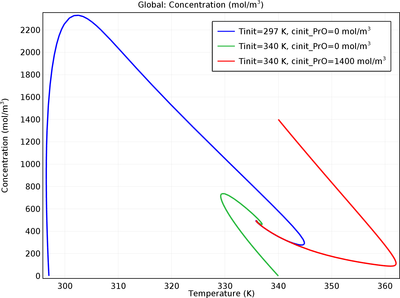
The hydrolysis of propylene oxide into propylene glycol is an important chemical process with 400,000 metric tons produced worldwide each year. Propylene glycol finds wide application as a moisturizer in foods, pharmaceuticals, and cosmetics. In this example, the startup phase of a ... En savoir plus


