
La Bibliothèque d'Applications présente des modèles construits avec COMSOL Multiphysics pour la simulation d'une grande variété d'applications, dans les domaines de l'électromagnétisme, de la mécanique des solides, de la mécanique des fluides et de la chimie. Vous pouvez télécharger ces modèles résolus avec leur documentation détaillée, comprenant les instructions de construction pas-à-pas, et vous en servir comme point de départ de votre travail de simulation. Utilisez l'outil de recherche rapide pour trouver les modèles et applications correspondant à votre domaine d'intérêt. Notez que de nombreux exemples présentés ici sont également accessibles via la Bibliothèques d'Applications intégrée au logiciel COMSOL Multiphysics® et disponible à partir du menu Fichier.
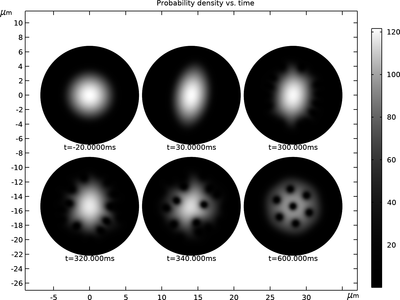
This tutorial model solves the Gross–Pitaevskii Equation for the vortex lattice formation in a rotating Bose–Einstein condensate bound by a harmonic trap. The equation is essentially a nonlinear single-particle Schrödinger Equation, with the inter-particle interaction represented by a ... En savoir plus
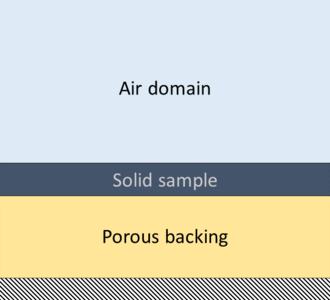
This app allows to calculate the absorption coefficient and surface impedance of a sound absorbers for normal and random incidences. The computed quantities can be used when setting up boundary conditions in a Pressure Acoustics, Frequency Domain model or a Ray Acoustics model. The ... En savoir plus
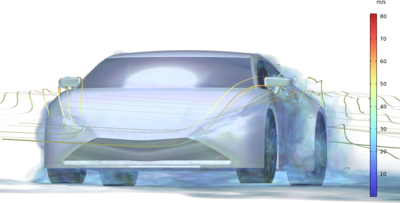
FSI analysis of a sports car side door and side rear view mirror. The model is based on large eddy simulation analysis of a sports car. The flow field is used for a structural analysis of the side mirror and side door to estimate the flow-induced vibrations. En savoir plus
In this model, the transmitter (microstrip patch) and receiver (Yagi–Uda) antennas are modeled simultaneously in the FEM domain and are coupled with FEM–BEM coupling. The results are compared with the analytical Friis transmission formula. In detail, the emw and emw2 interfaces find out ... En savoir plus
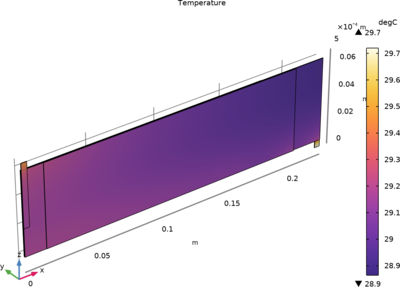
This example replicates the results of the Jelly Roll tutorial example using a flattened representation of the wound spiral-based geometry. See that model entry for details on the background, original geometry, materials, and the general physics setup. Mapping the original problem to a ... En savoir plus
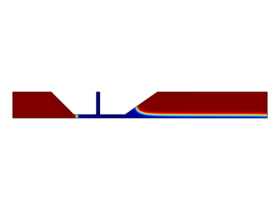
This tutorial shows how to model a slot die coating process with a power-law non-Newtonian fluid in one of the two phases. The model uses a two-phase flow phase-field method. En savoir plus
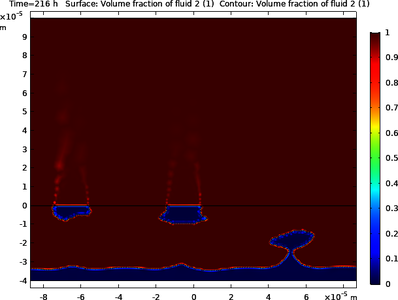
This example models galvanic corrosion between two different phases in a magnesium alloy for a representative cross-sectional microstructure configuration. The Phase Field interface is used here to model dissolution of a constituent phase leading to topological changes. The electrode ... En savoir plus
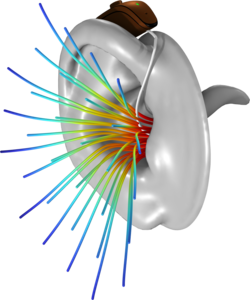
This model demonstrates how to perform a hearing aid acoustic feedback response analysis, including both the in-ear hearing aid and the hearing aid cassette. The hearing aid modeled is a ReSound OMNIA™ device from GN Hearing A/S. The hearing aid is tested on a combined pinna and ear ... En savoir plus
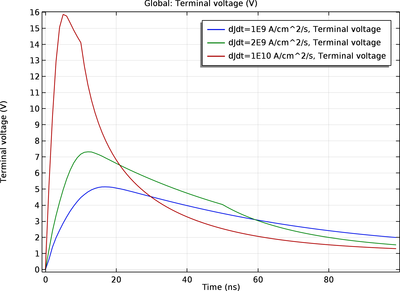
This tutorial simulates the turn-on transient (forward recovery) of a simple PIN diode, based on the book "Fundamentals of Power Semiconductor Devices" by B. J. Baliga (p. 242, 2008 edition). The diode is current driven with a constant ramp rate of 1e9, 2e9 and 1e10 A/cm^2/sec and a ... En savoir plus
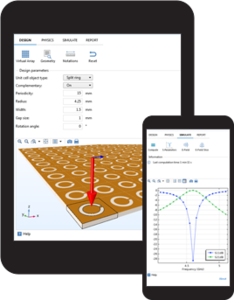
This app demonstrates the following: Designing an app for small screens such as smartphones User-interface navigation with a top menu typically used on websites Geometry parts and parameterized geometries Visualizing periodicity of a geometry with material rendering Warning messages on ... En savoir plus