
La Bibliothèque d'Applications présente des modèles construits avec COMSOL Multiphysics pour la simulation d'une grande variété d'applications, dans les domaines de l'électromagnétisme, de la mécanique des solides, de la mécanique des fluides et de la chimie. Vous pouvez télécharger ces modèles résolus avec leur documentation détaillée, comprenant les instructions de construction pas-à-pas, et vous en servir comme point de départ de votre travail de simulation. Utilisez l'outil de recherche rapide pour trouver les modèles et applications correspondant à votre domaine d'intérêt. Notez que de nombreux exemples présentés ici sont également accessibles via la Bibliothèques d'Applications intégrée au logiciel COMSOL Multiphysics® et disponible à partir du menu Fichier.
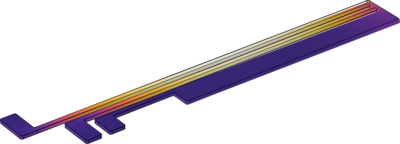
This tutorial model of a two-hot-arm thermal actuator couples three different physics phenomena: electric current conduction, heat conduction with heat generation, and structural stresses and strains due to thermal expansion. The model exists in three versions: Joule Heating of a ... En savoir plus
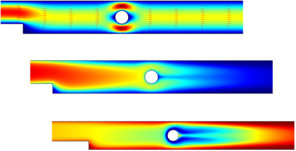
In this tutorial, the heat and mass transport equations are coupled to laminar flow in order to model exothermic reactions in a parallel plate reactor. It exemplifies how you can use COMSOL Multiphysics to systematically set up and solve increasingly sophisticated models using predefined ... En savoir plus
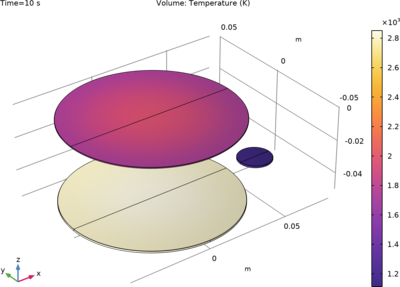
In the semiconductor industry, rapid thermal annealing (RTA) is a semiconductor process step used for the activation of dopants and the interfacial reaction of metal contacts. In principle, the operation involves rapid heating of a wafer from ambient to approximately 1000–1500 K. As soon ... En savoir plus
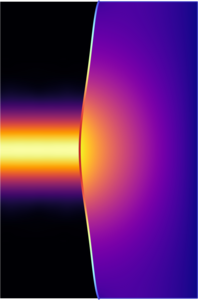
The thermal effects of a laser beam incident on a Semiconductor Saturable Absorber Mirror (SESAM) are simulated under a range of incident beam powers. This is done in two steps. The first study simulates the multiphysics combination of the saturated absorption of the beam on a SESAM, ... En savoir plus
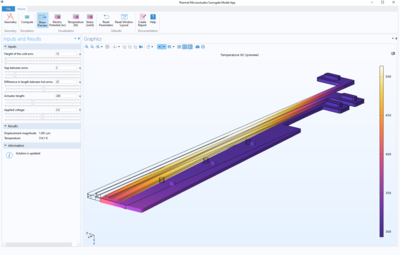
The Thermal Actuator Surrogate Model Application demonstrates how the computational speed can be increased with the use of a surrogate model. This app demonstrates the following: Adjusting input parameters via sliders, with near-instantaneous updates to the solution retrieved from the ... En savoir plus
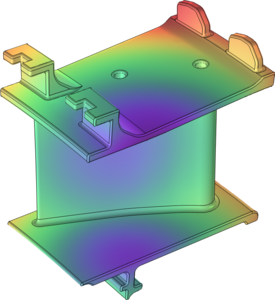
This example shows how to compute thermally induced stresses in a turbine stator blade using the Thermal Stress, Solid interface. The conditions within gas turbines are extreme. The pressure can be as high as 40 bar, and the temperature more than 1000 K. Any new component must therefore ... En savoir plus
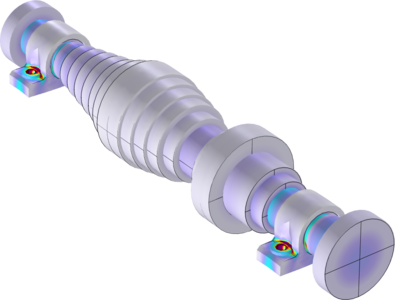
Hydrodynamic bearings generate heat due to the viscous losses in the lubricant. As a result, the temperature of the rotor increases causing deformation and thermal stresses in both the rotor and the bearing housing. This example shows how to model different physical phenomena that are ... En savoir plus
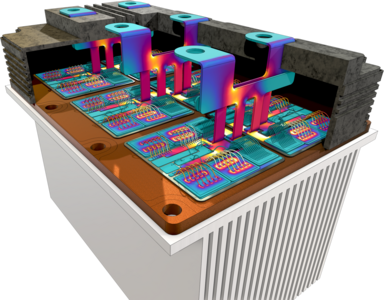
This industrial-scale proof of concept (POC) model demonstrates how to perform an electric-thermal analysis of a high-power insulated-gate bipolar transistor module (IGBT module). The module has a rated voltage of 1200 V, and nominal current of 1800 A. Using a stationary study the ... En savoir plus
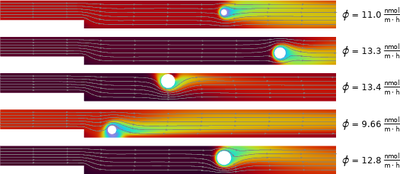
This tutorial illustrates how to use the Uncertainty Quantification (UQ) functionality to answer questions regarding sensitivity and reliability of a flow reactor with thermal decomposition. The tutorial investigates what uncertainties in parameters dominates the survival of a nutrient ... En savoir plus
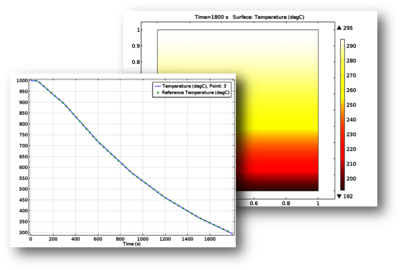
This entry is a compilation of some examples from DIN EN 1991-1-2 (Actions on structures exposed to fire). Models that are included: 1. Cooling (HT) 2. Heating (HT) 3. Heat transfer through multiple layers (HT) 4. Thermal elongation (SME, thermal stress) 5. Thermal expansion (SME, HT, ... En savoir plus