
La Bibliothèque d'Applications présente des modèles construits avec COMSOL Multiphysics pour la simulation d'une grande variété d'applications, dans les domaines de l'électromagnétisme, de la mécanique des solides, de la mécanique des fluides et de la chimie. Vous pouvez télécharger ces modèles résolus avec leur documentation détaillée, comprenant les instructions de construction pas-à-pas, et vous en servir comme point de départ de votre travail de simulation. Utilisez l'outil de recherche rapide pour trouver les modèles et applications correspondant à votre domaine d'intérêt. Notez que de nombreux exemples présentés ici sont également accessibles via la Bibliothèques d'Applications intégrée au logiciel COMSOL Multiphysics® et disponible à partir du menu Fichier.
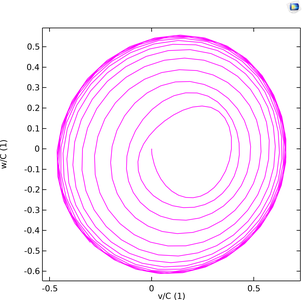
The Whirling of a Uniform Shaft tutorial model shows you how to perform a transient analysis of a uniform shaft under gravity. The shaft is supported by two hydrodynamic bearings at its ends. The gyroscopic effect causes the rotor to whirl about its initial axis and the rotor eventually ... En savoir plus

See how to perform a vibration analysis of the crankshaft of a 3-cylinder reciprocating engine in this tutorial model. Due to the eccentricity of the crank-pin and balance masses on the crankshaft, it undergoes self-excited vibration under rotation. The crankshaft is modeled using solid ... En savoir plus
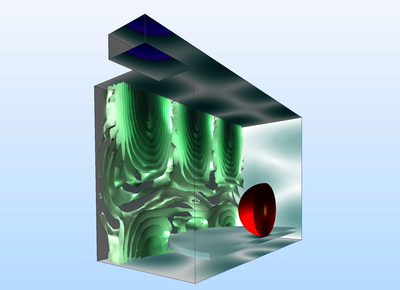
This is a model of the heating process in a microwave oven. The distributed heat source is computed in a stationary, frequency-domain electromagnetic analysis. This is followed by a transient heat transfer simulation showing how the heat redistributes in the food. En savoir plus
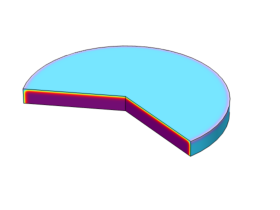
When cooking food, such as a patty, in convection ovens there is a trade off in the heating method. If the patty is heated at a low oven temperature the cooking is slow and the patty dries out, resulting in a poor taste. If the patty is heated rapidly at a high temperature, it is ... En savoir plus
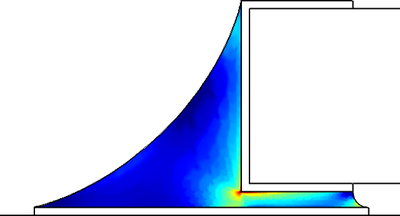
A surface mount resistor is subjected to thermal cycling. The difference in the thermal expansion of different materials will introduce stresses in the structure. The solder which connects the resistor with the printed circuit board is seen as the weakest link in the assembly. It ... En savoir plus
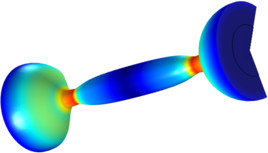
The Marangoni effect results in a slip velocity in the tangential direction on a fluid/fluid interface due to gradients in the surface tension coefficient. When the surface tension coefficient is constant, a two-fluid system may exist in static equilibrium. This is because the surface ... En savoir plus
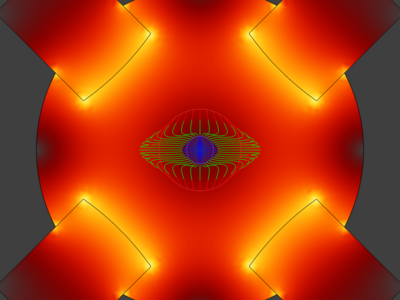
Just like optical lenses focus light, electric and magnetic lenses can be used for focusing beams of charged particles. This COMSOL Multiphysics model shows the path of B5+ ions passing through a focusing system of three magnetic quadrupoles. Each of the quadropoles focus the beam of ... En savoir plus
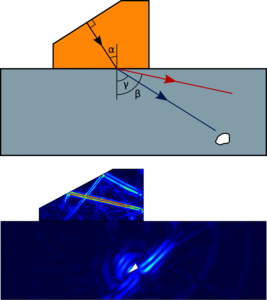
Angle beam ultrasonic units are used for nondestructive testing (NDT) of solid objects, such as metal pipes. They are especially useful for detecting flaws in and around welding areas, such as pores, small cracks, lack of fusion, etc. Angle beam NDT is often used where the straight beam ... En savoir plus
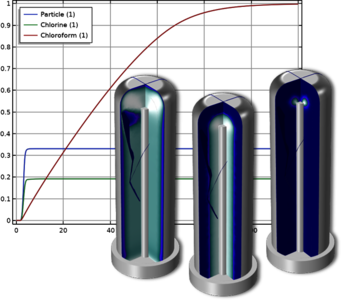
This example illustrates how to model the transport of different contaminants through a ceramic water filter candle with an activated carbon core. These types of water filters can be found in table top gravity filters, as well as attached to the faucet or as part of a larger reverse ... En savoir plus
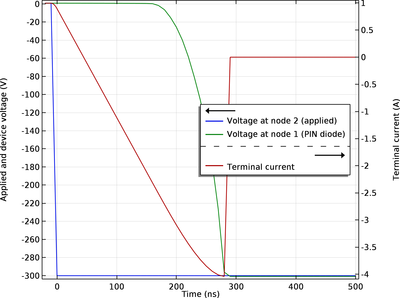
This tutorial simulates the turn-off transient (reverse recovery) of a simple PIN diode with an inductive load, loosely based on the book "Fundamentals of Power Semiconductor Devices" by B. J. Baliga (p. 256, 2008 edition). Unlike the book, which assumes an initial constant current ramp ... En savoir plus


