
La Bibliothèque d'Applications présente des modèles construits avec COMSOL Multiphysics pour la simulation d'une grande variété d'applications, dans les domaines de l'électromagnétisme, de la mécanique des solides, de la mécanique des fluides et de la chimie. Vous pouvez télécharger ces modèles résolus avec leur documentation détaillée, comprenant les instructions de construction pas-à-pas, et vous en servir comme point de départ de votre travail de simulation. Utilisez l'outil de recherche rapide pour trouver les modèles et applications correspondant à votre domaine d'intérêt. Notez que de nombreux exemples présentés ici sont également accessibles via la Bibliothèques d'Applications intégrée au logiciel COMSOL Multiphysics® et disponible à partir du menu Fichier.
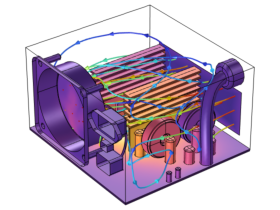
This study simulates the thermal behavior of a computer Power Supply Unit (PSU). Most of such electronic enclosures include cooling devices to avoid electronic components to be damaged by excessively high temperatures. In this model, an extracting fan and a perforated grille cause an air ... En savoir plus
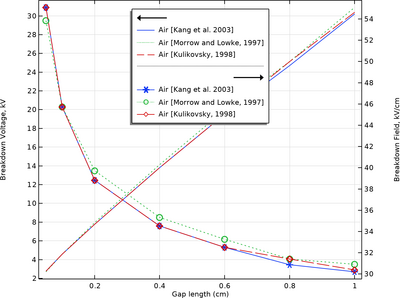
This model calculates the DC breakdown voltage between parallel electrodes in air using a detailed charge transport approach. It is currently one-dimensional for simplicity but can be extended to other gases and dimensions. The results closely match experimental data found in the ... En savoir plus
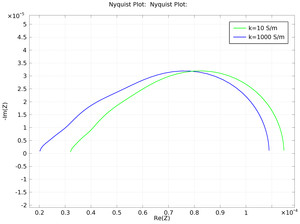
A fuel cell unit cell is modeled using the full Butler-Volmer expression for the anodic and cathodic charge transfer reactions. The anodic and cathodic overpotentials depend on the local ionic and electronic potentials, which are obtained from the charge balance equations for ionic and ... En savoir plus
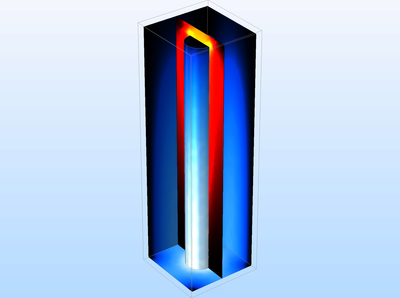
Microwave filters are used to eliminate unwanted frequency components in the output from microwave transmitters. They are typically inserted between a power amplifier and an antenna. The amplifiers are nonlinear and produce harmonics that must be eliminated with filters that have a ... En savoir plus
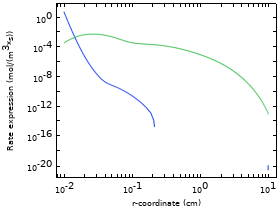
This tutorial presents a study of positive and negative corona discharges in dry air at atmospheric pressure. The discharges are sustained within two electrodes in a coaxial configuration by a high voltage DC source applied to the inner electrode. Two different types of models are used: ... En savoir plus
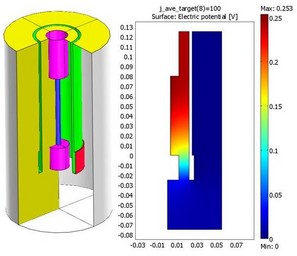
Rotating cylinder Hull cells are an important experimental tool in electroplating and electrodeposition and are used for the measurement of nonuniform current distribution, mass transport, and throwing power of plating baths. The model reproduces the results for a commercially available ... En savoir plus
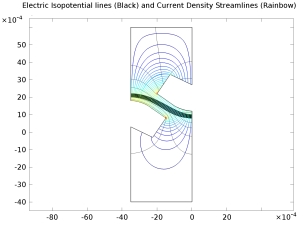
The chlor-alkali membrane process is one of the largest in industrial electrolysis with the production of roughly 40 million metric tons of both chlorine and caustic soda per year. Chlorine is used predominantly for the production of vinyl chloride monomer, which in turn is used for the ... En savoir plus
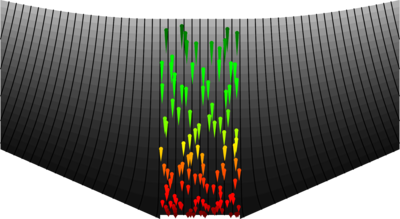
An electron gun must be able to draw a sufficient current and accelerate the electrons to the desired speed. The first part of an electron gun geometry presents unique design challenges because the emitted electron speeds are usually lowest there, and therefore the space charge density ... En savoir plus
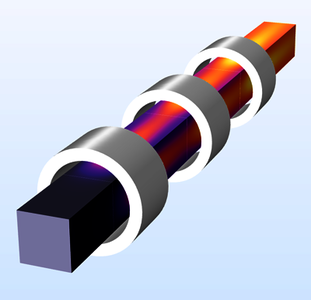
This app demonstrates the following: Geometry parts and parameterized geometries Using tables for user input parameters Visualization on a 2D cross-section of a 3D geometry Improved visualization and user experience when a geometry object (the air object) is hidden. Induction heating ... En savoir plus
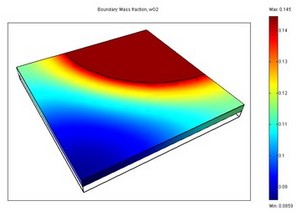
A stationary 3D model of a generic fuel cell cathode describing the mass fraction distribution of oxygen, water, and nitrogen, as well as the current distribution. The model uses Darcy's Law to describe convection, and couples this to Maxwell-Stefan diffusivities to also describe mass ... En savoir plus


