
La Bibliothèque d'Applications présente des modèles construits avec COMSOL Multiphysics pour la simulation d'une grande variété d'applications, dans les domaines de l'électromagnétisme, de la mécanique des solides, de la mécanique des fluides et de la chimie. Vous pouvez télécharger ces modèles résolus avec leur documentation détaillée, comprenant les instructions de construction pas-à-pas, et vous en servir comme point de départ de votre travail de simulation. Utilisez l'outil de recherche rapide pour trouver les modèles et applications correspondant à votre domaine d'intérêt. Notez que de nombreux exemples présentés ici sont également accessibles via la Bibliothèques d'Applications intégrée au logiciel COMSOL Multiphysics® et disponible à partir du menu Fichier.
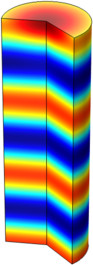
In this model, sound created by a vibrating piston radiates through a baffled pipe. The impedance is measured and then used in an impedance boundary condition that replaces the surrounding air domain. This technique can be employed to reduce solution time and memory usage for large ... En savoir plus
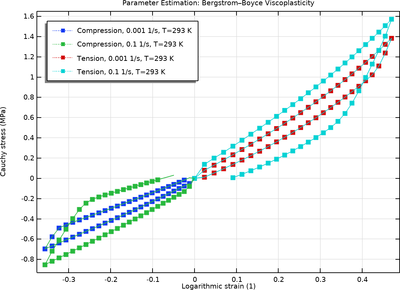
This tutorial model demonstrates how to estimate the material parameters of a viscoplastic Bergstrom–Boyce model suitable for nonequilibrium modeling of rubber-like materials. The data used for parameter estimation consists of cyclic uniaxial tension and compression tests at two ... En savoir plus
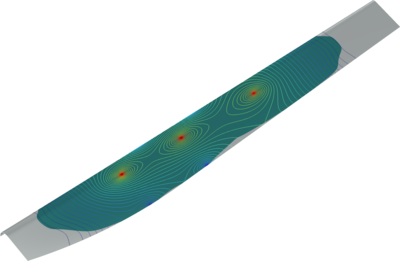
This example shows the modeling of a resin transfer molding (RTM) process for a wind turbine blade using the Two-Phase Flow, Level Set, Brinkman Equations interface. Resin is injected into a preform consisting of different composites with different anisotropic permeabilities. En savoir plus
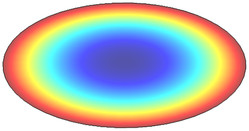
This benchmark model computes the total force acting on a vibrating disc in the frequency and time domains and compares both results with expressions derived analytically. When the vibration amplitude is small enough that the system is linear the frequency and time domain results agree ... En savoir plus
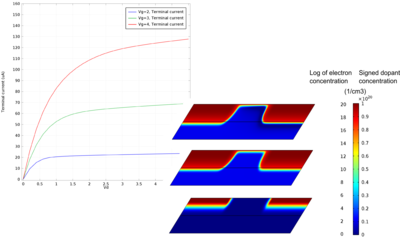
This model calculates the DC characteristics of a simple MOSFET. The drain current versus gate voltage characteristics are first computed in order to determine the threshold voltage for the device. Then the drain current vs drain voltage characteristics are computed for several gate ... En savoir plus
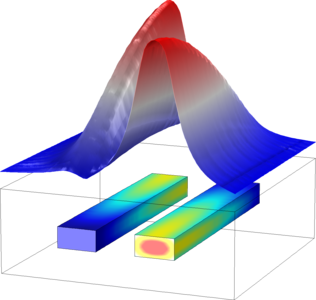
Two embedded optical waveguides in close proximity form a directional coupler. The cladding material is GaAs and the core material is ion-implanted GaAs. The waveguide is excited by the two first supermodes of the waveguide structure - the symmetric and antisymmetric modes. Two numeric ... En savoir plus
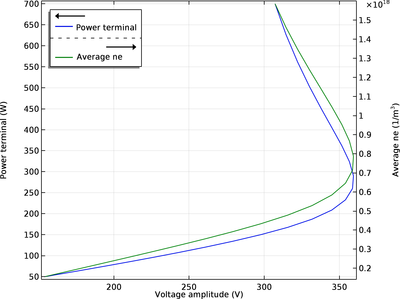
Capacitively coupled RF discharges can operate in two distinct regimes depending on the discharge power. In the low power regime, known as the alpha regime, the electric field oscillation is responsible to heat and create electrons. In the high power regime, known as gamma regime, the ... En savoir plus
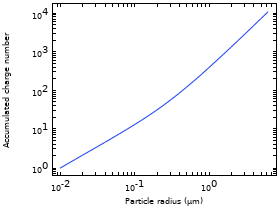
This model computes the fluid flow, charge transport and electric potential in an electrostatic precipitator. Based on the resulting fields, particles of different diameter are fed into the device and the transmission probability is computed. As expected, the separation efficiency shows ... En savoir plus
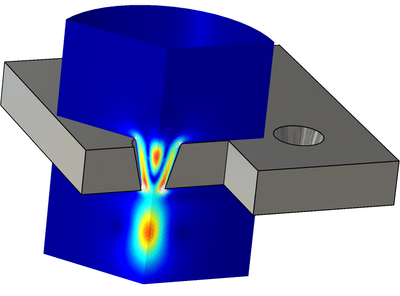
This model analyzes the nonlinear transfer impedance of a tapered orifice that can be part of a perforate or microperforated plate (MPP). The analysis is carried out for various degrees of tapering of the perforate and for a frequency range. A linear analysis is set up in the frequency ... En savoir plus
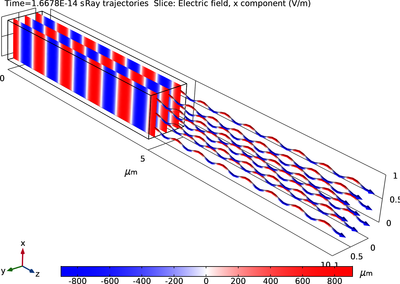
This tutorial shows how to set up a ray release based on the incident electric field at a boundary. First the Electomagnetic Waves, Frequency Domain interface is used to solve for the electric field of a plane wave. Then rays are released with initial intensity and polarization matching ... En savoir plus