
La Bibliothèque d'Applications présente des modèles construits avec COMSOL Multiphysics pour la simulation d'une grande variété d'applications, dans les domaines de l'électromagnétisme, de la mécanique des solides, de la mécanique des fluides et de la chimie. Vous pouvez télécharger ces modèles résolus avec leur documentation détaillée, comprenant les instructions de construction pas-à-pas, et vous en servir comme point de départ de votre travail de simulation. Utilisez l'outil de recherche rapide pour trouver les modèles et applications correspondant à votre domaine d'intérêt. Notez que de nombreux exemples présentés ici sont également accessibles via la Bibliothèques d'Applications intégrée au logiciel COMSOL Multiphysics® et disponible à partir du menu Fichier.
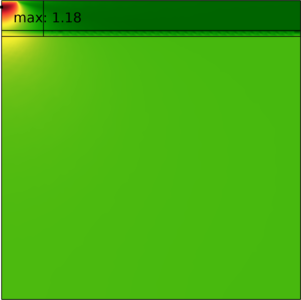
A standing contact fatigue test is a procedure used for testing crack growth on the subsurface level. In such a test, a spherical object is pressed against the tested materials and cycled between a high and low compressive load. No translational movement between the two occurs. After a ... En savoir plus

This example studies the deflection of a cantilever beam undergoing very large deflections. The beam is modeled using both the Solid Mechanics interface and the Beam interface. The results are compared with each other and with a benchmark solution from NAFEMS. In addition, a linear ... En savoir plus
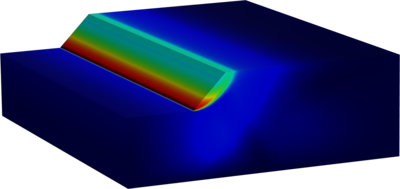
The strength reduction technique is a tool to find the factor of safety (FOS) in geotechnical problems, particularly in slope stability analyses. To determine the factor of safety of the slope, the strength properties in the Mohr–Coulomb model are gradually reduced until failure occurs. ... En savoir plus
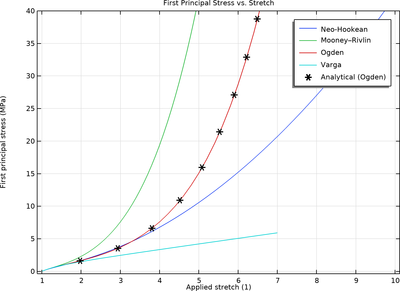
This model demonstrates the inflation of a rubber balloon with four different hyperelastic material models. The results are compared with the analytical solution for a thin-walled, spherical vessel. Controlling the inflation of hyperelastic balloons is important in clinical ... En savoir plus
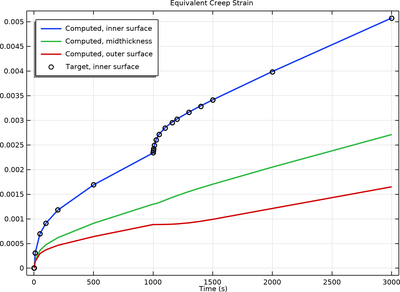
This model shows how to combine different types of material nonlinearity, such as creep and elastoplasticity. In this specific example you will perform a stress and nonlinear strain analysis on a thick cylinder under a nonproportional loading: an initial temperature increase followed by ... En savoir plus
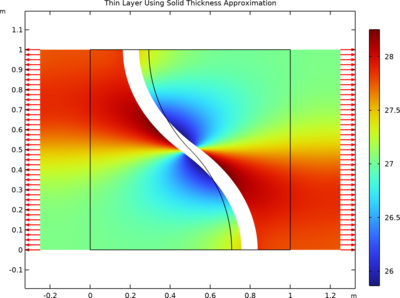
This model demonstrates alternative implementations used for describing a thin layer and the impact of the choice on the continuity of the displacement and stress fields. It is shown how a perfect interface can be obtained by asymptotically changing the material parameters. En savoir plus
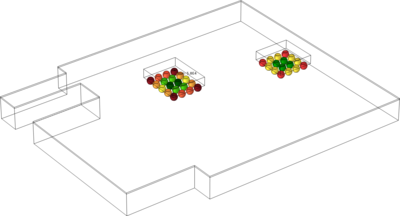
In a cooling system, a microelectronic component has been identified as the critical link. Since the power is repeatedly switched on and off, the component is subjected to thermal cycling. As a results a crack grows through a solder joint and disconnects the chip from the printed circuit ... En savoir plus
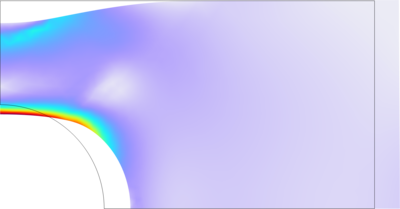
This example shows the analysis of a perforated plate loaded into the plastic regime. Part of the example is a benchmark, which you can find in section 7.10 of The Finite Element Method by O.C. Zienkiewicz. The unloading of the plate and residual stresses are also studied. In a second ... En savoir plus
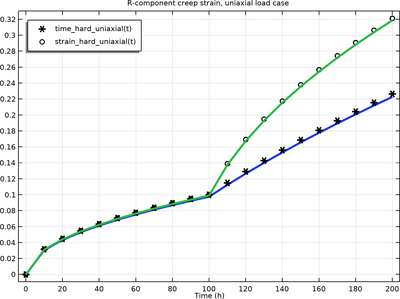
In this model example, you will study the creep behavior of material under non-constant loading. You will model the primary creep using a Norton–Bailey law and study the difference between the time hardening and the strain hardening methods available in COMSOL Multiphysics. The model is ... En savoir plus

Creep is an inelastic time-dependent deformation which occurs when a material is subjected to stress at sufficiently high temperature, say 40% of the melting point or more. Experimental creep data (using constant stress and temperature) often display three different types of behavior ... En savoir plus