
La Bibliothèque d'Applications présente des modèles construits avec COMSOL Multiphysics pour la simulation d'une grande variété d'applications, dans les domaines de l'électromagnétisme, de la mécanique des solides, de la mécanique des fluides et de la chimie. Vous pouvez télécharger ces modèles résolus avec leur documentation détaillée, comprenant les instructions de construction pas-à-pas, et vous en servir comme point de départ de votre travail de simulation. Utilisez l'outil de recherche rapide pour trouver les modèles et applications correspondant à votre domaine d'intérêt. Notez que de nombreux exemples présentés ici sont également accessibles via la Bibliothèques d'Applications intégrée au logiciel COMSOL Multiphysics® et disponible à partir du menu Fichier.
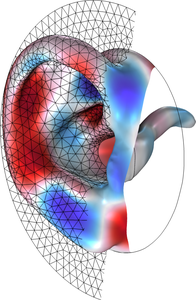
This model is of the P.57 Type 4.3 Full-band Ear Simulator. The model includes the geometry of the ear canal as well as the pinna defined in the ITU-T P.57 standard. The model also includes interpolation data for an ear drum impedance ensuring correct acoustic properties of the ear. The ... En savoir plus

The present model example is based on Copper Deposition in a Trench model available in Electrodeposition Application Library. The nonuniform deposition along the trench surface leads to formation of a cavity/void. Since the Deformed Geometry interface cannot handle topological changes, ... En savoir plus
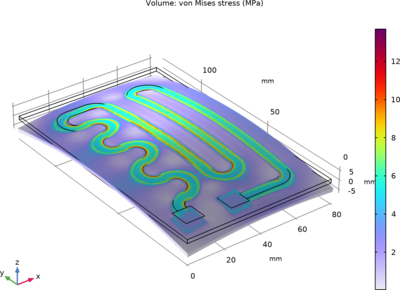
Small heating circuits find use in many applications. For example, in manufacturing processes, they heat up reactive fluids. The device in this tutorial example consists of an electrically resistive layer deposited on a glass plate. The layer results in Joule heating when a voltage is ... En savoir plus
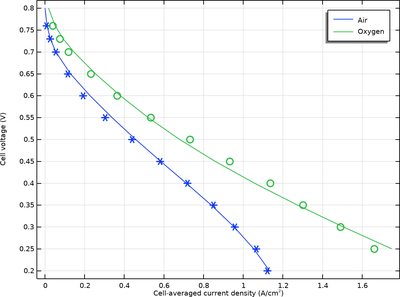
This tutorial demonstrates how to use stationary polarization data to perform parameter estimation of a polymer electrolyte membrane fuel cell (PEMFC) model. The model, defining a 5-layer membrane electrode assembly (MEA) is two-dimensional and includes electronic and ionic charge ... En savoir plus
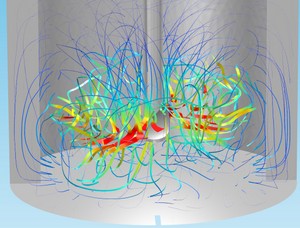
This model exemplifies the use of the Rotating Machinery interface, which allows you to model moving rotating parts in, for example, stirred tanks, mixers, and pumps. The Rotating Machinery interface formulates the Navier-Stokes equations in a rotating coordinate system. Parts that are ... En savoir plus
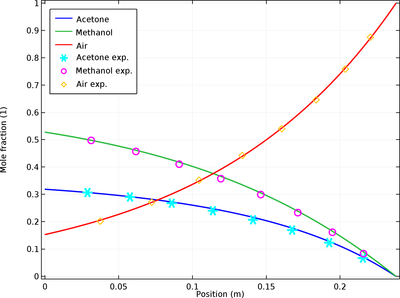
This example illustrates the use of the Maxwell-Stefan diffusion model available with the Transport of Concentrated Species interface. It models multicomponent gas-phase diffusion in a Stefan tube in 1D. In this case, it is a liquid mixture of acetone and methanol that evaporates into ... En savoir plus
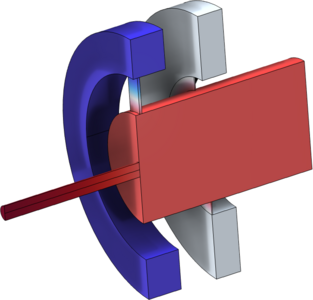
This model computes the input impedance/admittance to an acoustic system in the frequency domain. The system here represents a typical measurement setup used for testing hearing aids and includes domains with thermoviscous boundary layer losses. The input admittance, computed in the ... En savoir plus
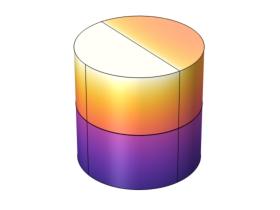
This example shows how to set up multiple sandwiched thin layers with different thermal conductivities in two different ways. First, the composite is modeled as a 3D object. In the second approach, the thin domains are modeled with thermal resistors in the Lumped Thermal System ... En savoir plus
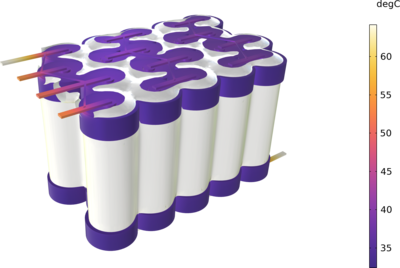
Thermal management of a battery pack is simulated considering two scenarios, air (natural convection) and phase change material (PCM) in the gap between the batteries. The PCM considered is a composite material of paraffin wax and graphite additive. Graphite is typically added for ... En savoir plus
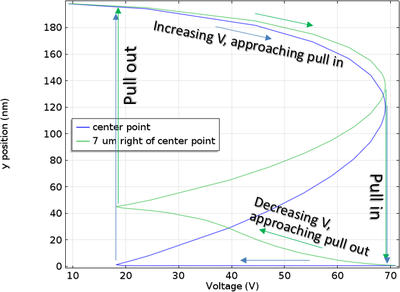
An electrostatically actuated MEMS resonator is simulated. The device is driven by an AC + DC bias voltage applied across a parallel plate capacitor. In this example, the pull-in and pull-out voltages of the resonator are computed. This is done via a quasi-static analysis of the ... En savoir plus