
La Bibliothèque d'Applications présente des modèles construits avec COMSOL Multiphysics pour la simulation d'une grande variété d'applications, dans les domaines de l'électromagnétisme, de la mécanique des solides, de la mécanique des fluides et de la chimie. Vous pouvez télécharger ces modèles résolus avec leur documentation détaillée, comprenant les instructions de construction pas-à-pas, et vous en servir comme point de départ de votre travail de simulation. Utilisez l'outil de recherche rapide pour trouver les modèles et applications correspondant à votre domaine d'intérêt. Notez que de nombreux exemples présentés ici sont également accessibles via la Bibliothèques d'Applications intégrée au logiciel COMSOL Multiphysics® et disponible à partir du menu Fichier.
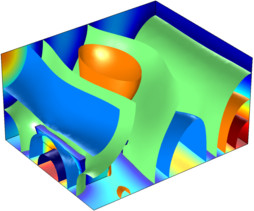
When designing a concert hall, it is extremely important to take the resonances into account. For a clear and neutral sound, the eigenfrequencies should be evenly spread through the registers. For the home stereo owner, who cannot actually change the shape of his living room, another ... En savoir plus
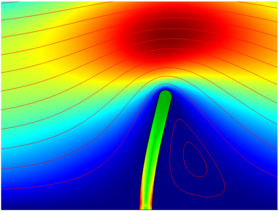
This model demonstrates how to set up a fluid-structure interaction problem in COMSOL Multiphysics. It illustrates how fluid flow can deform solid structures and how to solve for the flow in a continuously deforming geometry. The Fluid-Structure Interaction (FSI) multiphysics interface ... En savoir plus
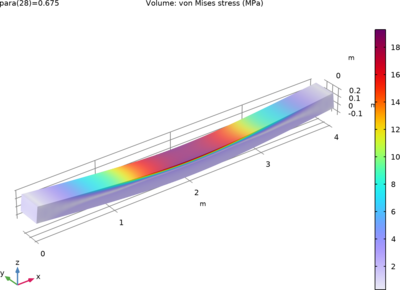
Concrete structures almost always contain reinforcements in the shape of steel bars ("rebars"). In COMSOL, rebars can be modeled either individually by adding a Truss interface to the Solid interface used for the concrete or using the Fiber subfeature to model their global effect. In ... En savoir plus
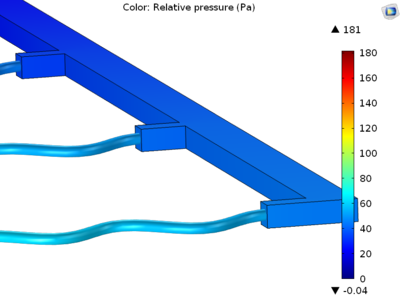
This example models flow in a microchannel heat exchanger by coupling a Laminar Flow interface in 3D to a Pipe Flow interface. By the use of the Pipe Flow interface to model the flow in the microchannels the problem size is significantly reduced. This model showcases the Pipe Connection ... En savoir plus
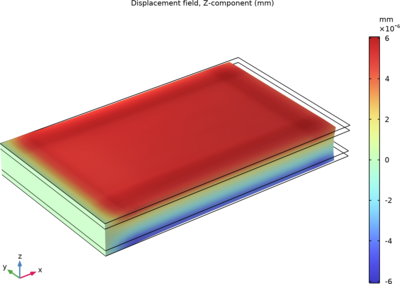
This tutorial is intended as a simple example showing how to model piezoelectric devices using the layered shell functionality. Two cases of material orientation are studied. In the first case, the pole axis is normal to the shell surface, which results in a thickness change. In the ... En savoir plus
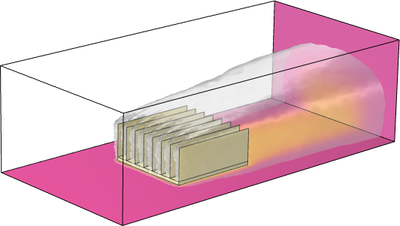
Thermoelectric elements are often used to cool or heat electronic components to a desired temperature. In such simulations, you are typically not interested in the behavior of the thermoelectric element itself but want to use its performance characteristics to model the overall response ... En savoir plus
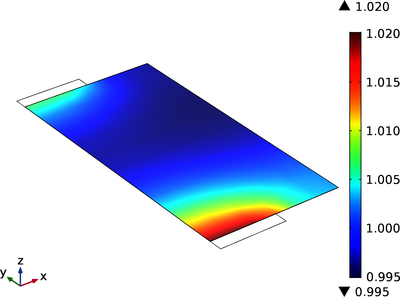
Large lithium-ion batteries are widely deployed in electric vehicles and for stationary energy storage applications. In the (stacked) pouch battery cell design, all current exits the cell on the cell "tabs", and as the cell size and power increase, the voltage gradients in the highly ... En savoir plus

This example describes an array of heating tubes submerged in a vessel with fluid flow entering at the bottom. This is a multiphysics model because it involves fluid dynamics coupled with heat transfer. The pressure and the velocity field are the solution of the Navier-Stokes equations, ... En savoir plus
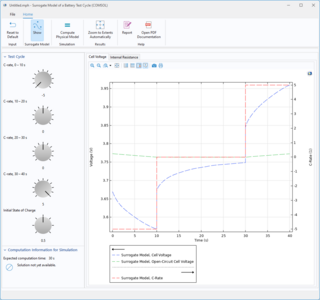
This app demonstrates the usage of a surrogate model function for predicting the cell voltage, cell open circuit voltage and internal resistance of an NMC111/graphite battery cell undergoing a battery test cycle. The surrogate function, a Deep Neural Network, has been fitted to a ... En savoir plus
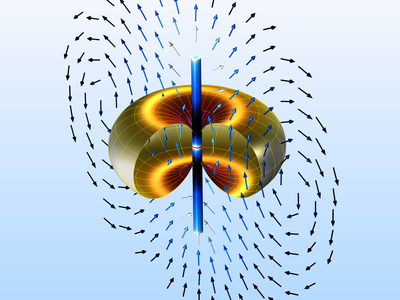
The dipole antenna is one of the most straightforward antenna configurations. It can be realized with two thin metallic rods that have a sinusoidal voltage difference applied between them. The length of the rods is chosen such that they are quarter wavelength elements at the operating ... En savoir plus


