
La Bibliothèque d'Applications présente des modèles construits avec COMSOL Multiphysics pour la simulation d'une grande variété d'applications, dans les domaines de l'électromagnétisme, de la mécanique des solides, de la mécanique des fluides et de la chimie. Vous pouvez télécharger ces modèles résolus avec leur documentation détaillée, comprenant les instructions de construction pas-à-pas, et vous en servir comme point de départ de votre travail de simulation. Utilisez l'outil de recherche rapide pour trouver les modèles et applications correspondant à votre domaine d'intérêt. Notez que de nombreux exemples présentés ici sont également accessibles via la Bibliothèques d'Applications intégrée au logiciel COMSOL Multiphysics® et disponible à partir du menu Fichier.
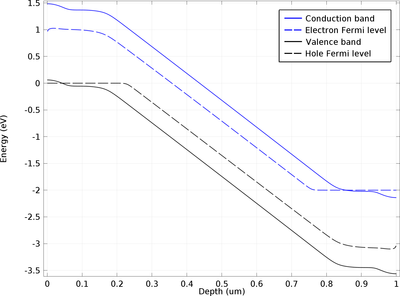
This simple model demonstrates how to use the Semiconductor Optoelectronics interfaces to model a simple GaAs PIN diode structure. Both the stimulated and spontaneous emission in the semiconductor are accounted for. The corresponding absorption of the light and the associated change in ... En savoir plus
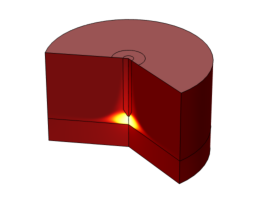
This example investigates the electrical and thermal characteristics of a plasma DC arc created in a point-to-plane configuration. The discharge is assumed to be in local thermodynamic equilibrium. The plasma is considered a conductive fluid medium and is modeled using a ... En savoir plus
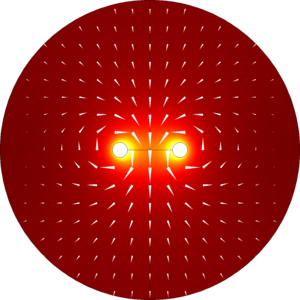
A parallel wire transmission line is composed of two conducting wires in a dielectric such as air. The fields around such a transmission line are not directly confined by the conductors, and extend to infinity, although they drop off in rapidly away from the wires. This model ... En savoir plus
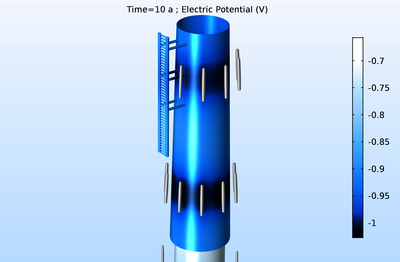
A monopile foundation is a large-diameter structural element that can be used to support structures like offshore wind turbines. This application exemplifies how the cathodic protection of a monopile decreases over time as the sacrificial anodes dissolve. The model can be used to ... En savoir plus

Small heating circuits find use in many applications. For example, in manufacturing processes, they heat up reactive fluids. The device in this tutorial consists of an electrically resistive layer deposited on a glass plate. The layer results in Joule heating when a voltage is applied to ... En savoir plus
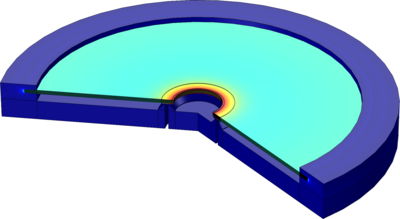
Piezoelectric valves are frequently employed in medical and laboratory applications due to their fast response times and quiet operation. Their energy efficient operation, also dissipates little heat, which is often important for these applications. This model shows how to model a ... En savoir plus
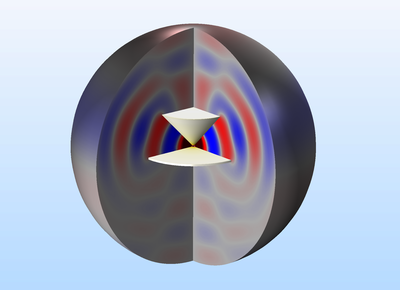
Conical antennas are useful for many applications due to their broadband characteristics and relative simplicity. In this example, we study the antenna impedance and radiation pattern as functions of frequency for a monoconical antenna with a finite ground plane and a 50 ohm coaxial ... En savoir plus

Modern cars have rear-windshield FM antennas to play FM radio. The radiation emitted from an antenna induces an electric current on the outer surface of any cable harnesses in the car, which can have negative effects. This model uses the RF Module to compute the far-field radiation ... En savoir plus
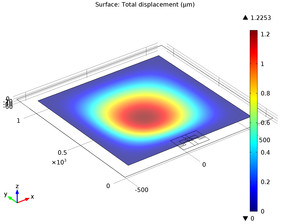
Piezoresistive pressure sensors were some of the first MEMS devices to be commercialized. Compared to capacitive pressure sensors, they are simpler to integrate with electronics, their response is more linear and they are inherently shielded from RF noise. They do, however, usually ... En savoir plus
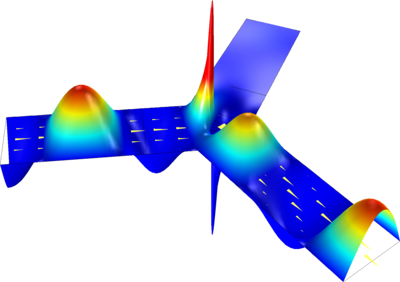
A microwave circulator is a multiport device in which a wave incident on Port 1 is coupled only into Port 2; a wave incident on Port 2 is coupled only into Port 3; and so on. Circulators are used to isolate microwave components, for example, to couple a transmitter and a receiver to a ... En savoir plus


