
La Bibliothèque d'Applications présente des modèles construits avec COMSOL Multiphysics pour la simulation d'une grande variété d'applications, dans les domaines de l'électromagnétisme, de la mécanique des solides, de la mécanique des fluides et de la chimie. Vous pouvez télécharger ces modèles résolus avec leur documentation détaillée, comprenant les instructions de construction pas-à-pas, et vous en servir comme point de départ de votre travail de simulation. Utilisez l'outil de recherche rapide pour trouver les modèles et applications correspondant à votre domaine d'intérêt. Notez que de nombreux exemples présentés ici sont également accessibles via la Bibliothèques d'Applications intégrée au logiciel COMSOL Multiphysics® et disponible à partir du menu Fichier.
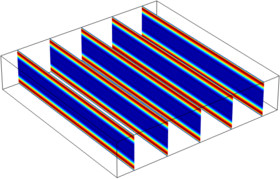
Whenever dimensions in waveguides become small compared to the viscous and thermal boundary layers it is necessary to model acoustics using thermoacoustics. In the present model the thermoacoustic wave field in a shallow uniform waveguide is modeled and compared to an analytical solution. En savoir plus
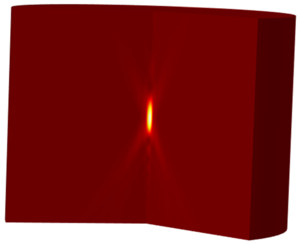
This tutorial shows how to model tissue heating induced by focused ultrasound. First, the stationary acoustic field in the water and the tissue are modeled to obtain the acoustic intensity distribution in the tissue. The absorbed acoustic energy is then calculated and used as the heat ... En savoir plus

This tutorial studies the propagation of sound in the presence of a porous absorber in the time domain. It demonstrates how to model a porous absorber using the local and extended reacting approximations and compares the two approaches for absorbers of various thickness. The dissipative ... En savoir plus
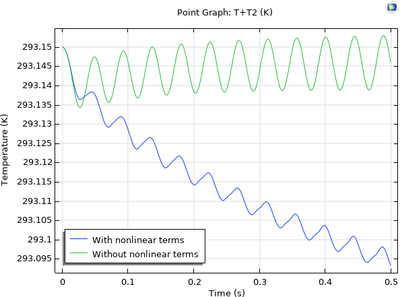
A thermoacoustic engine is a device with no moving parts that can generate acoustic energy from temperature gradients within the engine. It uses the relationship between the movement of oscillating air and the temperature changes in the air compressed and expanded by the acoustic waves. ... En savoir plus
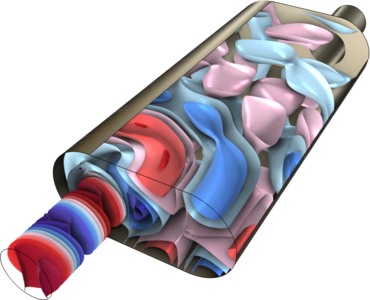
This example describes the pressure wave propagation in a muffler for an internal combustion engine. This example shows how to analyze both inductive and resistive damping in a muffler as well as the use of port boundary conditions. En savoir plus
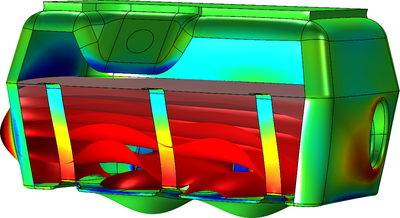
This model analyzes the frequency response of a fuel tank partially filled with fluid. The tank is submitted to a vertical acceleration. Two modeling methods are considered to represent the fluid: a traditional method of smearing the mass of the fluid through the wetted surface of the ... En savoir plus
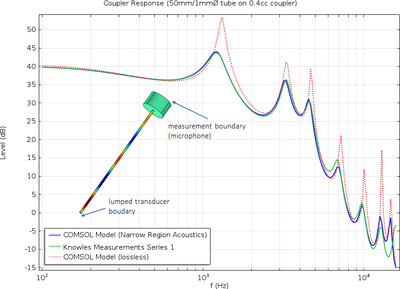
In this model a Knowles ED23146 receiver (miniature loudspeaker) is connected to a test set-up consisting of a 50 mm (1 mm diameter) earmold tube and a so-called 0.4-cc coupler. The receiver is modeled using a lumped spice network and connected to the finite element domain at the tube ... En savoir plus
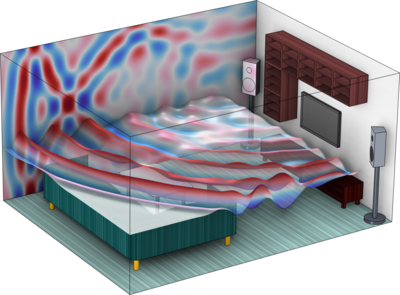
The use of wave-based techniques for room acoustic simulations has spread in the last years due to the increase in computational performance as well as the development of new numerical methods. The challenge of including realistic impedance conditions at walls is traditionally solved in ... En savoir plus
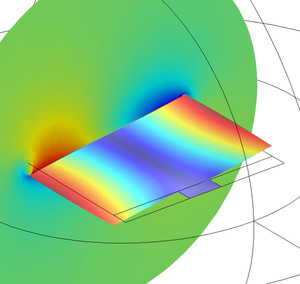
Micromirrors are used in certain MEMS devices to control optic elements. This model of a vibrating micromirror surrounded by air uses the Thermoacoustic-Shell Interaction user interface to model the fluid-solid interaction, and it thus includes the correct viscous and thermal damping of ... En savoir plus
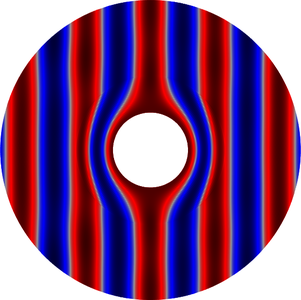
This example demonstrates how to use a background field in a sound scattering problem. The application is an acoustic invisibility cloak made of a metamaterial. Two different types of metamaterials are used, one using an anisotropic acoustic material with varying properties and one using ... En savoir plus