
La Bibliothèque d'Applications présente des modèles construits avec COMSOL Multiphysics pour la simulation d'une grande variété d'applications, dans les domaines de l'électromagnétisme, de la mécanique des solides, de la mécanique des fluides et de la chimie. Vous pouvez télécharger ces modèles résolus avec leur documentation détaillée, comprenant les instructions de construction pas-à-pas, et vous en servir comme point de départ de votre travail de simulation. Utilisez l'outil de recherche rapide pour trouver les modèles et applications correspondant à votre domaine d'intérêt. Notez que de nombreux exemples présentés ici sont également accessibles via la Bibliothèques d'Applications intégrée au logiciel COMSOL Multiphysics® et disponible à partir du menu Fichier.
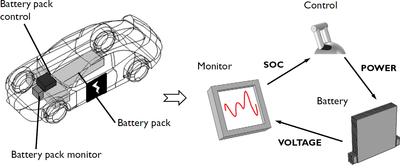
This is a template base model containing the physics, geometry and mesh of a lithium-ion battery, defined in 1D. The model makes use of four lithiation parameters which are used to define the relative balancing of the negative and positive electrodes, as well as global cell state of ... En savoir plus
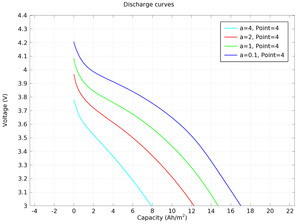
This model demonstrates the Lithium-Ion Battery interface for studying the discharge and charge of a lithium-ion battery for a given set of material properties. The geometry is in one dimension and the model is isothermal. Battery developers can use the model to investigate the influence ... En savoir plus
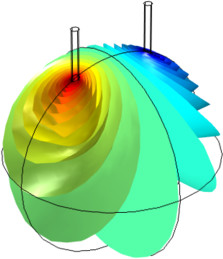
This tutorial example models the currents and the concentration of dissolved metal ions in a battery (corrosion cell) made from an orange and two metal nails. This type of battery is commonly used in chemistry lessons. Instead of an orange, lemons or potatoes can also be used. En savoir plus
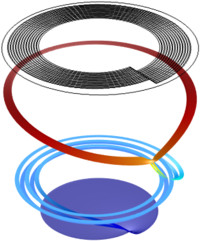
Due to the large differences in length scales in a lithium-ion battery, with the thickness of the different layers typically being several orders of magnitude smaller than the extension in the sheet direction, a lithium-ion battery is often well represented by a one-dimensional model. ... En savoir plus
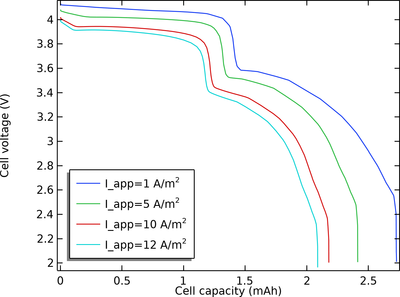
Sodium-ion batteries (SIB) are commonly presented as an alternative to lithium-ion batteries (LIB). The SIB chemistry uses Na+ instead of Li+ for electrolyte charge transport and as redox species in the electrode reactions, with the advantage of Na+ being more abundant and with a ... En savoir plus
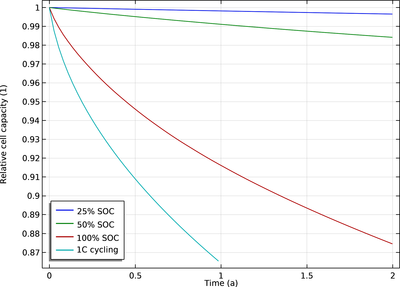
This tutorial demonstrates the Lumped Battery interface for modeling capacity loss in a battery. A set of lumped parameters are used to describe the capacity loss that occurs due to parasitic reactions in the battery, assuming no knowledge of the internal structure or design of the ... En savoir plus
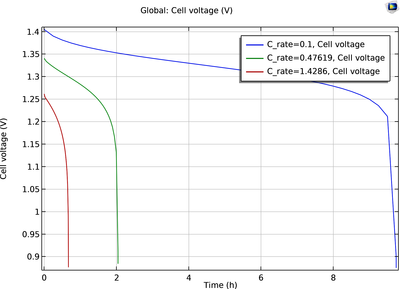
This model reproduces the NiCd battery model and the results presented in De Vidts' and White's paper from 1995. Ref: P. De Vidts, R. E. White, “Mathematical Modeling of a Nickel-Cadmium Cell: Proton Diffusion in the Nickel Electrode”, J. Electrochem. Soc, Vol. 142, No. 5, May 1995. En savoir plus
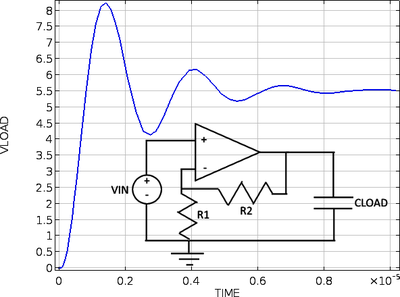
An operational amplifier (op-amp) is a differential voltage amplifier with a wide range of applications in analog electronics. This tutorial models an op-amp connected to a feedback loop and a capacitive load. The op-amp is modeled as an equivalent linear subcircuit in the Electrical ... En savoir plus
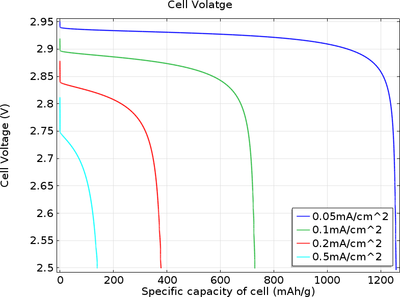
Rechargeable lithium-air batteries have recently attracted great interest mainly due to their high energy density. The theoretical value is about 11400 Wh/kg which is around 10 times greater than the lithium-ion batteries. In this tutorial, discharge of a lithium-air battery is ... En savoir plus
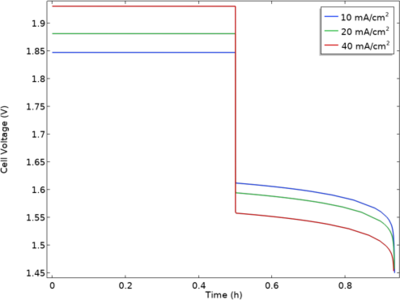
The zinc bromine redox flow battery is an electrochemical energy storage technology suitable for stationary applications. Compared to other flow battery chemistries, the Zn-Br cell potentially features lower cost, higher energy densities and better energy efficiencies. In the cell ... En savoir plus


