
La Bibliothèque d'Applications présente des modèles construits avec COMSOL Multiphysics pour la simulation d'une grande variété d'applications, dans les domaines de l'électromagnétisme, de la mécanique des solides, de la mécanique des fluides et de la chimie. Vous pouvez télécharger ces modèles résolus avec leur documentation détaillée, comprenant les instructions de construction pas-à-pas, et vous en servir comme point de départ de votre travail de simulation. Utilisez l'outil de recherche rapide pour trouver les modèles et applications correspondant à votre domaine d'intérêt. Notez que de nombreux exemples présentés ici sont également accessibles via la Bibliothèques d'Applications intégrée au logiciel COMSOL Multiphysics® et disponible à partir du menu Fichier.
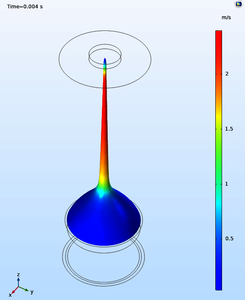
This model deals with electrohydrodynamics (EHD), where a charge separation on the phase boundary between a liquid and air involves the formation of a charged layer. This charged layer allows for a net force to be induced at the interphase when a large electric field is applied. The ... En savoir plus
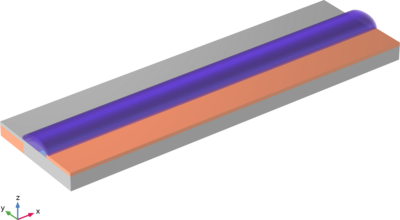
This model demonstrates the simulation of surface dielectric barrier discharges (DBDs) using the Electric Discharge interface. The formulation incorporates a comprehensive set of physical processes, including charge transport, impact ionization, electron attachment, recombination, and ... En savoir plus
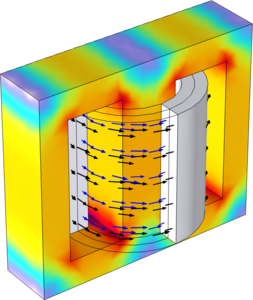
This is the transient model of a single phase E-core transformer using a homogenized approach for the multi-turn primary and secondary coils. The model includes the effect of magnetic saturation (B–H curve) in the core and shows how to connect the transformer model to the external ... En savoir plus
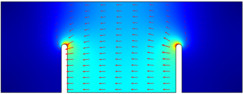
This example treats the modeling of electroosmotic flow in porous media. The system consists of a compartment of sintered porous material and two electrodes that generate an electric field. The cell combines pressure and electroosmotic driven flow. The equations that are solved are the ... En savoir plus
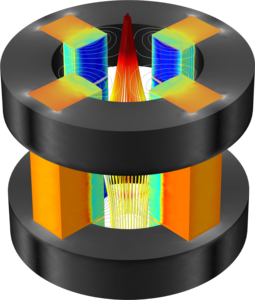
Just like optical lenses focus light, electric and magnetic lenses can focus beams of charged particles. Systems of magnetic quadrupole lenses find a common use in focusing both ion and particle beams in accelerators at nuclear and particle physics centers. This model shows the path of ... En savoir plus
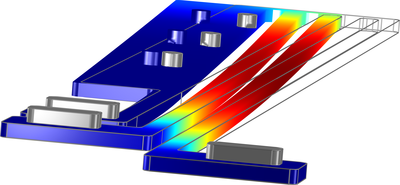
A model of a thermal microactuator requires the coupled simulation of electric current conduction with heat generation, heat conduction, and structural stresses and strains due to thermal expansion. The purpose of this model is to demonstrate how to access the cluster computing ... En savoir plus
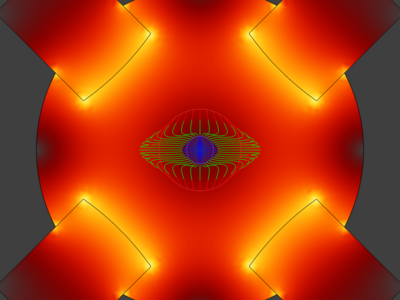
Just like optical lenses focus light, electric and magnetic lenses can be used for focusing beams of charged particles. This COMSOL Multiphysics model shows the path of B5+ ions passing through a focusing system of three magnetic quadrupoles. Each of the quadropoles focus the beam of ... En savoir plus
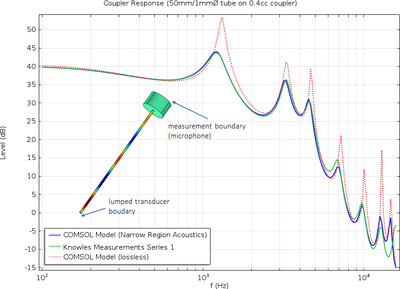
In this model a Knowles ED23146 receiver (miniature loudspeaker) is connected to a test set-up consisting of a 50 mm (1 mm diameter) earmold tube and a so-called 0.4-cc coupler. The receiver is modeled using a lumped spice network and connected to the finite element domain at the tube ... En savoir plus
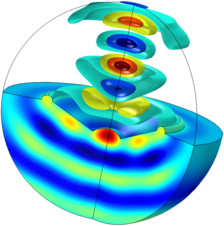
Example of a moving-coil loudspeaker where lumped parameters represent the behavior of the electrical and mechanical components. The Thiele-Small parameters (small-signal parameters) serve as input to the lumped model, which is represented using the Electric Circuit interface. The ... En savoir plus
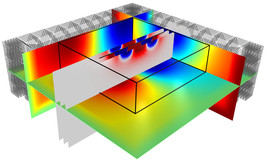
The classical forward problem of geoelectrics (includes electrical resistivity tomography, ERT and earlier techniques as vertical electric sounding, VES) is the calculation of potentials at a given set of electrodes (M,N) while current is injected at other electrodes (A,B) into the ... En savoir plus


