
La Bibliothèque d'Applications présente des modèles construits avec COMSOL Multiphysics pour la simulation d'une grande variété d'applications, dans les domaines de l'électromagnétisme, de la mécanique des solides, de la mécanique des fluides et de la chimie. Vous pouvez télécharger ces modèles résolus avec leur documentation détaillée, comprenant les instructions de construction pas-à-pas, et vous en servir comme point de départ de votre travail de simulation. Utilisez l'outil de recherche rapide pour trouver les modèles et applications correspondant à votre domaine d'intérêt. Notez que de nombreux exemples présentés ici sont également accessibles via la Bibliothèques d'Applications intégrée au logiciel COMSOL Multiphysics® et disponible à partir du menu Fichier.
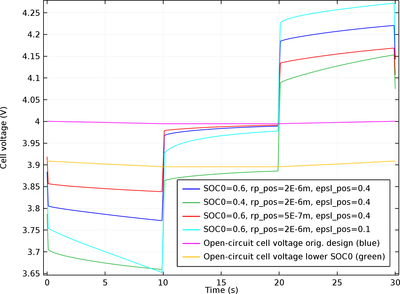
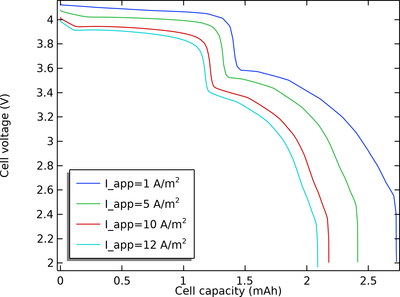
This tutorial digs deeper into the investigation of rate capability in a battery and shows how the Lithium-Ion Battery interface is an excellent modeling tool for doing this. The rate capability is studied in terms of polarization (voltage loss) or the internal resistance causing this ... En savoir plus
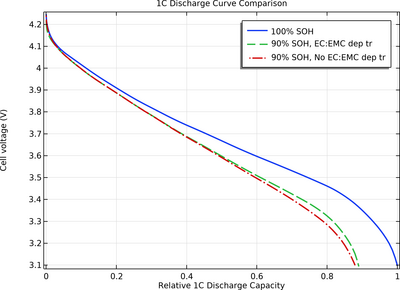
The liquid electrolyte in lithium-ion batteries (LIBs) typically consists of a lithium salt, such as LiPF6, dissolved in one or several solvents. Commercial LIBs commonly employ a mix of multiple hydrocarbon-based solvents along with additional additives. In an electrolyte consisting of ... En savoir plus

Electrode balancing is an important factor in the design of lithium-ion batteries. In this model, use the experimental open-circuit voltage of a cell and some basic assumptions, followed by an optimization solver, to find a proper electrode balancing. Get more details in this ... En savoir plus

The following example is a 2D tutorial model of a lithium-ion battery. The cell geometry is not based on a real application; it is only meant to demonstrate a 2D model setup. En savoir plus

This model showcases a nail penetration experiment into a layered battery. It couples the Solid Mechanics, Lithium-Ion Battery, and Heat Transfer interfaces. A nail is punched into a sandwiched battery consisting of two electrodes and a separator. As soon as the nail connects both ... En savoir plus
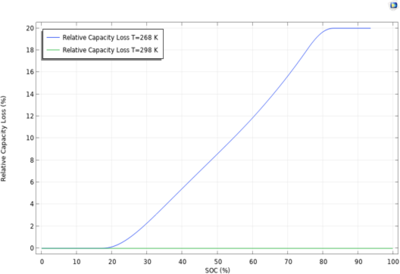
Deposition of metallic lithium on the negative electrode in preference to lithium intercalation is known to be a capacity loss and safety concern for lithium-ion batteries. Harsh charge conditions such as high currents (fast charging) and/or low temperatures can lead to lithium plating. ... En savoir plus
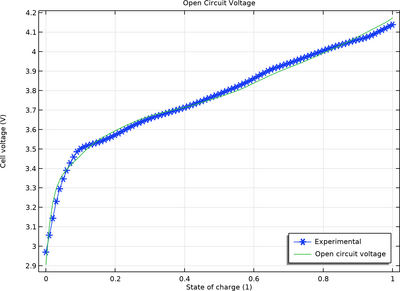
This application performs parameter estimation (fitting) of the active lithiation windows of the negative and positive electrode materials of a lithium-ion battery, based on a experimental open-circuit voltage (OCV) curve measured as a function of the cell state of charge (SOC). Once a ... En savoir plus
Sodium-ion batteries (SIB) are commonly presented as an alternative to lithium-ion batteries (LIB). The SIB chemistry uses Na+ instead of Li+ for electrolyte charge transport and as redox species in the electrode reactions, with the advantage of Na+ being more abundant and with a ... En savoir plus


