
La Bibliothèque d'Applications présente des modèles construits avec COMSOL Multiphysics pour la simulation d'une grande variété d'applications, dans les domaines de l'électromagnétisme, de la mécanique des solides, de la mécanique des fluides et de la chimie. Vous pouvez télécharger ces modèles résolus avec leur documentation détaillée, comprenant les instructions de construction pas-à-pas, et vous en servir comme point de départ de votre travail de simulation. Utilisez l'outil de recherche rapide pour trouver les modèles et applications correspondant à votre domaine d'intérêt. Notez que de nombreux exemples présentés ici sont également accessibles via la Bibliothèques d'Applications intégrée au logiciel COMSOL Multiphysics® et disponible à partir du menu Fichier.
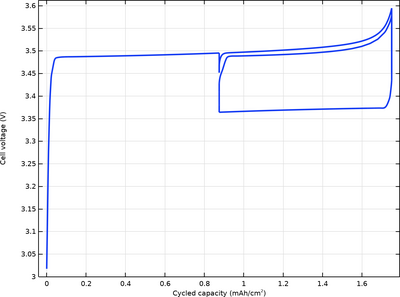
Lithium iron phosphate (LFP) is a common positive electrode material in lithium-ion batteries. Specific for the LFP electrode material is that its equilibrium (open circuit) potential, when defined as a function of the lithiation state, features a large flat plateau with a more or less ... En savoir plus
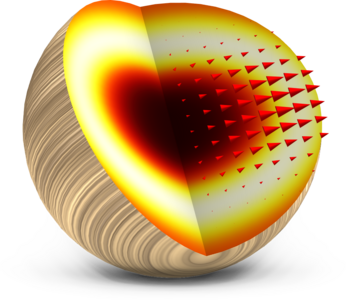
The pyrolysis of a centimeter-sized wood particle presents a fully coupled multiphysics problem with mass transfer, fluid flow, and heat transfer. This example model consists of two parts. The first part demonstrates how to set up a model describing the pyrolysis of a porous, ... En savoir plus
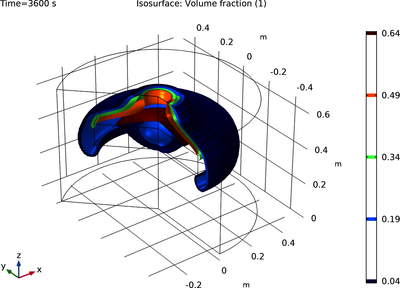
This example demonstrate two-phase flow in a porous medium which contains a low permeable lens. The heavier phase infiltrates the porous medium, so the low permeable lens is infiltrated only when a critical saturation at the outside is reached. En savoir plus
This is a tutorial model of the coupling between flow of a fluid in an open channel and a porous block attached to one of the channel walls. The flow is described by the Navier-Stokes equation in the free region and a Forchheimer-corrected version of the Brinkman equations in the porous ... En savoir plus

Drying of porous media is an important process in the food and paper industry among others. Many physical effects must be considered: fluid flow, heat transfer with phase change, and transport of participating liquids and gases. All of these effects are strongly coupled, and predefined ... En savoir plus
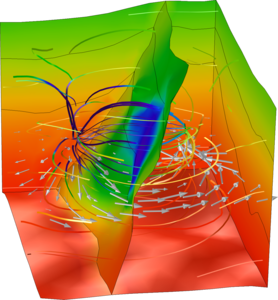
This is one of the two models from the blog post about heat transfer in the subsurface: Coupling Heat Transfer with Subsurface Porous Media Flow Note: Poroelasticity is not included here. En savoir plus
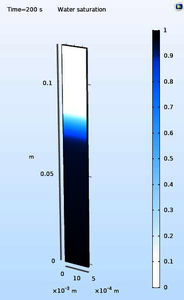
This example models wicking in a porous medium. Wicking is the phenomenon that occurs when a dry porous material is put into contact with a fluid: it will absorb the fluid due to capillary forces. The absorption will continue until an equilibrium is reached where the gravitational forces ... En savoir plus

This model example investigates the transport of reactants and water in a high temperature PEMFC. The model includes mass and momentum transport phenomena in the flow channels, gas diffusion layers (GDLs), and porous electrodes, as well as electrochemical currents in the GDLs, the porous ... En savoir plus
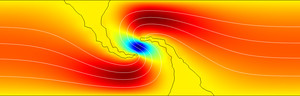
Topology optimization of the Navier-Stokes equations is encountered in different branches and applications, such as in the design of ventilation systems for cars. A common technique applicable to such problems is to let the distribution of porous material vary continuously. In this ... En savoir plus
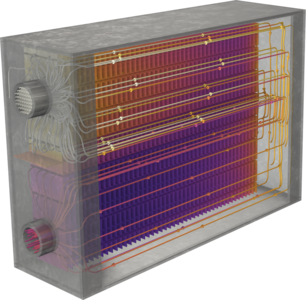
This tutorial model shows how a plate-fin heat exchanger made of aluminum is used to cool down hot oil with colder air. In order to maximize heat transfer, the heat exchanger is made of a porous aluminum matrix in which the hot oil flows. Heat is conducted through aluminum fins in ... En savoir plus


