
La Bibliothèque d'Applications présente des modèles construits avec COMSOL Multiphysics pour la simulation d'une grande variété d'applications, dans les domaines de l'électromagnétisme, de la mécanique des solides, de la mécanique des fluides et de la chimie. Vous pouvez télécharger ces modèles résolus avec leur documentation détaillée, comprenant les instructions de construction pas-à-pas, et vous en servir comme point de départ de votre travail de simulation. Utilisez l'outil de recherche rapide pour trouver les modèles et applications correspondant à votre domaine d'intérêt. Notez que de nombreux exemples présentés ici sont également accessibles via la Bibliothèques d'Applications intégrée au logiciel COMSOL Multiphysics® et disponible à partir du menu Fichier.

Modern cars have rear-windshield FM antennas to play FM radio. The radiation emitted from an antenna induces an electric current on the outer surface of any cable harnesses in the car, which can have negative effects. This model uses the RF Module to compute the far-field radiation ... En savoir plus
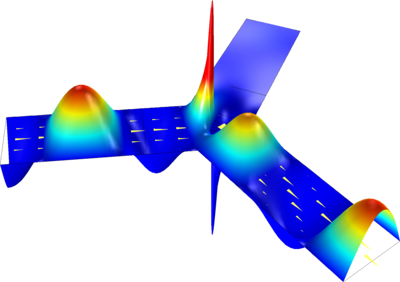
A microwave circulator is a multiport device in which a wave incident on Port 1 is coupled only into Port 2; a wave incident on Port 2 is coupled only into Port 3; and so on. Circulators are used to isolate microwave components, for example, to couple a transmitter and a receiver to a ... En savoir plus
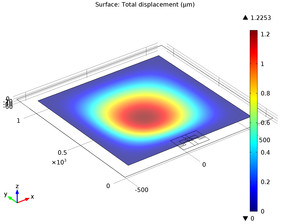
Piezoresistive pressure sensors were some of the first MEMS devices to be commercialized. Compared to capacitive pressure sensors, they are simpler to integrate with electronics, their response is more linear and they are inherently shielded from RF noise. They do, however, usually ... En savoir plus
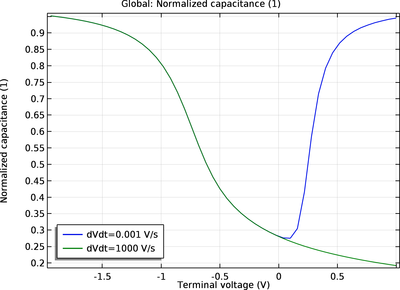
The metal-silicon-oxide (MOS) structure is the fundamental building block for many silicon planar devices. Its capacitance measurements provide a wealth of insight into the working principles of such devices. This tutorial constructs a simple 1D model of a MOS capacitor (MOSCAP). Both ... En savoir plus
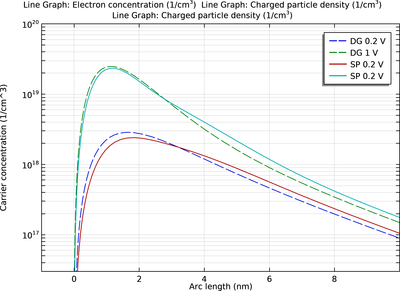
This tutorial demonstrates the use of the density-gradient formulation to include the effect of quantum confinement in the device physics simulation of a silicon inversion layer. This formulation requires only a moderate increase of computational resources as compared to the conventional ... En savoir plus
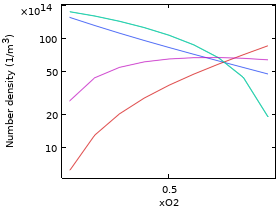
This tutorial model solves for an inductively coupled plasma reactor in a mixture of argon/oxygen. The model computes the fluid flow and gas heating. Important aspects and strategies for modeling electronegative discharges are discussed. En savoir plus
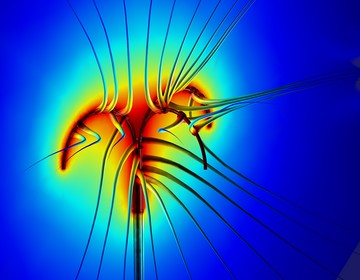
One method for removing cancerous tumors from healthy tissue is to heat the malignant tissue to a critical temperature that kills the cancer cells. This example accomplishes the localized heating by inserting a four-armed electric probe through which an electric current runs. Equations ... En savoir plus
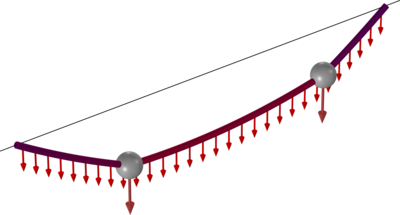
A cable is a structural member which has stiffness only in its tangential direction, but virtually no bending stiffness. When supported only at its two ends it deflects under gravitational load forming a curve known as catenary. This example shows how to model components such as cables, ... En savoir plus
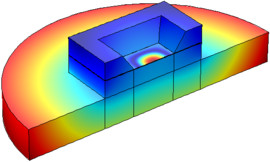
A capacitive pressure sensor is simulated. This model shows how to simulate the response of the pressure sensor to an applied pressure, and also how to analyze the effects of packing induced stresses on the sensor performance. En savoir plus
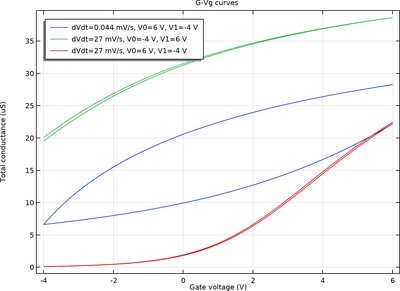
This tutorial analyzes the hysteresis of the conductance-gate-voltage (G-Vg) curves of an InAs nanowire FET, using the density-gradient theory to add the effect of quantum confinement to the conventional drift-diffusion formulation, without a large increase of computational costs. The ... En savoir plus


