
La Bibliothèque d'Applications présente des modèles construits avec COMSOL Multiphysics pour la simulation d'une grande variété d'applications, dans les domaines de l'électromagnétisme, de la mécanique des solides, de la mécanique des fluides et de la chimie. Vous pouvez télécharger ces modèles résolus avec leur documentation détaillée, comprenant les instructions de construction pas-à-pas, et vous en servir comme point de départ de votre travail de simulation. Utilisez l'outil de recherche rapide pour trouver les modèles et applications correspondant à votre domaine d'intérêt. Notez que de nombreux exemples présentés ici sont également accessibles via la Bibliothèques d'Applications intégrée au logiciel COMSOL Multiphysics® et disponible à partir du menu Fichier.
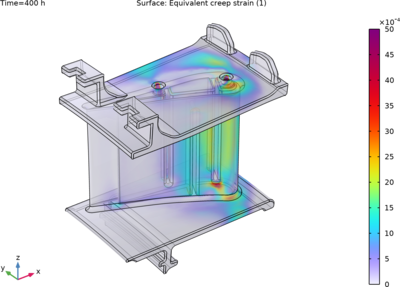
This example shows how to compute deformations caused by secondary creep in a turbine stator blade. The creep rate is highly influenced by temperature, and the deformation and stress relaxation is thus controlled by the temperature field. En savoir plus
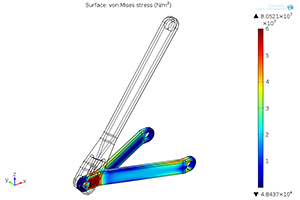
This example illustrates how to model a barrel hinge connecting two solid objects in an assembly. In this model, the details of the connection are not the focus of the analysis, therefore, the hinge joint is modeled using a Joint feature in the Multibody Dynamics Module. The connected ... En savoir plus
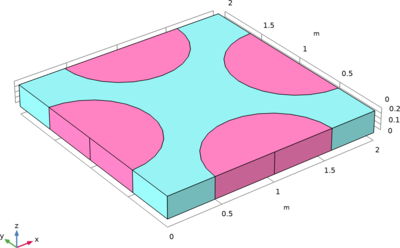
In this example, the micromechanical properties of a piezoelectric fiber composite are studied. The homogenized electromechanical properties of the composite are derived from the individual microscopic properties of matrix and fiber. En savoir plus
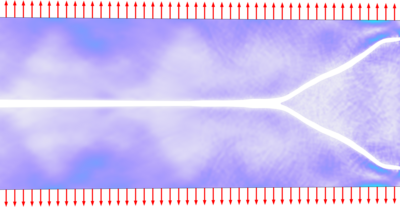
In this example, a benchmark problem in dynamic fracture of brittle materials is analyzed using the AT1 phase-field damage model. An instantaneous tensile load is applied to a planar tension specimen with a pre-existing crack. Initially, the crack propagates perpendicular to the loading ... En savoir plus
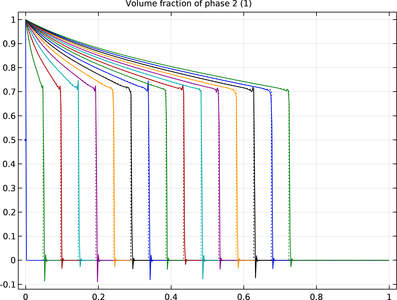
This benchmark models two-phase flow in a porous medium in 1D, where the flow can be analytically described by the Buckley-Leverett equation. En savoir plus

Trusses are structural members that can only sustain axial forces, but no bending or torsion. In the following example you first build and solve a simple 2D truss model using the 2D Truss interface. Later on, you analyze a 3D variant of the same problem using the 3D Truss interface. This ... En savoir plus
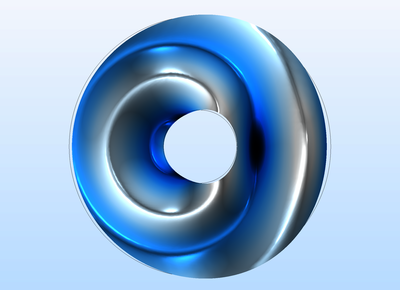
This example model calculates the bistatic radar cross section (RCS) per unit length of a circle using the Electromagnetic Waves, Time Explicit physics interface. A 2D circle is excited by a 200 MHz sinusoidal signal modulated by a temporal Gaussian pulse. A wideband RCS frequency ... En savoir plus
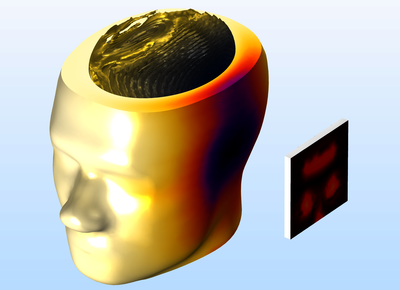
Users of consumer electronics with radiating devices are exposed to radio frequency (RF) emission. The amount of exposure is defined as the specific absorption rate (SAR). That is, the SAR value represents the radio frequency (RF) energy rate absorbed by a body. This model computes local ... En savoir plus
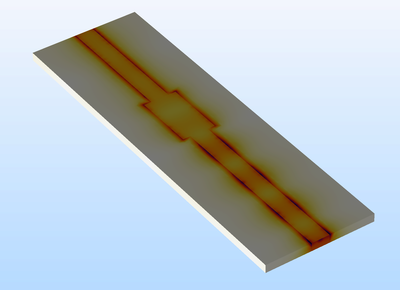
While transient analyses are useful for time domain reflectometry (TDR) to handle signal integrity (SI) problems, many RF and microwave examples are addressed using frequency domain simulations generating S-parameters. However, from the frequency domain data it is difficult to identify ... En savoir plus
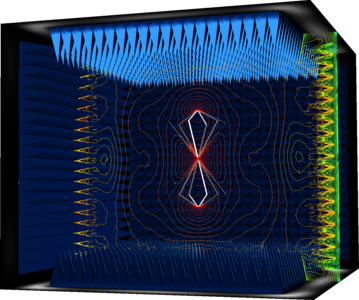
An anechoic chamber is used to measure antenna characterization, electromagnetic interference (EMI), and electromagnetic compatibility (EMC). Within the chamber are absorbers that are configured with an array of pyramidal objects that steer the propagating incident field onto their ... En savoir plus


