
La Bibliothèque d'Applications présente des modèles construits avec COMSOL Multiphysics pour la simulation d'une grande variété d'applications, dans les domaines de l'électromagnétisme, de la mécanique des solides, de la mécanique des fluides et de la chimie. Vous pouvez télécharger ces modèles résolus avec leur documentation détaillée, comprenant les instructions de construction pas-à-pas, et vous en servir comme point de départ de votre travail de simulation. Utilisez l'outil de recherche rapide pour trouver les modèles et applications correspondant à votre domaine d'intérêt. Notez que de nombreux exemples présentés ici sont également accessibles via la Bibliothèques d'Applications intégrée au logiciel COMSOL Multiphysics® et disponible à partir du menu Fichier.
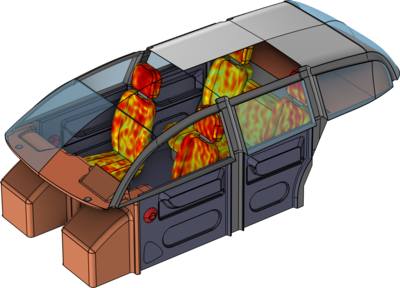
This tutorial shows the analysis of a car cabin in order to study the performance of a sound system in the low to mid frequency range. The cabin is of a typical sedan interior, that is, the inside of a hard-top family car. The model studies the frequency response at the location of a ... En savoir plus
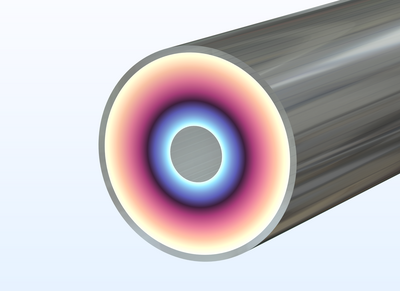
This example demonstrates how to compute transmission line parameters such as series resistance, series inductance, shunt conductance, and shunt capacitance per unit length using the predefined Transmission Line RLGC Parameters multiphysics interface. The demonstration also includes the ... En savoir plus
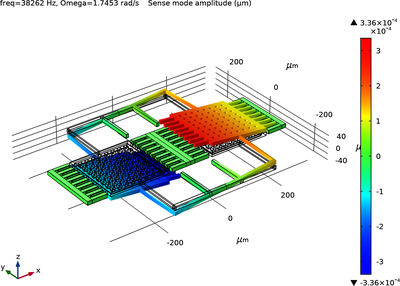
This tutorial example of a comb drive tuning fork gyroscope is kindly provided by Dr. James Ransley at Veryst Engineering, LLC. The model demonstrates fully parameterized geometry, extensive use of selection features, implementation of analytic formulas for the electromechanical forces ... En savoir plus
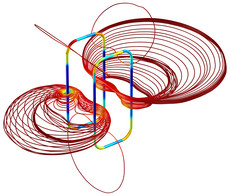
RFIDs are used in a multitude of applications such as tracking or identifying consumer products and their packaging. An RFID system consists of two main parts: A tag or transponder with a printed circuit-board (PCB) antenna A reader unit with a larger RF antennaThe reader antenna ... En savoir plus
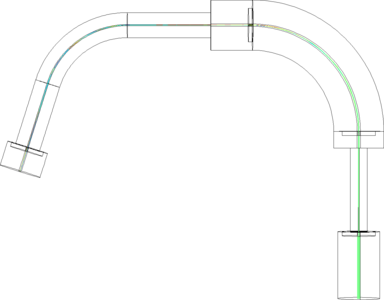
This tutorial utilizes the Particle Beam feature to examine the performance of a high-precision spectrometer. An ion beam is subjected to electric and magnetic forces, and only a fraction of the incoming beam is transmitted to the detector. The Particle Counter feature is used to compute ... En savoir plus
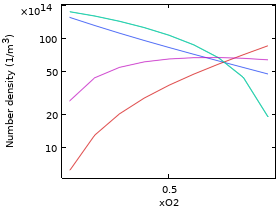
This tutorial model solves for an inductively coupled plasma reactor in a mixture of argon/oxygen. The model computes the fluid flow and gas heating. Important aspects and strategies for modeling electronegative discharges are discussed. En savoir plus

One way to design a filter is to use the element values of well-known filter prototypes, such as maximally flat or equal-ripple low-pass filters. It is easier to fabricate a distributed element filter on a microwave substrate than a lumped element filter, since it is cumbersome to find ... En savoir plus
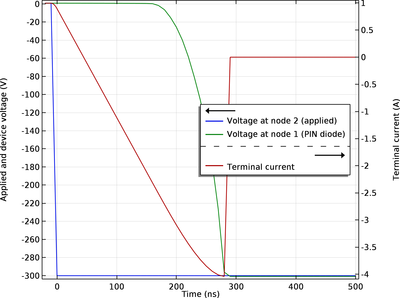
This tutorial simulates the turn-off transient (reverse recovery) of a simple PIN diode with an inductive load, loosely based on the book "Fundamentals of Power Semiconductor Devices" by B. J. Baliga (p. 256, 2008 edition). Unlike the book, which assumes an initial constant current ramp ... En savoir plus
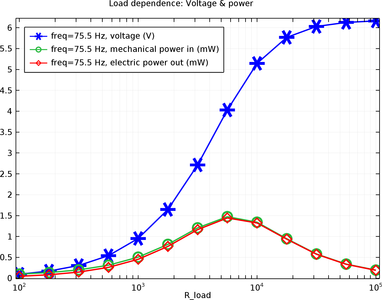
This model shows how to analyze a simple, cantilever based, piezoelectric energy harvester. A sinusoidal acceleration is applied to the energy harvester and the output power is evaluated as a function of frequency, load impedance and acceleration magnitude. En savoir plus
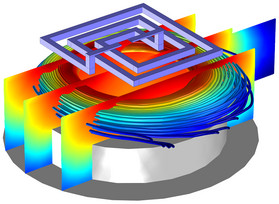
The COMSOL® software includes capabilities for 3D plasma modeling. In this example, a square coil is placed on top of a dielectric window and is electrically excited at 13.56 MHz. A plasma is formed in the chamber beneath the dielectric window, which contains argon gas at low ... En savoir plus


