
La Bibliothèque d'Applications présente des modèles construits avec COMSOL Multiphysics pour la simulation d'une grande variété d'applications, dans les domaines de l'électromagnétisme, de la mécanique des solides, de la mécanique des fluides et de la chimie. Vous pouvez télécharger ces modèles résolus avec leur documentation détaillée, comprenant les instructions de construction pas-à-pas, et vous en servir comme point de départ de votre travail de simulation. Utilisez l'outil de recherche rapide pour trouver les modèles et applications correspondant à votre domaine d'intérêt. Notez que de nombreux exemples présentés ici sont également accessibles via la Bibliothèques d'Applications intégrée au logiciel COMSOL Multiphysics® et disponible à partir du menu Fichier.
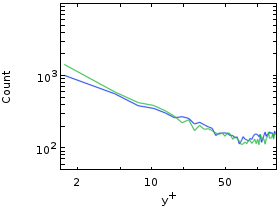
In this benchmark model, solid particles are released in a fully developed turbulent channel flow. The particles are subjected to a drag force that includes contributions from the fluid turbulence, implemented using a Continuous Random Walk (CRW) model. Because the turbulence in the ... En savoir plus
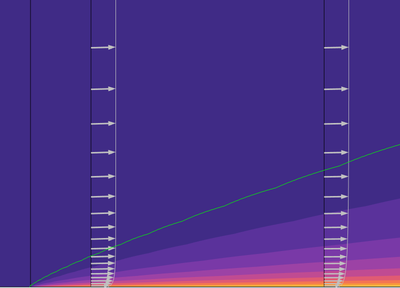
This model is a verification case to attest the behavior of turbulence models and wall functions in the boundary layer of a turbulent flow. The velocity and the temperature are compared to the theoretical curves in a wall-resolved and a wall-modeled approach using the Algebraic y+ ... En savoir plus
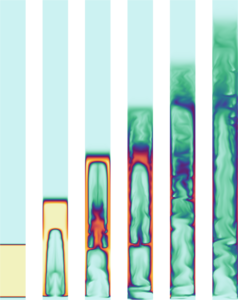
Circulating fluidized beds are widely used in the food & beverage, pharmaceutical, chemical, and energy industries to achieve efficient contact between solid and fluid reactants. This model visualizes how a circulating fluidized bed operates. In the model, the dispersed phase, which ... En savoir plus
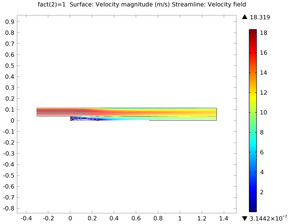
The backward facing step is an interesting case for studying the performance and solution strategy of a turbulence model. In this case, the flow is subjected to a sudden increase of cross-sectional area, resulting in a separation of flow starting at the point of expansion. Spatial ... En savoir plus
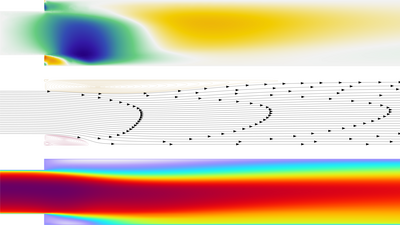
The Turbulent flow, Elliptic Blending R-ε interface is used to analyze fully developed turbulent flow in a spanwise rotating channel. Due to the influence of the Coriolis force on turbulence, profiles of the flow variables are skewed at moderate rotation rates. An asymmetry between the ... En savoir plus
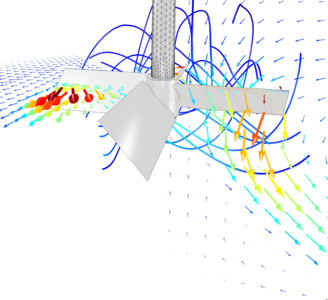
This model shows how to use simulations to predict power numbers with Power Law fluids in a mixer. It simulates the behavior of flow in a flat bottom tank with a single four-blade pitched impeller. The flow was modeled as laminar and the frozen rotor approach was used to solve the ... En savoir plus
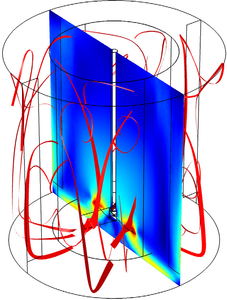
This tutorial example simulates the flow in a flat bottom mixer containing, agitated by a pitched four blade impeller, where the fluid is water, and flow is assumed to be turbulent. The flow in the mixer is modeled using the k-ε turbulence model, and a time-dependent simulation ... En savoir plus
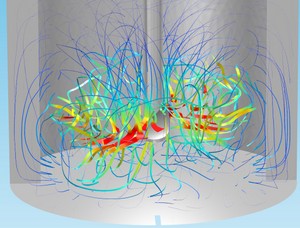
This model exemplifies the use of the Rotating Machinery interface, which allows you to model moving rotating parts in, for example, stirred tanks, mixers, and pumps. The Rotating Machinery interface formulates the Navier-Stokes equations in a rotating coordinate system. Parts that are ... En savoir plus
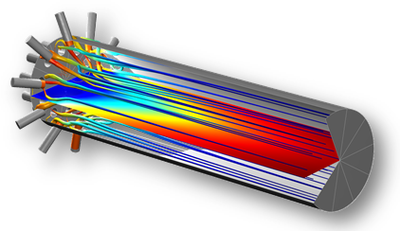
In a polymerization reactor for polyester manufacturing, the mixing in the reactor is achieved by impinging turbulent jets of reactants onto each other. The turbulence affects the reaction kinetics and quality of the polymer linkage. Turbulent flows involving rapid reaction kinetics are ... En savoir plus
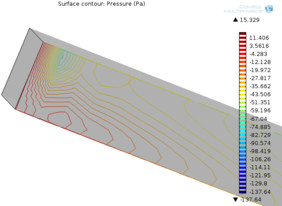
A lab-on-a-chip platform can be realized on a rotating disc by designing channels and other features to use the Coriolis or centrifugal forces to manipulate the flow. These forces are controlled by changing the angular velocity of the disc, so the platform is programmed by using a ... En savoir plus