
La Bibliothèque d'Applications présente des modèles construits avec COMSOL Multiphysics pour la simulation d'une grande variété d'applications, dans les domaines de l'électromagnétisme, de la mécanique des solides, de la mécanique des fluides et de la chimie. Vous pouvez télécharger ces modèles résolus avec leur documentation détaillée, comprenant les instructions de construction pas-à-pas, et vous en servir comme point de départ de votre travail de simulation. Utilisez l'outil de recherche rapide pour trouver les modèles et applications correspondant à votre domaine d'intérêt. Notez que de nombreux exemples présentés ici sont également accessibles via la Bibliothèques d'Applications intégrée au logiciel COMSOL Multiphysics® et disponible à partir du menu Fichier.
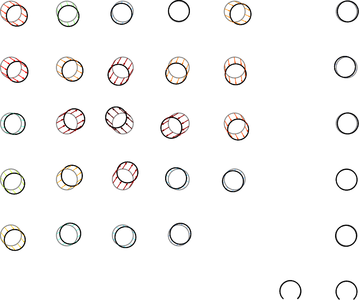
This model builds on the photonic crystal model, where a photonic crystal structure is studied. This structure has a band gap, so only waves within a specific frequency range will propagate through the outlined guide geometry. This model changes the position of the pillars in order to ... En savoir plus
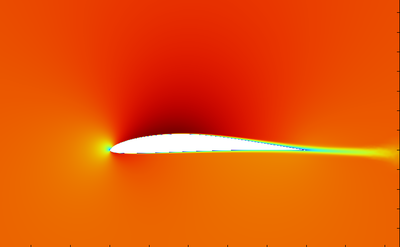
The flow around the Eppler 387 airfoil is computed with the SST turbulence model both with and without the transition model. The reuslts are compared with experimental values. En savoir plus
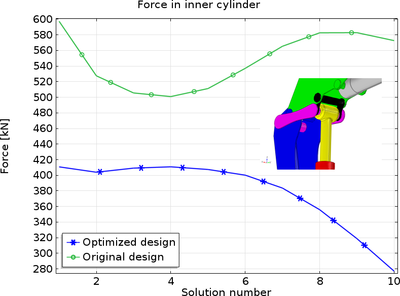
In complex mechanical systems, it can be challenging to find an optimal (or even good enough) solution only through engineering insight or trial-and-error procedures. Using mathematical optimization methods can then be an efficient path to a better design. In this example, a link ... En savoir plus
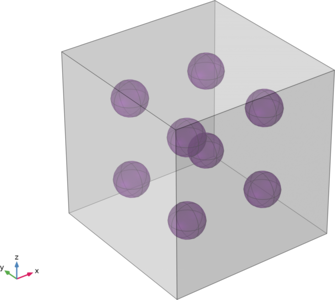
In this example, the homogenized elastic and viscoelastic properties of a particulate composite are computed based on the individual properties of elastic particles embedded in a viscoelastic matrix. Periodic boundary conditions are applied to a unit cell of the particulate composite ... En savoir plus

The mutual inductance and induced currents between a single turn primary and twenty turn secondary coil in a concentric coplanar arrangement is computed using a frequency domain model. Each turn of the secondary coil is modeled explicitly. The results are compared against analytic ... En savoir plus
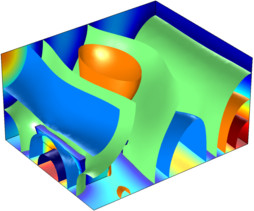
When designing a concert hall, it is extremely important to take the resonances into account. For a clear and neutral sound, the eigenfrequencies should be evenly spread through the registers. For the home stereo owner, who cannot actually change the shape of his living room, another ... En savoir plus
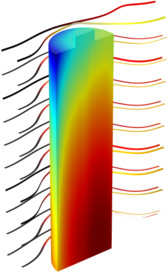
This example simulates the heat profile in an air-cooled cylindrical battery in 3d. The battery is placed in a matrix in a battery pack. The thermal model is coupled to a 1d-battery model that is used to generate a heat source in the active battery material. The model requires the ... En savoir plus
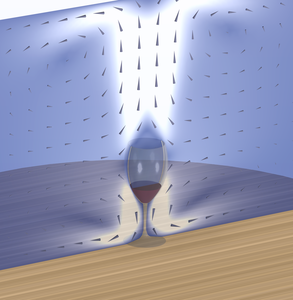
During professional wine tasting, several samples of wine are judged in one session. It is important that each sample is covered, since evaporation of ethanol and water will change the taste. This model simulates the evaporation of ethanol and water from a wine glass. Evaporation of ... En savoir plus
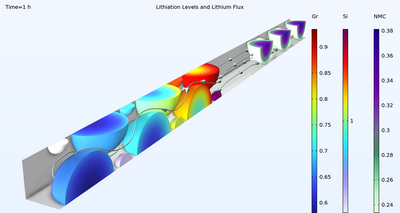
This model describes the behavior of a lithium-ion battery unit cell modeled using an idealized heterogeneous three-dimensional geometry. In contrast to the typical homogenized approach for describing porous electrodes, heterogeneous models define the actual shapes of the electrode ... En savoir plus
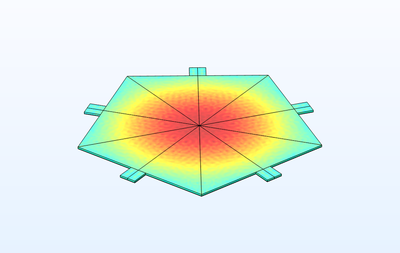
This tutorial demonstrates how an electrical circuit model of a MEMS resonator can be derived using the Parameter Estimation feature. The model is a modified Butterworth-Van Dyke circuit created using the Electrical Circuit interface and represents a Thin-Film Bulk Acoustic Resonator ... En savoir plus


