
La Bibliothèque d'Applications présente des modèles construits avec COMSOL Multiphysics pour la simulation d'une grande variété d'applications, dans les domaines de l'électromagnétisme, de la mécanique des solides, de la mécanique des fluides et de la chimie. Vous pouvez télécharger ces modèles résolus avec leur documentation détaillée, comprenant les instructions de construction pas-à-pas, et vous en servir comme point de départ de votre travail de simulation. Utilisez l'outil de recherche rapide pour trouver les modèles et applications correspondant à votre domaine d'intérêt. Notez que de nombreux exemples présentés ici sont également accessibles via la Bibliothèques d'Applications intégrée au logiciel COMSOL Multiphysics® et disponible à partir du menu Fichier.
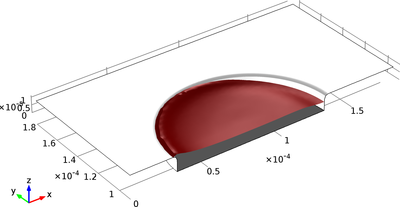
This model simulates the shape evolution of a microconnector bump over time as copper deposits on an electrode surface. Transport of cupric ions in the electrolyte occurs by convection and diffusion. The electrode kinetics are described by a concentration dependent Butler-Volmer ... En savoir plus
Steel pipelines are often subjected to complex stress/strain conditions in the oil and gas industry. Additionally, pipes are subjected to significant longitudinal strain due to soil movement. For the elastoplastic stress simulation, the Solid Mechanics interface is used with the small ... En savoir plus
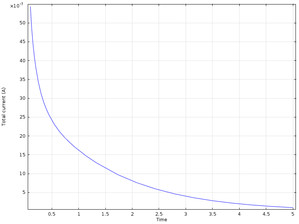
The common electroanalytical method of exhaustive amperometric detection in a microscopic thin layer is modelled as a 1D-symmetric diffusion problem. The simulated result agrees with the analytical Cottrell equation at short times, and deviates as expected at long times when the ... En savoir plus
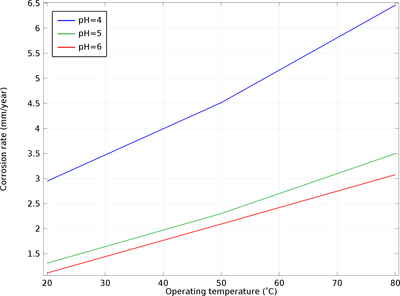
Carbon dioxide in aqueous solution is highly corrosive and can cause significant damage to steel designs. Such conditions arise in pipes used in a variety of applications, especially within the petrochemical industry. In this tutorial example, turbulent flows consisting of carbon ... En savoir plus
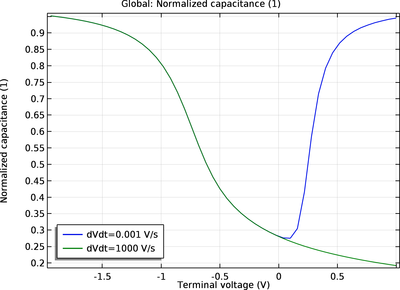
The metal-silicon-oxide (MOS) structure is the fundamental building block for many silicon planar devices. Its capacitance measurements provide a wealth of insight into the working principles of such devices. This tutorial constructs a simple 1D model of a MOS capacitor (MOSCAP). Both ... En savoir plus
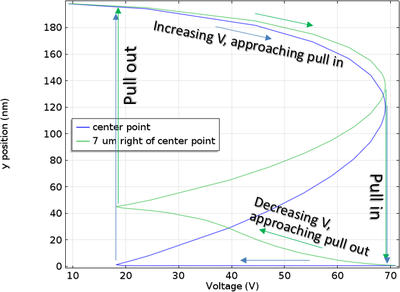
An electrostatically actuated MEMS resonator is simulated. The device is driven by an AC + DC bias voltage applied across a parallel plate capacitor. In this example, the pull-in and pull-out voltages of the resonator are computed. This is done via a quasi-static analysis of the ... En savoir plus
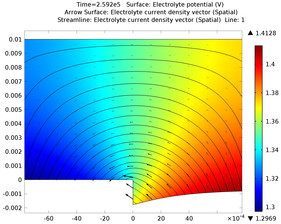
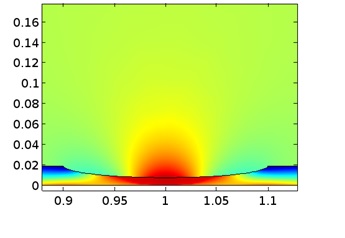
This 2D model demonstrates how to model a galvanic couple in which the corrosion of the anode causes a geometry deformation. The parameter data used is for an Magnesium Alloy (AE44) - mild steel couple in brine solution (salt water). En savoir plus
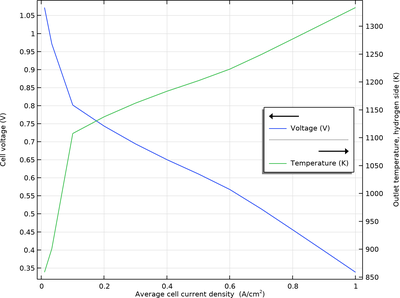
In this model of an ammonia-fed solid oxide fuel cell, the required hydrogen is supplied through endothermic thermal decomposition of ammonia. The model includes the full coupling between the mass balances and gas flow in the H2 and O2 gas diffusion electrodes, the momentum balances in ... En savoir plus
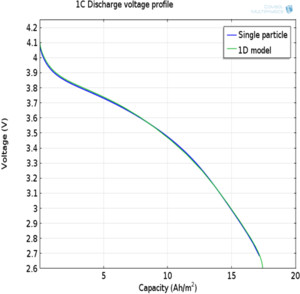
An isothermal single particle model formulation for a lithium-ion battery is presented in this work. The single particle model is a simplification of the 1D formulation for a lithium-ion battery along with a few assumptions. The model is typically valid for low-medium current scenarios. ... En savoir plus
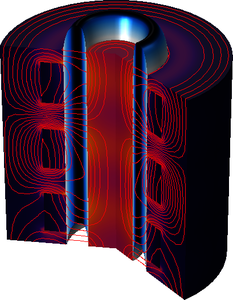
Induction pumps are used in high temperature cooling systems. The principle of operation is equivalent to a linear three phase induction motor. The lack of moving parts and the pumped liquid being kept in a hermetically closed system are clear advantages. This model shows how to simulate ... En savoir plus


