
La Bibliothèque d'Applications présente des modèles construits avec COMSOL Multiphysics pour la simulation d'une grande variété d'applications, dans les domaines de l'électromagnétisme, de la mécanique des solides, de la mécanique des fluides et de la chimie. Vous pouvez télécharger ces modèles résolus avec leur documentation détaillée, comprenant les instructions de construction pas-à-pas, et vous en servir comme point de départ de votre travail de simulation. Utilisez l'outil de recherche rapide pour trouver les modèles et applications correspondant à votre domaine d'intérêt. Notez que de nombreux exemples présentés ici sont également accessibles via la Bibliothèques d'Applications intégrée au logiciel COMSOL Multiphysics® et disponible à partir du menu Fichier.
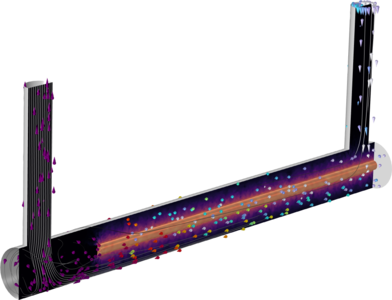
In this example, a simple ultraviolet (UV) water purification reactor is modeled using a combination of ray tracing, computational fluid dynamics, and Lagrangian particle tracking. First, the volumetric fluence rate is accumulated along rays released from the surface of the UV lamp using ... En savoir plus
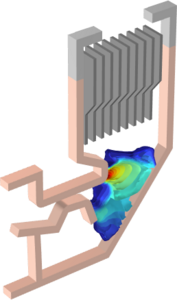
Unwanted electrical arcing poses significant risks to the reliability and safety of electrical and electronic systems. To enhance predictive capabilities and deepen understanding of arc behavior, we present a comprehensive numerical model for simulating transient arc discharge phenomena ... En savoir plus
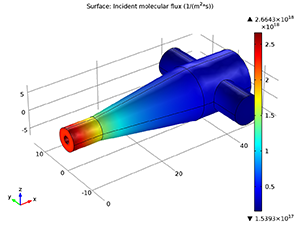
This model computes the transmission probability through an RF coupler using both the angular coefficient method available in the Free Molecular Flow interface and a Monte Carlo method using the Mathematical Particle Tracing interface. The computed transmission probability determined by ... En savoir plus
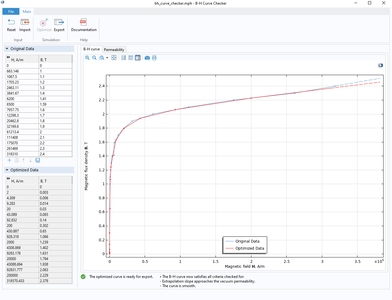
This app demonstrates the following: Importing measured data from a text file Handling measured data using methods Exporting the results to a text file. The app can be used to verify and optimize B–H curves using experimental data. It also generates curve data in the over-fluxed ... En savoir plus

This tutorial model demonstrates how to use the Combined Inductively/DC Discharge interface to simulate the plasma generated in a pulsed arc. This modeling technique is useful for a large range of industrial applications including cutting, welding, spraying, waste destruction, and ... En savoir plus
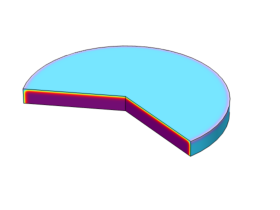
When cooking food, such as a patty, in convection ovens there is a trade off in the heating method. If the patty is heated at a low oven temperature the cooking is slow and the patty dries out, resulting in a poor taste. If the patty is heated rapidly at a high temperature, it is ... En savoir plus
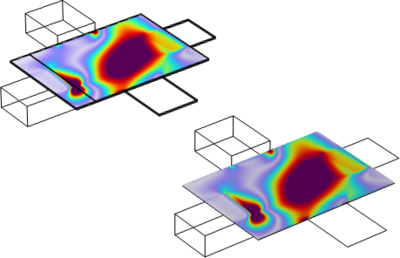
Layered shell elements, which are used for modeling composite shells, often connected to solid and shell elements in a cladding or side-by-side configuration to represent a realistic structure. For such applications, it becomes important to connect layered shell element correctly and ... En savoir plus
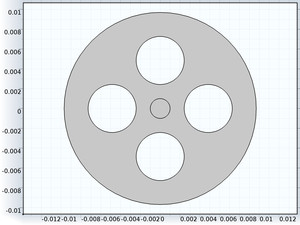
A quadrupole mass filter (QMF) is a key component of a modern mass spectrometer. A QMF uses direct current (DC) and alternating current (AC) electric fields to analyze positive or negative ions by mass to charge ratio. A QMF consists of 4 parallel rods spaced equidistantly, the ratio of ... En savoir plus
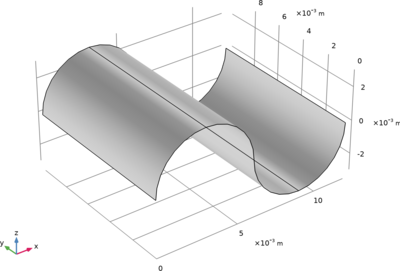
This example presents a homogenized model of a corrugated sheet based on a unit cell approach. The numerically obtained equivalent stiffness matrices are compared with various analytical models. Two corrugation profiles, trapezoidal and round, are considered in this example. En savoir plus
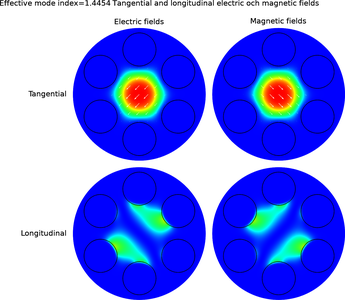
A mode analysis study is used to find the complex effective indices for a microstructured optical fiber (MOF), consisting of air holes in a silica host. As the effective index is smaller than the refractive index of the silica background material, the modes are leaky. The model ... En savoir plus


