
La Bibliothèque d'Applications présente des modèles construits avec COMSOL Multiphysics pour la simulation d'une grande variété d'applications, dans les domaines de l'électromagnétisme, de la mécanique des solides, de la mécanique des fluides et de la chimie. Vous pouvez télécharger ces modèles résolus avec leur documentation détaillée, comprenant les instructions de construction pas-à-pas, et vous en servir comme point de départ de votre travail de simulation. Utilisez l'outil de recherche rapide pour trouver les modèles et applications correspondant à votre domaine d'intérêt. Notez que de nombreux exemples présentés ici sont également accessibles via la Bibliothèques d'Applications intégrée au logiciel COMSOL Multiphysics® et disponible à partir du menu Fichier.
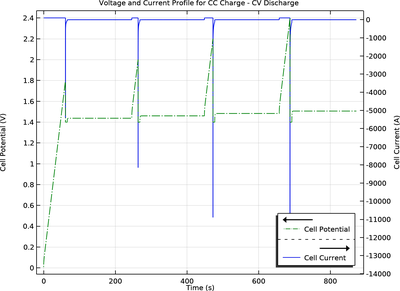
Electrochemical supercapacitors feature relatively higher energy densities than conventional capacitors. With several advantages, such as fast charging, long charge–discharge cycles, and broad operating temperature ranges, electrochemical supercapacitors have found wide applications in ... En savoir plus
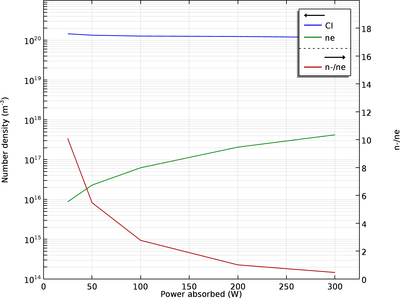
Plasma discharges containing chlorine are commonly used to etch semiconductors and metals in microelectronics fabrication. This tutorial model studies chlorine plasma discharges using a global (volume-averaged) diffusion model. Global diffusion models can run simulations in a fraction ... En savoir plus
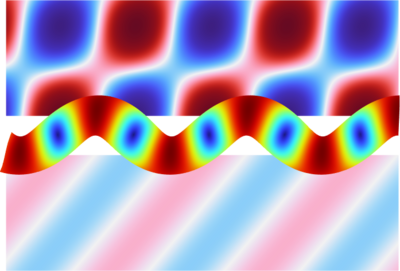
In this model, two fluids are separated by a solid elastic structure. An acoustic pressure wave impacts the structure resulting in a reflected wave and a wave transmitted with a loss through the structure. This model investigates the transmission loss through the structure. The effects ... En savoir plus
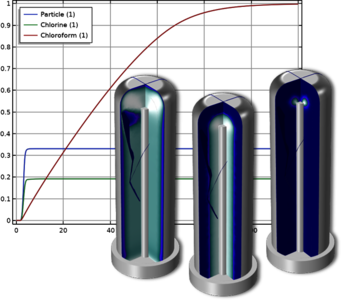
This example illustrates how to model the transport of different contaminants through a ceramic water filter candle with an activated carbon core. These types of water filters can be found in table top gravity filters, as well as attached to the faucet or as part of a larger reverse ... En savoir plus
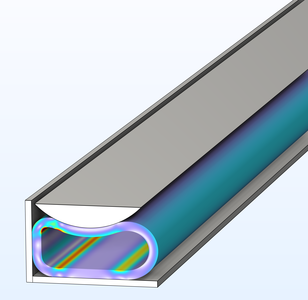
In this model you study the force-deflection relation of a car door seal made from a soft rubber material. The model uses a hyperelastic material model together with formulations that can account for the large deformations and contact conditions. En savoir plus
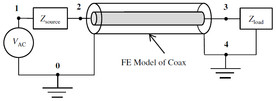
A model built with the RF Module can be connected to an electrical circuit equivalent, if there is some structure outside of the model space that you wish to approximate as a circuit equivalent. In this model, the 3D model of a coaxial cable is connected to a voltage source, in series ... En savoir plus
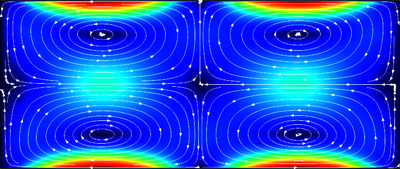
Recent advances in the fabrication of microfluidic systems require handling of live cells and other micro particles as well as mixing. All this can, for example, be achieved using acoustic radiation forces and the viscous drag from the streaming flow. Streaming: Due to the nonlinear ... En savoir plus
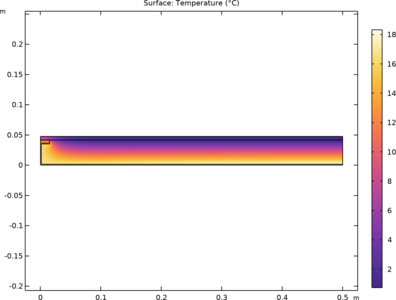
This example studies heat transfer in a composite two-dimensional structure. Four materials with distinct thermal conductivities k compose the structure. The top and bottom boundaries are facing environments respectively at 0°C and 20°C. The temperature distribution and the heat flux ... En savoir plus
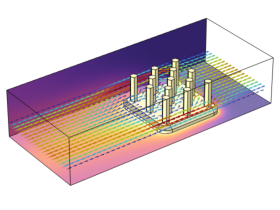
This model is intended as a first introduction to simulations of fluid flow and conjugate heat transfer. It shows you how to: Draw an air box around a device in order to model convective cooling in this box, set a total heat flux on a boundary using automatic area computation, and ... En savoir plus
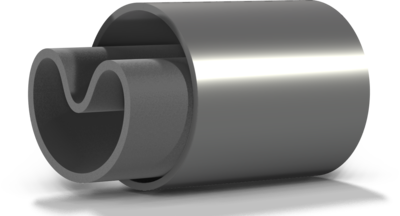
In this example, the Bergstrom–Bischoff material model is used to model the temperature and strain dependent behavior of High Density Polyethylene (HDPE) used, for example, to make liners for damaged pipes in oil and gas applications, or to make type IV hydrogen storage vessels for fuel ... En savoir plus