
La Bibliothèque d'Applications présente des modèles construits avec COMSOL Multiphysics pour la simulation d'une grande variété d'applications, dans les domaines de l'électromagnétisme, de la mécanique des solides, de la mécanique des fluides et de la chimie. Vous pouvez télécharger ces modèles résolus avec leur documentation détaillée, comprenant les instructions de construction pas-à-pas, et vous en servir comme point de départ de votre travail de simulation. Utilisez l'outil de recherche rapide pour trouver les modèles et applications correspondant à votre domaine d'intérêt. Notez que de nombreux exemples présentés ici sont également accessibles via la Bibliothèques d'Applications intégrée au logiciel COMSOL Multiphysics® et disponible à partir du menu Fichier.
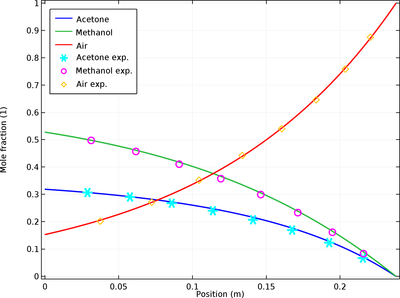
This example illustrates the use of the Maxwell-Stefan diffusion model available with the Transport of Concentrated Species interface. It models multicomponent gas-phase diffusion in a Stefan tube in 1D. In this case, it is a liquid mixture of acetone and methanol that evaporates into ... En savoir plus
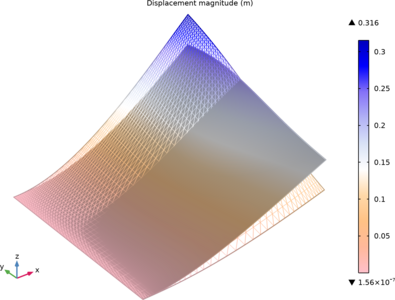
Composite laminates are synthetic structures and there is always a possibility to optimize the design in terms of the number of layers, the material of each layer, the thickness of each layer, and the stacking sequence for the specified loading conditions. Designers need to know how safe ... En savoir plus
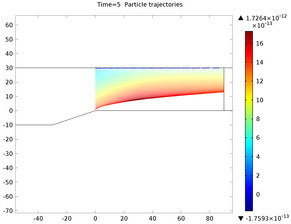
When a temperature gradient in a gas exists, suspended particles will tend to move from regions of high temperature to low. The force which produces this effect is called the thermophoretic force. Gas molecules colliding with a particle from the hot side have a higher velocity than the ... En savoir plus
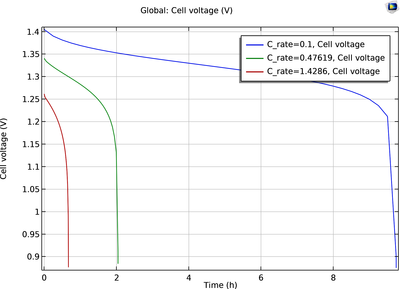
This model reproduces the NiCd battery model and the results presented in De Vidts' and White's paper from 1995. Ref: P. De Vidts, R. E. White, “Mathematical Modeling of a Nickel-Cadmium Cell: Proton Diffusion in the Nickel Electrode”, J. Electrochem. Soc, Vol. 142, No. 5, May 1995. En savoir plus
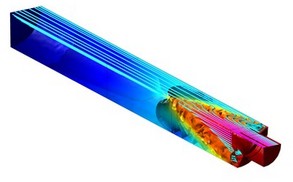
This example models the casting process of a metal rod from liquid to solid state using the Non-Isothermal Flow multiphysics interface, which combines heat transfer and fluid flow. The model describes the fluid and solid flow and heat transport, including the phase transfer from melt to ... En savoir plus
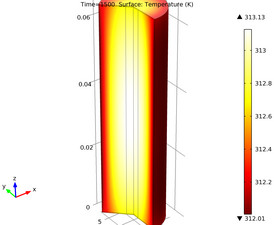
This model example simulates an air-cooled cylindrical 18650 lithium-ion battery during a charge-discharge cycle, followed by a relaxing period. A lumped (0D) cell model is used to model the battery cell chemistry, and a two-dimensional axi-symmetrical model is used to model the ... En savoir plus
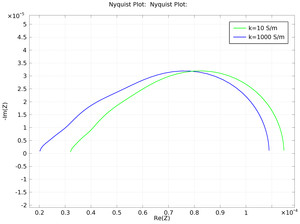
A fuel cell unit cell is modeled using the full Butler-Volmer expression for the anodic and cathodic charge transfer reactions. The anodic and cathodic overpotentials depend on the local ionic and electronic potentials, which are obtained from the charge balance equations for ionic and ... En savoir plus
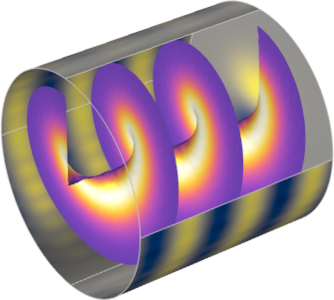
This model simulates Gaussian to Laguerre Gaussian beam shaping with the Beam Envelopes interface, the unidirectional wave formulation. The input beam is a focusing Gaussian beam with a topological spiral phase. It is known that this phase mask converts a Gaussian beam to a donut ... En savoir plus
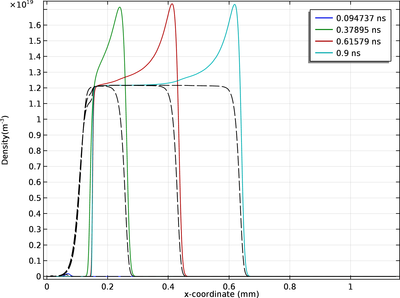
Streamers are transient filamentary electric discharges that can develop in a nonconducting background in the presence of an intense electric field. These discharges can attain high electron number density and consequently a high concentration of chemical active species that are relevant ... En savoir plus
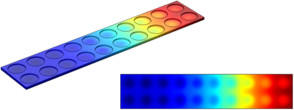
In small PEM fuel cell systems (in the sub-100 W range) no active devices for cooling or air transport are normally used. This is due to the desire to minimize parasitic power losses from pumps and fans, and to reduce the system complexity, size, and cost. The reactants at the cathode ... En savoir plus


