
La Bibliothèque d'Applications présente des modèles construits avec COMSOL Multiphysics pour la simulation d'une grande variété d'applications, dans les domaines de l'électromagnétisme, de la mécanique des solides, de la mécanique des fluides et de la chimie. Vous pouvez télécharger ces modèles résolus avec leur documentation détaillée, comprenant les instructions de construction pas-à-pas, et vous en servir comme point de départ de votre travail de simulation. Utilisez l'outil de recherche rapide pour trouver les modèles et applications correspondant à votre domaine d'intérêt. Notez que de nombreux exemples présentés ici sont également accessibles via la Bibliothèques d'Applications intégrée au logiciel COMSOL Multiphysics® et disponible à partir du menu Fichier.
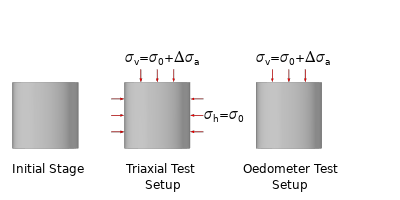
In this example, triaxial and oedometer tests are simulated using the Modified Cam-Clay material model. A nonlinear stress-strain relation is recovered with the constant Poisson's ratio formulation. The hardening and softening behavior is recovered for normally consolidated and highly ... En savoir plus
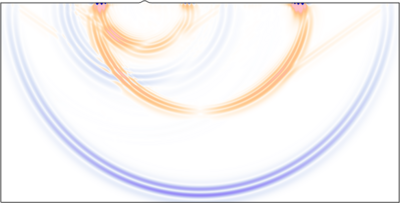
The propagation of elastic waves in the ground after a seismic event is simulated using a 2D model. The effect of the ground surface topology on the wave propagation is illustrated when an ideal half-space is modified with the presence of a small mountain. The model is a variation of ... En savoir plus
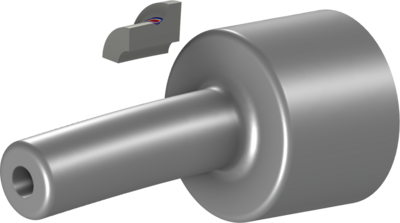
In this tutorial model, it is demonstrated how to incorporate a localized nonlinearity in a submodel. In this case, an initial elastic analysis reveals that a small region of a structure has stresses above the yield limit. To improve the results, an elastoplastic material model is added ... En savoir plus
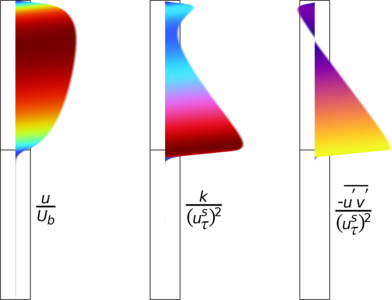
This setup demonstrates how the characteristics of turbulent flow in a channel are modified by the presence of an adjacent porous region. Asymmetric velocity profiles, higher turbulence levels, and higher friction coefficients both at the solid wall and the fluid-porous interface are ... En savoir plus
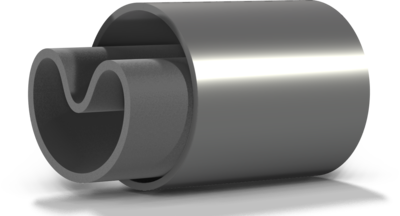
In this example, the Bergstrom–Bischoff material model is used to model the temperature and strain dependent behavior of High Density Polyethylene (HDPE) used, for example, to make liners for damaged pipes in oil and gas applications, or to make type IV hydrogen storage vessels for fuel ... En savoir plus
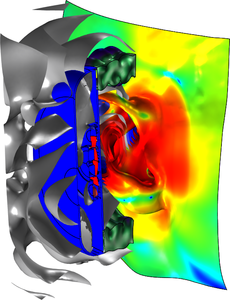
Headphones are closely coupled to the ear, and so it is not possible to measure their sensitivity in a classical acoustic free-field setup used for loudspeakers. The measurement requires the use of artificial heads and ears to accurately represent the usage conditions. This model shows ... En savoir plus
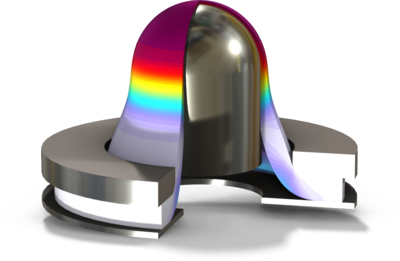
Ultrahigh Molecular Weight (UHMW) Polyethylene is a material commonly employed in knee and hip joint replacements. The “small punch test” is designed to assess mechanical properties using very small samples, such that because of their size they can directly be explanted. This example ... En savoir plus
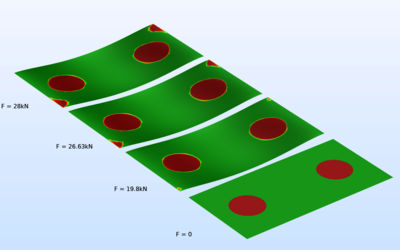
Interfacial failure or delamination in a composite material can be simulated with a cohesive zone model (CZM). A key ingredient of a cohesive zone model is a traction-separation law that describes the softening in the cohesive zone near the delamination tip. This example shows the ... En savoir plus
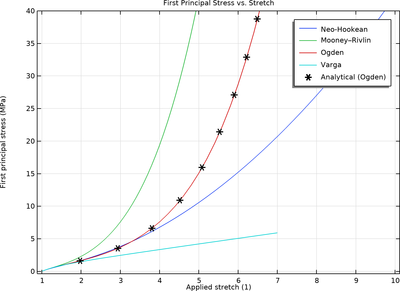
This model demonstrates the inflation of a rubber balloon with four different hyperelastic material models. The results are compared with the analytical solution for a thin-walled, spherical vessel. Controlling the inflation of hyperelastic balloons is important in clinical ... En savoir plus
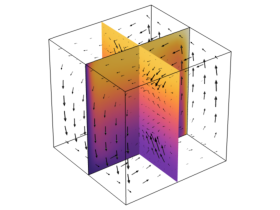
This example studies the stationary state of free convection in a cavity filled with air and bounded by two vertical plates. To generate the buoyancy flow, the plates are heated at different temperatures, set in a range to keep the flow laminar. En savoir plus