
La Bibliothèque d'Applications présente des modèles construits avec COMSOL Multiphysics pour la simulation d'une grande variété d'applications, dans les domaines de l'électromagnétisme, de la mécanique des solides, de la mécanique des fluides et de la chimie. Vous pouvez télécharger ces modèles résolus avec leur documentation détaillée, comprenant les instructions de construction pas-à-pas, et vous en servir comme point de départ de votre travail de simulation. Utilisez l'outil de recherche rapide pour trouver les modèles et applications correspondant à votre domaine d'intérêt. Notez que de nombreux exemples présentés ici sont également accessibles via la Bibliothèques d'Applications intégrée au logiciel COMSOL Multiphysics® et disponible à partir du menu Fichier.
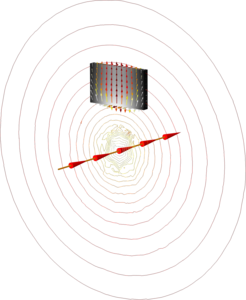
Induced eddy currents and associated thermal loads is of interest in many high power AC applications. This example is of general nature and illustrates some of the involved physics as well as suitable modeling techniques in the AC/DC Module. In this model a metallic plate is placed ... En savoir plus
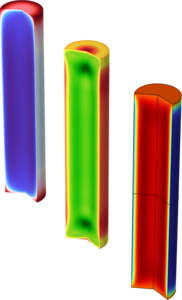
A steel billet is quenched in oil from its austenitic state. A 2D axisymmetric model is used to simulate the coupled problem of austenite decomposition, heat transfer, and solid mechanics. During the quenching process, the austenite decomposes into a combination of ferrite, pearlite, ... En savoir plus
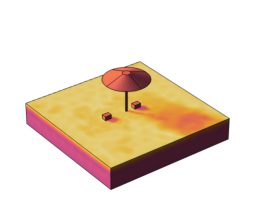
This tutorial model illustrates how to analyze the thermal effects of the sun as an external radiative source and considers wavelength-dependent surface emissivities. Specifically, the model features two coolers containing beverage cans that are exposed to ambient conditions and a beach ... En savoir plus

A cooling flange in a chemical process is used to cool the process fluid, which flows through the flange. The surrounding air cools the flange via natural convection. In the stationary model, the forced convection to the process fluid is modeled using a constant heat transfer ... En savoir plus
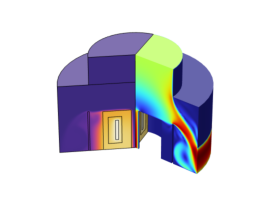
The inductor is a common component in a variety of electrical devices. Its applications include power transformation and measurements, and it can also be used together with capacitors to create oscillators. In small devices with many components, such as in laptops, heat generation can ... En savoir plus
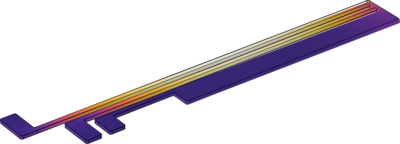
This tutorial model of a two-hot-arm thermal actuator couples three different physics phenomena: electric current conduction, heat conduction with heat generation, and structural stresses and strains due to thermal expansion. The model exists in three versions: Joule Heating of a ... En savoir plus
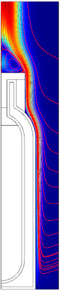
The following example solves a pure conduction and a free-convection problem in which a vacuum flask holding hot coffee dissipates thermal energy. The main interest is to calculate the flask's cooling power; that is, how much heat it loses per unit time. This tutorial model treats the ... En savoir plus
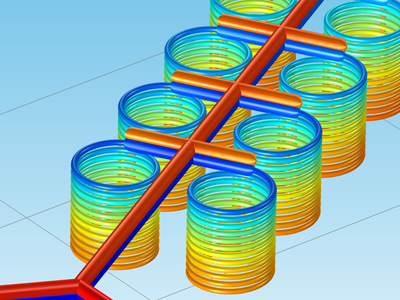
Ponds and lakes can serve as thermal reservoirs in geothermal heating applications. In this example, fluid circulates underwater through polyethylene piping in a closed system. The pipes are coiled in a slinky shape and grouped onto sleds. The Non-isothermal Pipe Flow interface sets up ... En savoir plus
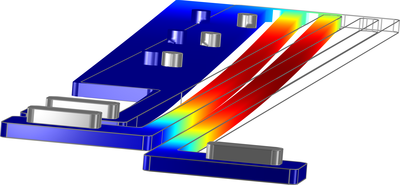
This example model consists of a two-hot-arm thermal actuator made of polysilicon. The actuator is activated through thermal expansion. The temperature increase required to deform the two hot arms, and thus displace the actuator, is obtained through Joule heating (resistive heating). The ... En savoir plus
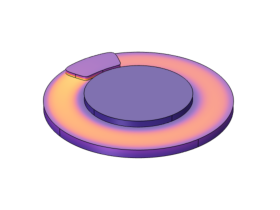
This example models the transient heating, and final temperature, of a disc brake of a car in brake-and-release sequence. It is important to model the transient heating and the following convective cooling to determine the minimum interval between a series of similar brake engagements. ... En savoir plus