
La Bibliothèque d'Applications présente des modèles construits avec COMSOL Multiphysics pour la simulation d'une grande variété d'applications, dans les domaines de l'électromagnétisme, de la mécanique des solides, de la mécanique des fluides et de la chimie. Vous pouvez télécharger ces modèles résolus avec leur documentation détaillée, comprenant les instructions de construction pas-à-pas, et vous en servir comme point de départ de votre travail de simulation. Utilisez l'outil de recherche rapide pour trouver les modèles et applications correspondant à votre domaine d'intérêt. Notez que de nombreux exemples présentés ici sont également accessibles via la Bibliothèques d'Applications intégrée au logiciel COMSOL Multiphysics® et disponible à partir du menu Fichier.
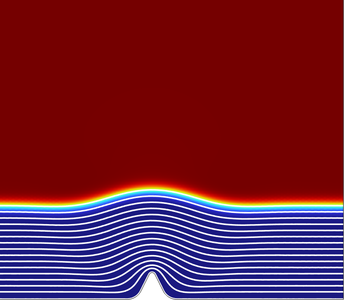
This example demonstrates how to couple the Lithium-ion Battery interface to the Phase Field interface for modeling electrode deformations. The example is based on the Lithium Plating with Deformation model, available in the Battery Design Module Application Library. As current is ... En savoir plus
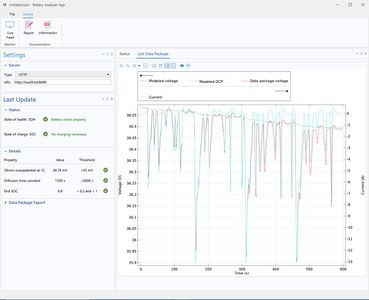
These two apps can be run to set up a digital twin of an electric scooter battery. The Digital Twin Simulator of an Electric Scooter Battery (the "simulator" app) simulates the use of an electric scooter and generates battery current and voltage data over time. The Digital Twin ... En savoir plus
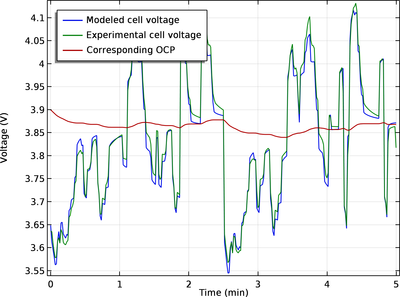
This tutorial uses a “black-box” approach to define a battery model based on a small set of lumped parameters, assuming no knowledge of the internal structure or design of the battery electrodes, or choice of materials. The input to the model is the battery capacity, the initial state ... En savoir plus
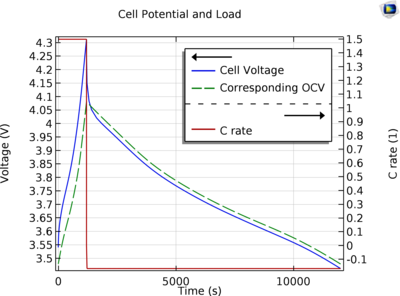
This app can be used as a design tool to develop an optimized battery configuration for a specific application. The application computes the capacity, energy efficiency, heat generation, and capacity losses due to parasitic reactions of a battery for a specific load cycle. Various ... En savoir plus
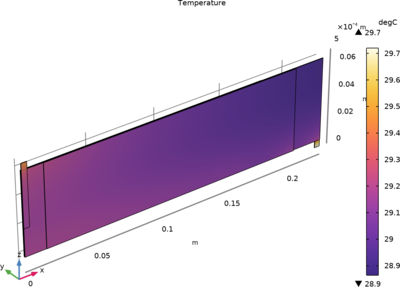
This example replicates the results of the Jelly Roll tutorial example using a flattened representation of the wound spiral-based geometry. See that model entry for details on the background, original geometry, materials, and the general physics setup. Mapping the original problem to a ... En savoir plus
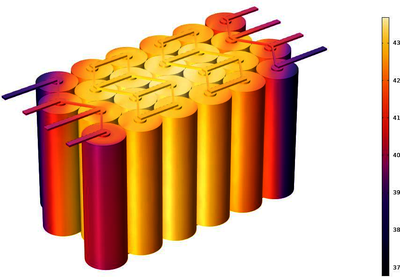
This app demonstrates the following: Dynamic help system using card stacks Multiple components (1D and 3D) in a single app Toggle buttons in the ribbon for showing different input, hiding/showing geometry selections, and for dynamic help Geometry parts and parameterized geometries ... En savoir plus
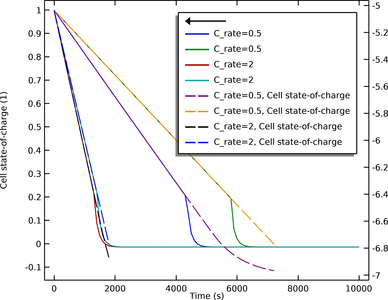
This tutorial demonstrates how to integrate multiple Lumped Battery models into the Electrical Circuit interface. Two batteries are connected in series. Each battery is protected by a shunt resistances that is activated if the battery state-of-charge reaches below a certain threshold ... En savoir plus
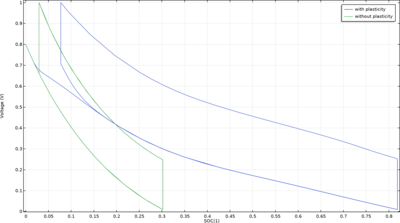
This example shows how to model Lithium diffusion in a silicon electrode that swells. The model shows how swelling-induced plastic deformation can increase the maximum state of charge (SOC). En savoir plus
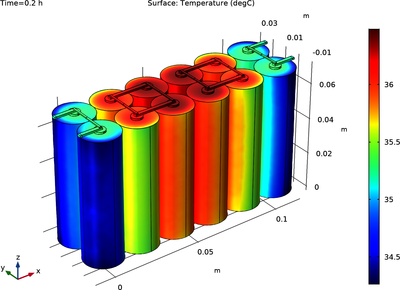
This example demonstrates how to model the temperature distribution in a battery pack during a 4C discharge. The pack is constructed by first coupling two cylindrical batteries in parallel. Six parallel-connected pairs are then connected in series to create the full pack. (This is also ... En savoir plus
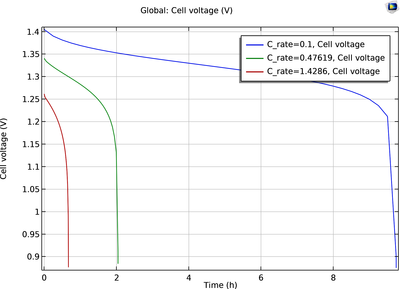
This model reproduces the NiCd battery model and the results presented in De Vidts' and White's paper from 1995. Ref: P. De Vidts, R. E. White, “Mathematical Modeling of a Nickel-Cadmium Cell: Proton Diffusion in the Nickel Electrode”, J. Electrochem. Soc, Vol. 142, No. 5, May 1995. En savoir plus


