
La Bibliothèque d'Applications présente des modèles construits avec COMSOL Multiphysics pour la simulation d'une grande variété d'applications, dans les domaines de l'électromagnétisme, de la mécanique des solides, de la mécanique des fluides et de la chimie. Vous pouvez télécharger ces modèles résolus avec leur documentation détaillée, comprenant les instructions de construction pas-à-pas, et vous en servir comme point de départ de votre travail de simulation. Utilisez l'outil de recherche rapide pour trouver les modèles et applications correspondant à votre domaine d'intérêt. Notez que de nombreux exemples présentés ici sont également accessibles via la Bibliothèques d'Applications intégrée au logiciel COMSOL Multiphysics® et disponible à partir du menu Fichier.
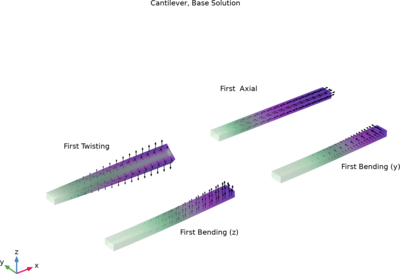
This example explores the shift in natural frequencies caused by changing the temperature. One study investigates a doubly clamped beam where both ends are fixed, while the other study looks at a cantilever beam where only one end is fixed. The following effects are studied: Stress ... En savoir plus
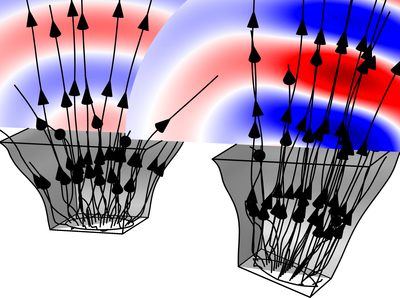
This model demonstrates how to use the Control Function feature to perform shape optimization on a rectangular horn for an improved on axis response. The results of the initial design are exported to a new component via a Filter dataset. Further, the off-axis spatial response is improved ... En savoir plus
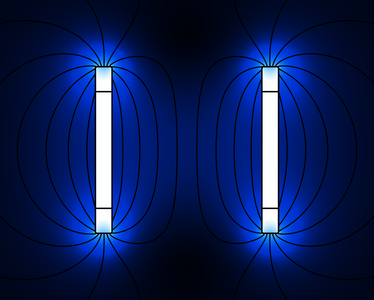
In this set of verification models and associated documentation, the accuracy of electromagnetic force calculations is investigated. Using various techniques, the total force and torque on a rigid body is determined and compared to analytical models. Using fillets, advanced meshing and ... En savoir plus

This example investigates the electrical performance of a cascaded cavity filter operating in the millimeter-wave 5G band with temperature changes. The thermal variations result in structural deformations of the structure. Thus, the resonant frequencies of the filter elements (cavities) ... En savoir plus
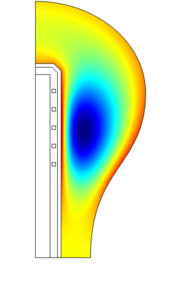
This model simulates an electrodeless lamp with argon/mercury chemistry. The low excitation threshold for mercury atoms means that even though the mercury is present in small concentrations, its behavior dominates. There is strong UV emission from the plasma at 185 nm and 253 nm. The UV ... En savoir plus
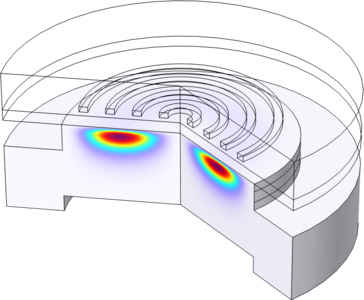
This tutorial model solves for an inductively coupled plasma reactor in a mixture of CF4/O2. The plasma transport, magnetic fields, fluid flow, and heat transfer are solved for fully self-consistently. The oxygen mole fraction of the reactor feed is parameterized. En savoir plus
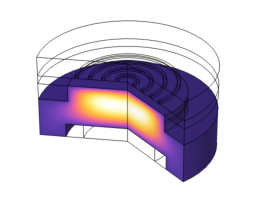
This tutorial model solves for an inductively coupled plasma reactor with RF bias (also known as ICP/CCP reactors) in a mixture of argon/chlorine. The model computes the fluid flow and gas heating. Important aspects and strategies for modeling electronegative discharges are discussed. En savoir plus
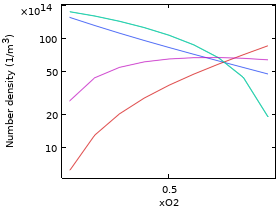
This tutorial model solves for an inductively coupled plasma reactor in a mixture of argon/oxygen. The model computes the fluid flow and gas heating. Important aspects and strategies for modeling electronegative discharges are discussed. En savoir plus
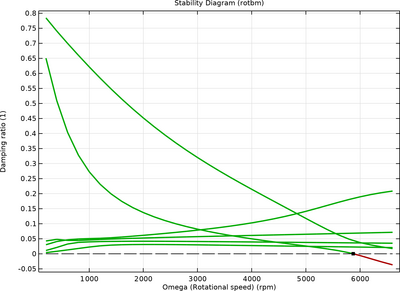
In this tutorial model, you will see how to set up an eigenfrequency analysis of a rotor with multiple disks and bearings. The example illustrates how to use Campbell and stability diagrams to identify the critical speeds and the stability threshold. The rotor is modeled using the Beam ... En savoir plus
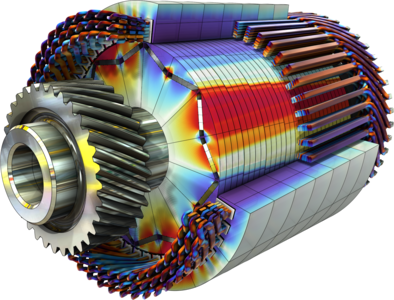
This series of models demonstrates how to do advanced electric machine modeling with COMSOL Multiphysics® — in 2D, 2.5D, and full 3D with end effects included. It investigates the performance of a Permanent Magnet Synchronous Motor, as is often used in modern electric vehicles. ... En savoir plus


