
La Bibliothèque d'Applications présente des modèles construits avec COMSOL Multiphysics pour la simulation d'une grande variété d'applications, dans les domaines de l'électromagnétisme, de la mécanique des solides, de la mécanique des fluides et de la chimie. Vous pouvez télécharger ces modèles résolus avec leur documentation détaillée, comprenant les instructions de construction pas-à-pas, et vous en servir comme point de départ de votre travail de simulation. Utilisez l'outil de recherche rapide pour trouver les modèles et applications correspondant à votre domaine d'intérêt. Notez que de nombreux exemples présentés ici sont également accessibles via la Bibliothèques d'Applications intégrée au logiciel COMSOL Multiphysics® et disponible à partir du menu Fichier.
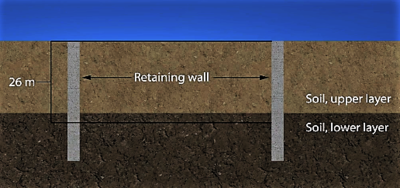
This example shows how to model a deep excavation. The main application area of this type of modeling is in civil engineering. In this case, the in situ lateral pressure acting on the retaining wall during the soil excavation is modeled with boundary loads. The soil assumes Drucker ... En savoir plus
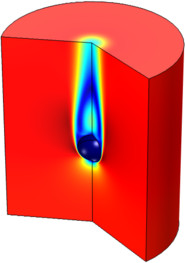
The first stop for polluted water entering a water work is normally a large tank, where large particles are left to settle. Generally, gravity settling is an economical method of separating particles. If the fluid in the tank is moving at a controlled low velocity, the particles can be ... En savoir plus
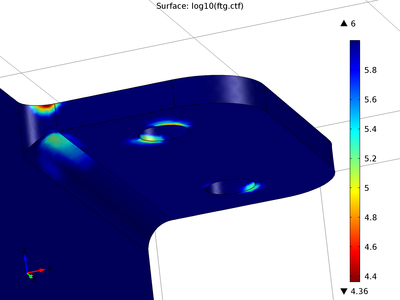
The S–N curve, also called the Wöhler curve, is one of the most popular methods for fatigue evaluation. The curve relates stress amplitude to the limiting fatigue life and can be obtained directly from a set of standard fatigue test. Many times our applications are subjected to ... En savoir plus
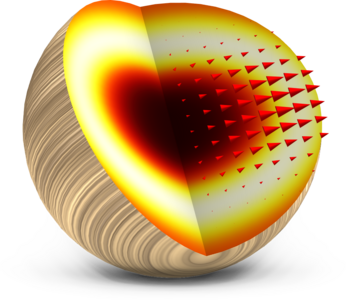
The pyrolysis of a centimeter-sized wood particle presents a fully coupled multiphysics problem with mass transfer, fluid flow, and heat transfer. This example model consists of two parts. The first part demonstrates how to set up a model describing the pyrolysis of a porous, ... En savoir plus
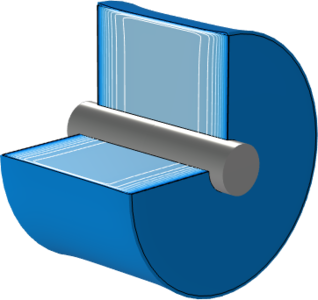
This example demonstrates how to model moisture transfer and induced swelling in a paperboard roll subject to varying ambient conditions. The material properties of the paperboard are anisotropic. En savoir plus
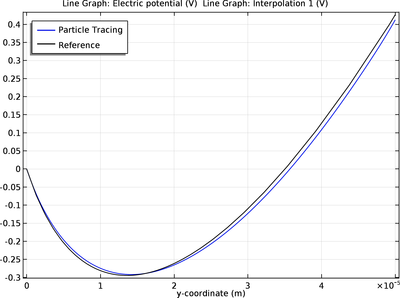
When electrons are emitted from a heated cathode in a plane parallel vacuum diode, they contribute to the space charge density in the diode, which in turn affects the electric potential distribution. If the potential difference between the cathode and the anode is not sufficiently large, ... En savoir plus
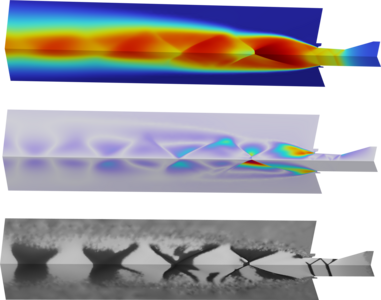
In this example, the High Mach Number Flow, Low Reynolds Number k-e interface is used to compute the compressible turbulent flow from a rectangular nozzle. Mesh refinement based on the estimation of the shock strength and the shear-layer strength is employed to achieve appropriate ... En savoir plus
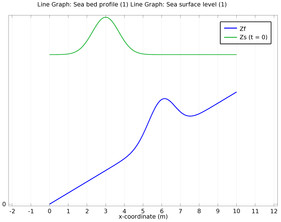
The Shallow Water equations are frequently used for modeling both oceanographic and atmospheric fluid flow. Models of such systems lead to the prediction of areas eventually affected by pollution, coast erosion and polar ice-cap melting. Comprehensive modeling of such phenomena using ... En savoir plus
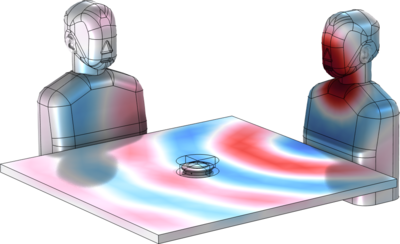
This tutorial model shows a virtual test setup of a conference speaker. The speaker system consists of a loudspeaker as well as three microphones. The model instigates the loudspeaker sound radiation, feedback, as well as the ability of the system to detect sound (speech) emitted from a ... En savoir plus
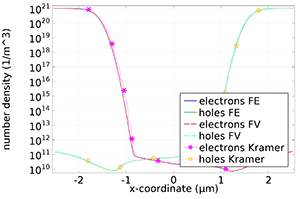
This simple benchmark model computes the potential and carrier concentrations for a one-dimensional p-n junction using both the finite element and finite volume methods. The results are compared with an equivalent device from the book, "Semiconductor Devices: A Simulation Approach," by ... En savoir plus


