
La Bibliothèque d'Applications présente des modèles construits avec COMSOL Multiphysics pour la simulation d'une grande variété d'applications, dans les domaines de l'électromagnétisme, de la mécanique des solides, de la mécanique des fluides et de la chimie. Vous pouvez télécharger ces modèles résolus avec leur documentation détaillée, comprenant les instructions de construction pas-à-pas, et vous en servir comme point de départ de votre travail de simulation. Utilisez l'outil de recherche rapide pour trouver les modèles et applications correspondant à votre domaine d'intérêt. Notez que de nombreux exemples présentés ici sont également accessibles via la Bibliothèques d'Applications intégrée au logiciel COMSOL Multiphysics® et disponible à partir du menu Fichier.

This tutorial demonstrates how to compute the periodic steady-state solution of a nonlinear model problem using an optimization solver. The solver modifies the initial conditions at the beginning of a period to match the solution at the end of the period. The model solves much faster ... En savoir plus
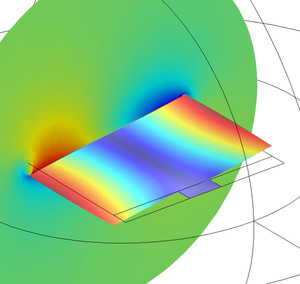
Micromirrors are used in certain MEMS devices to control optic elements. This model of a vibrating micromirror surrounded by air uses the Thermoacoustic-Shell Interaction user interface to model the fluid-solid interaction, and it thus includes the correct viscous and thermal damping of ... En savoir plus
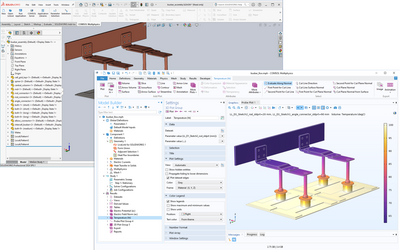
This tutorial model of the Joule heating effect in a busbar demonstrates how to synchronize an assembly between the SOLIDWORKS® software and the COMSOL Multiphysics® software, how to modify the geometry from COMSOL Multiphysics®, and how to run a geometric ... En savoir plus
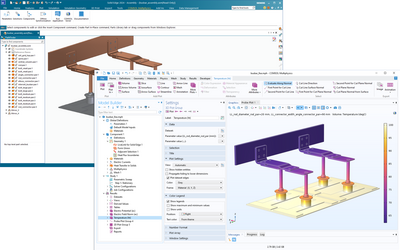
This tutorial model of the Joule heating effect in a busbar demonstrates how to synchronize an assembly between the Solid Edge® software and the COMSOL Multiphysics® software, how to modify the geometry from COMSOL Multiphysics®, and how to run a geometric ... En savoir plus
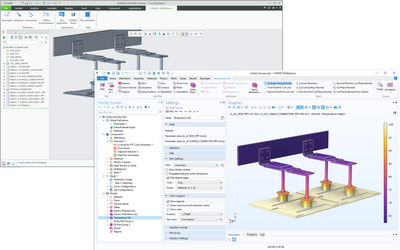
This tutorial model of the Joule heating effect in a busbar demonstrates how to synchronize an assembly between the PTC Creo Parametric™ software and the COMSOL Multiphysics® software, how to modify the geometry from COMSOL Multiphysics®, and how to run a ... En savoir plus
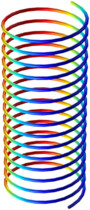
This model computes the trajectory of an ion in a uniform magnetic field using the Newtonian, Lagrangian and Hamiltonian formulations available in the Mathematical Particle Tracing interface. En savoir plus
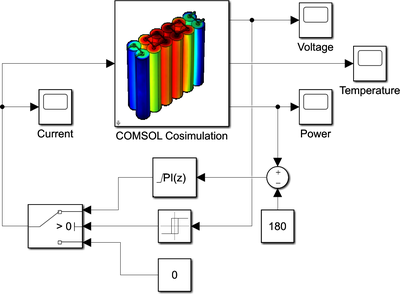
This model computes the temperature distribution in a battery pack that is in use at a specified power. The current is controlled in Simulink® to ensure constant power during usage. En savoir plus
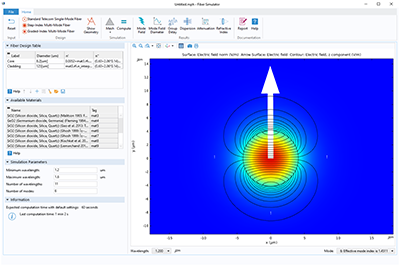
The transmission speed of optical waveguides is superior to microwave waveguides because optical devices have a much higher operating frequency than microwaves, enabling a far higher bandwidth. Single-mode step-index fibers are used for long-haul (even transoceanic) communication, ... En savoir plus
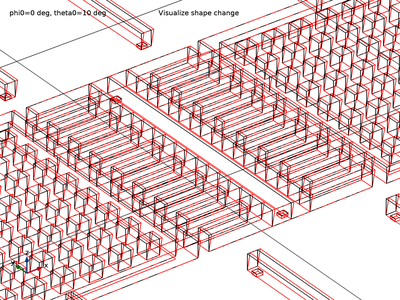
This tutorial example is kindly provided by Dr. James Ransley at Veryst Engineering, LLC. This model continues from the base model “A Micromachined Comb-Drive Tuning Fork Rate Gyroscope”, which is also provided by Dr. Ransley. The model demonstrates how to accurately compute the effects ... En savoir plus
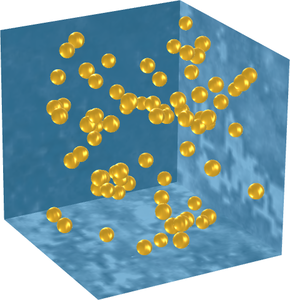
Recovery of precious metals in recycling of electronics, or extraction from ore, is usually performed through leaching of the metal into an aqueous phase. Precious metals require the use of an oxidant, and often, a complexant. In the case of gold, the cyanide anion (CN-) forms a soluble ... En savoir plus


