
La Bibliothèque d'Applications présente des modèles construits avec COMSOL Multiphysics pour la simulation d'une grande variété d'applications, dans les domaines de l'électromagnétisme, de la mécanique des solides, de la mécanique des fluides et de la chimie. Vous pouvez télécharger ces modèles résolus avec leur documentation détaillée, comprenant les instructions de construction pas-à-pas, et vous en servir comme point de départ de votre travail de simulation. Utilisez l'outil de recherche rapide pour trouver les modèles et applications correspondant à votre domaine d'intérêt. Notez que de nombreux exemples présentés ici sont également accessibles via la Bibliothèques d'Applications intégrée au logiciel COMSOL Multiphysics® et disponible à partir du menu Fichier.
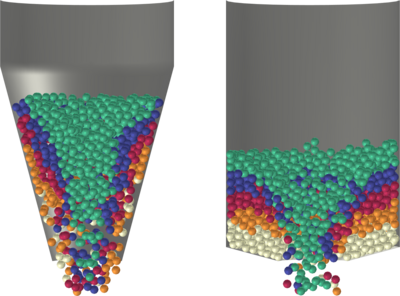
This model demonstrates the effect of the hopper design on the resulting flow patterns of the grains exiting the hopper. The flow changes from mass flow to funnel flow when the conical angle of the hopper is increased. En savoir plus
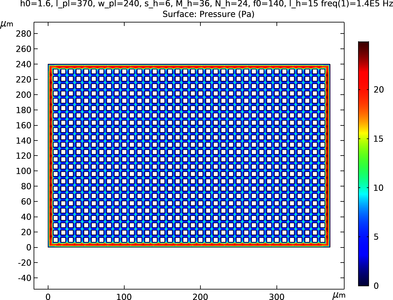
This benchmark model compares the damping coefficients of perforated plates from computation results versus experimental data. The simulation includes 18 different geometric configurations. It uses the Bao's perforation model, which is built-in in the Thin Film Flow physics interface. ... En savoir plus
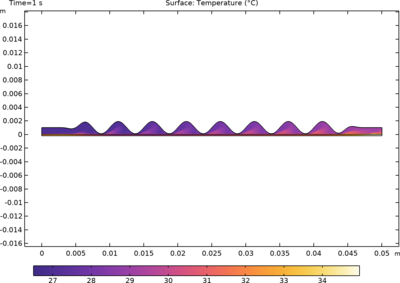
The heat exchanger in this tutorial model contains a dynamic wall with an oscillating wave shape. The deformation induces mixing in the fluid and reduces the formation of thermal boundary layers. Hence, it increases heat transfer between the walls and the fluid. In addition, the wave ... En savoir plus
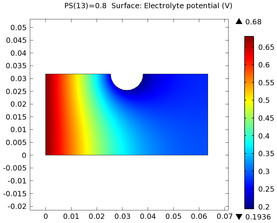
This example models cathodic protection of a steel reinforcing bar in concrete. Three different electrochemical reactions are considered on the steel surface. Charge and oxygen transport are modeled in the concrete domain, where the electrolyte conductivity and oxygen diffusivity depend ... En savoir plus
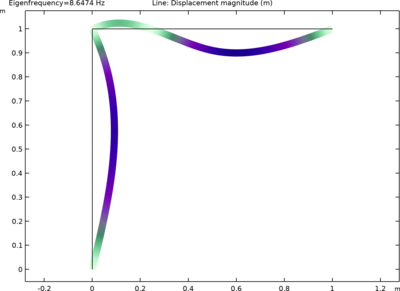
In this model, you build and solve a 2D beam model using the 2D Structural Mechanics Beam interface. This model describes the eigenfrequency analysis of a simple geometry. A point mass and point mass moment of inertia are used in the model. The two first eigenfrequencies are compared ... En savoir plus
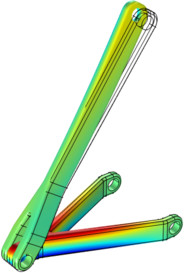
A hinge between two mechanical components is modeled by coupling two rigid connectors. This method can be used for simulating many types of mechanisms. In mechanical assemblies, parts are sometimes connected so that they are free to move relative to each other in one or more degrees of ... En savoir plus
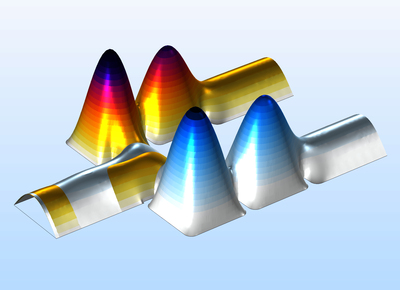
A diplexer is a device that combines or splits signals into two different frequency bands, widely used in mobile communication systems. This model simulates splitting properties using a simplified 2D geometry. The computed S-parameters and electric fields at the lower and upper bands ... En savoir plus
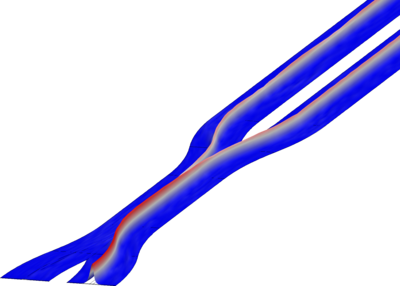
A Mach-Zehnder modulator is used for controlling the amplitude of an optical wave. The input waveguide is split up into two waveguide interferometer arms. If a voltage is applied across one of the arms, a phase shift is induced for the wave passing through that arm. When the two arms are ... En savoir plus
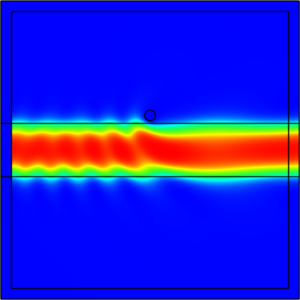
This model includes a dielectric slab waveguide with a small lossy metallic object nearby. The object causes light to be scattered, absorbed, and both reflected and transmitted along the waveguide. Learn more in this accompanying blog post: Modeling a Scatterer Near an Optical Waveguide En savoir plus
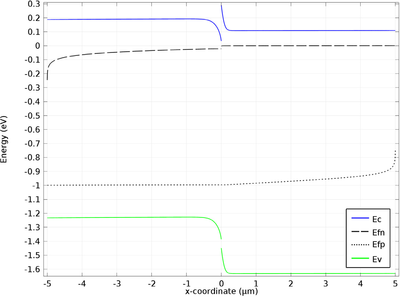
This benchmark model simulates three different heterojunction configurations under forward and reverse bias. It shows the difference in using the continuous quasi-Fermi level formulation versus the thermionic emission formulation for the charge transfer across the heterojunction. The ... En savoir plus


