
La Bibliothèque d'Applications présente des modèles construits avec COMSOL Multiphysics pour la simulation d'une grande variété d'applications, dans les domaines de l'électromagnétisme, de la mécanique des solides, de la mécanique des fluides et de la chimie. Vous pouvez télécharger ces modèles résolus avec leur documentation détaillée, comprenant les instructions de construction pas-à-pas, et vous en servir comme point de départ de votre travail de simulation. Utilisez l'outil de recherche rapide pour trouver les modèles et applications correspondant à votre domaine d'intérêt. Notez que de nombreux exemples présentés ici sont également accessibles via la Bibliothèques d'Applications intégrée au logiciel COMSOL Multiphysics® et disponible à partir du menu Fichier.
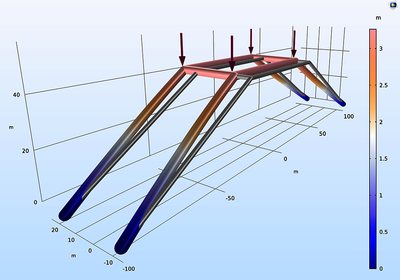
This model illustrates the instability of a space arc frame under concentrated vertical loading. The Beam interface is utilized. Two different approaches are used: A full incremental nonlinear analysis, where a small lateral load is applied to break the symmetry of the structure A ... En savoir plus
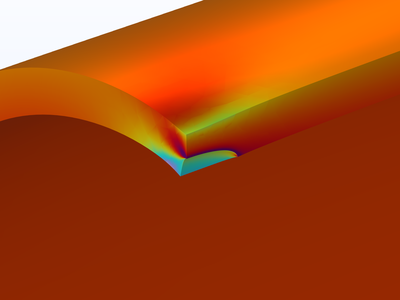
In this benchmark example, a semi-elliptical crack at the inner surface of a cylinder is studied. The inside of the cylinder and the crack faces are subjected to a pressure load. The J-integral is calculated along the crack front, and the stress intensity factor is then compared with the ... En savoir plus

Light pipes are structures that can be used to transport light between different locations. In general, they can be divided into two major groups: tubes lined with a reflective coating and transparent solids that contain light via total internal reflection. In this tutorial, light is ... En savoir plus
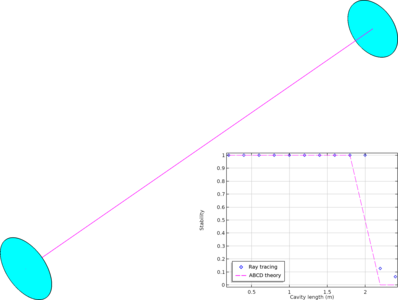
In this model, two concave mirrors are placed at a distance and a ray is released from a point inside the cavity. Then the ray is traced for a predefined time period that is sufficiently long. Ray tracing continues until the predefined computation time has passed if the laser cavity is ... En savoir plus
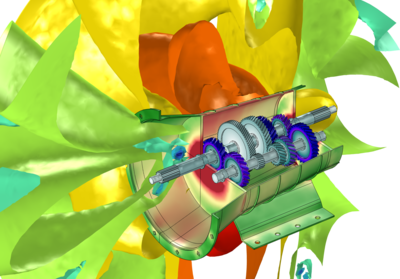
This example illustrates the modeling of vibration and noise in a 5-speed synchromesh gearbox of a manual transmission vehicle. A transient multibody analysis is performed to compute the gearbox vibration for the specified engine speed and external load. The normal acceleration of the ... En savoir plus
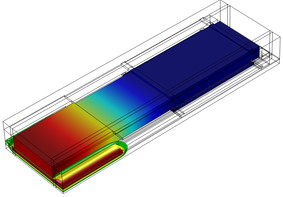
An electrostatically actuated MEMS resonator is simulated in the time and frequency domains. The device is driven by an AC + DC bias voltage applied across a parallel plate capacitor. The dependence of the resonant frequency on DC bias is assessed, and frequency domain and transient ... En savoir plus
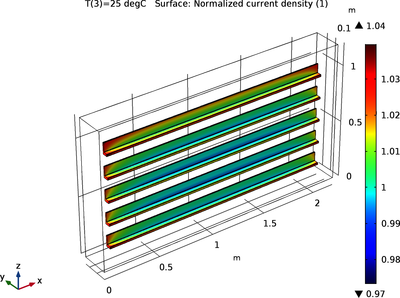
When anodizing aluminum, the surface is electrochemically altered to form an abrasive and corrosion-resistive Al2O3 film. The electrode kinetics during the process are only marginally affected as the oxide layer grows, so a stationary analysis of the current distribution is sufficient to ... En savoir plus
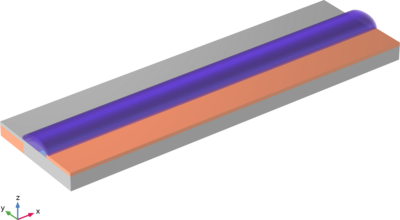
This model demonstrates the simulation of surface dielectric barrier discharges (DBDs) using the Electric Discharge interface. The formulation incorporates a comprehensive set of physical processes, including charge transport, impact ionization, electron attachment, recombination, and ... En savoir plus
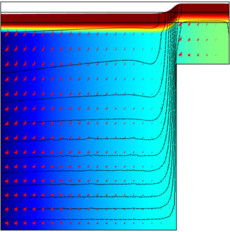
The Poroelasticity interface couples Darcy's law and solid mechanics to assess deformation of porous media that results from fluid withdrawals. The model builds on top of the Terzaghi Compaction example. Results from Terzaghi compaction and Biot poroelasticity analyses are compared to ... En savoir plus

The Schmidt-Cassegrain Telescope demonstrated in this tutorial is a classic design using an aspheric corrector lens and two spherical mirrors. The aspheric corrector is created using the 'Aspheric Even Lens 3D' part from the Ray Optics part library. En savoir plus


