
La Bibliothèque d'Applications présente des modèles construits avec COMSOL Multiphysics pour la simulation d'une grande variété d'applications, dans les domaines de l'électromagnétisme, de la mécanique des solides, de la mécanique des fluides et de la chimie. Vous pouvez télécharger ces modèles résolus avec leur documentation détaillée, comprenant les instructions de construction pas-à-pas, et vous en servir comme point de départ de votre travail de simulation. Utilisez l'outil de recherche rapide pour trouver les modèles et applications correspondant à votre domaine d'intérêt. Notez que de nombreux exemples présentés ici sont également accessibles via la Bibliothèques d'Applications intégrée au logiciel COMSOL Multiphysics® et disponible à partir du menu Fichier.
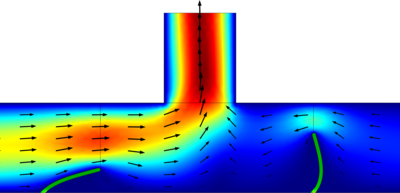
Micropumps are key components of microfluidic systems with applications ranging from biological fluid handling to microelectronic cooling. This model simulates the mechanism of a valveless micropump, that is designed to be effective at low Reynolds numbers, overcoming hydrodynamic ... En savoir plus
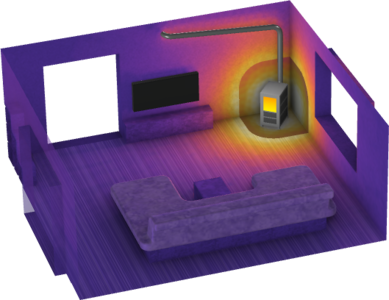
This model represents a stove in a living room. A radiation study is performed with the Surface-to-Surface Radiation physics interface. It shows the intensity of the stove radiation received on different surfaces of the room. En savoir plus
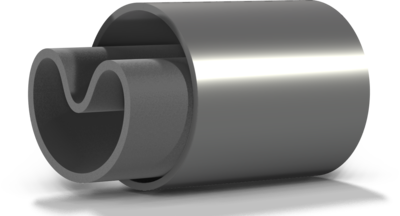
In this example, the Bergstrom–Bischoff material model is used to model the temperature and strain dependent behavior of High Density Polyethylene (HDPE) used, for example, to make liners for damaged pipes in oil and gas applications, or to make type IV hydrogen storage vessels for fuel ... En savoir plus
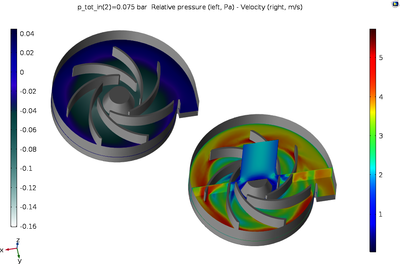
Centrifugal pumps are used in various applications and can be found in many industries. The size of the pump in this model is typical for automotive applications. This model shows how to set up rotating machinery simulations using the frozen rotor approximation for modeling centrifugal ... En savoir plus
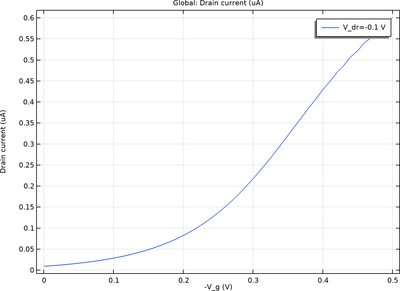
This model shows how to model an electrolyte-gated organic field-effect transistor based on a general drift–diffusion model. The model uses the Transport of Charge Carriers interface and the Electrostatics interface. The transistor characteristics are visualized. Formation of the EDLs in ... En savoir plus
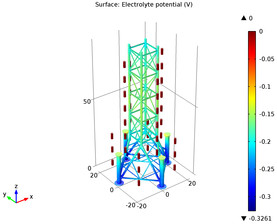
Steel structures immersed in seawater can be protected from corrosion through cathodic protection. This protection can be achieved by an impressed external current or by using sacrificial anodes. The use of sacrificial anodes is often preferred due to its simplicity. This example models ... En savoir plus
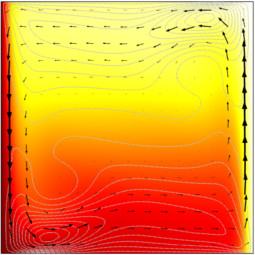
This model couples the Navier Stokes equations and the heat transfer equations to examine density driven flow of free fluids. Here the fluid is in a square cavity with a heated wall. The buoyancy force is a Boussinesq term added to the Navier-Stokes equations. The equation is ... En savoir plus
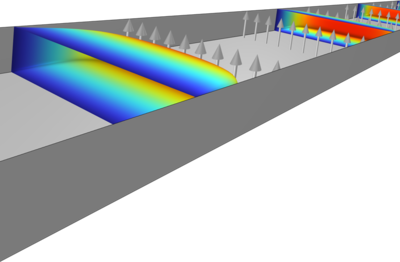
In nuclear fusion reactors, the conducting fluid, such as the fusion plasma and the liquid metal in the reactor blanket, will interact with the background magnetic field. This phenomenon is referred to as magnetohydrodynamics (MHD). The electromagnetic field and fluid flow are fully ... En savoir plus

In this time-dependent model, a silica block of glass, coated with a thin copper layer is subjected to a heat flux. Copper is a highly conductive material, while the silica glass is of poor thermal conductivity, which sets up an highly-varied temperature differential. The model must ... En savoir plus
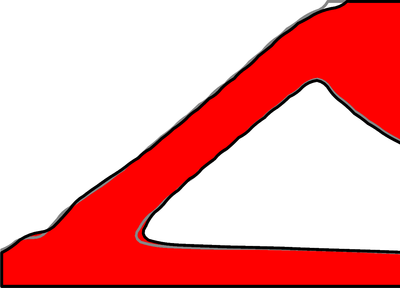
This model demonstrates how the Free Shape Boundary feature can be used to perform shape optimization on a design found with topology optimization. The model uses the same objective and constraint as the original, which results in a slightly higher stiffness for the same mass. En savoir plus


