
La Bibliothèque d'Applications présente des modèles construits avec COMSOL Multiphysics pour la simulation d'une grande variété d'applications, dans les domaines de l'électromagnétisme, de la mécanique des solides, de la mécanique des fluides et de la chimie. Vous pouvez télécharger ces modèles résolus avec leur documentation détaillée, comprenant les instructions de construction pas-à-pas, et vous en servir comme point de départ de votre travail de simulation. Utilisez l'outil de recherche rapide pour trouver les modèles et applications correspondant à votre domaine d'intérêt. Notez que de nombreux exemples présentés ici sont également accessibles via la Bibliothèques d'Applications intégrée au logiciel COMSOL Multiphysics® et disponible à partir du menu Fichier.
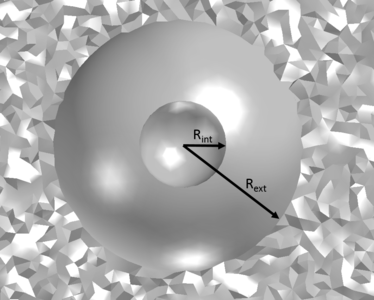
When simulating surface-to-surface radiation, we rely on the view factors between elements of diffuse surfaces that emit and receive radiation. To compute surface-to-surface radiation in a given geometry, operators are created by the heat interface and can be used to evaluate view ... En savoir plus
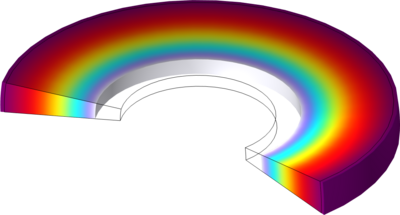
Creep is an inelastic time-dependent deformation which occurs when a material is subjected to stress at sufficiently high temperature, say 40% of the melting point or more. Experimental creep data (using constant stress and temperature) often display three different types of behavior ... En savoir plus
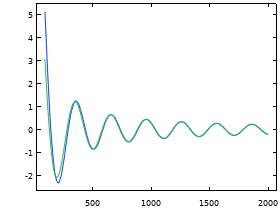
In this tutorial model, the far-field radiation pattern of a dipole antenna is computed in a 2D axisymmetric model component. Then, in a separate 3D model component, a ray is released using the far-field radiation pattern to initialize the ray's intensity, polarization, and phase. En savoir plus
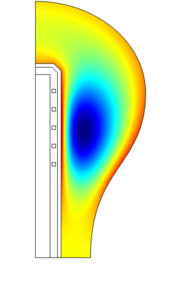
This model simulates an electrodeless lamp with argon/mercury chemistry. The low excitation threshold for mercury atoms means that even though the mercury is present in small concentrations, its behavior dominates. There is strong UV emission from the plasma at 185 nm and 253 nm. The UV ... En savoir plus
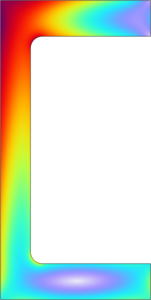
This benchmark demonstrates how to use the Beam interface in the Structural Mechanics Module. It calculates the deformation, section forces, and stresses in a cantilever beam as well as a number of eigenfrequencies. It also illustrates how to use the Beam Cross Section interface to ... En savoir plus
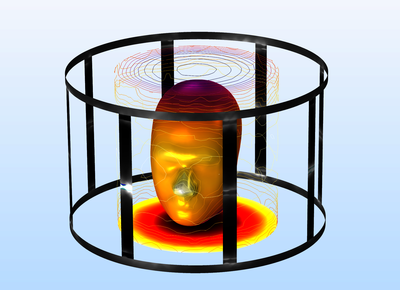
Magnetic resonance imaging (MRI) systems generate a magnetic flux density (B-field) to create images. Providing a homogeneous field distribution within a birdcage coil is a key factor for improving the quality of the scanned data. A homogeneous magnetic field can be found through ... En savoir plus
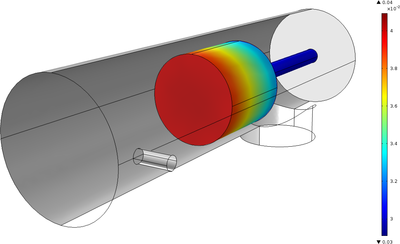
Chemical vapor deposition (CVD) is a process often used in the semiconductor industry to grow layers of high-purity solid material on top of a wafer substrate. CVD is achieved using many different techniques and across a range of pressures from atmospheric to ultrahigh vacuum (UHV/CVD). ... En savoir plus
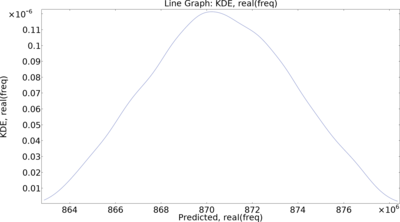
Uncertainty quantification is used to study the effect of manufacturing variation on the performance of a 2D solidly mounted resonator (2D SMR). This tutorial shows how the resonant frequency is affected by thickness variations of the piezoelectric layer and the Bragg reflector layers. ... En savoir plus
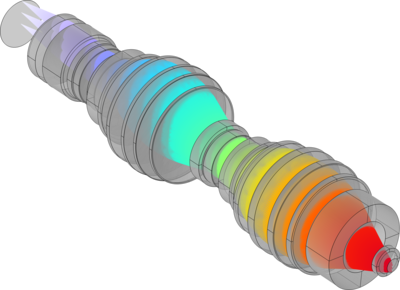
Microlithography lenses are used to project the image of an integrated circuit onto a silicon substrate. This tutorial demonstrates how to create a 21-element fused silica lens which has a NA of 0.56 which is designed to be used at a wavelength of 248nm. The lens, which has a total ... En savoir plus
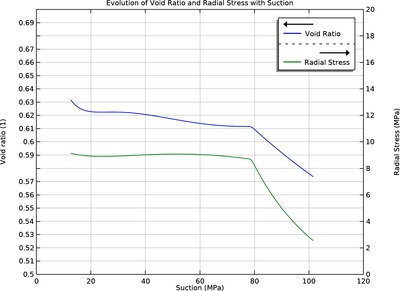
In this example, the Extended Barcelona Basic Model (BBMx) is used to model oedometer, uniaxial swelling, triaxial, and constrained swelling tests on bentonite clays in order to recover the hydromechanical characteristics of the soil samples. There is a good qualitative agreement ... En savoir plus


