
La Bibliothèque d'Applications présente des modèles construits avec COMSOL Multiphysics pour la simulation d'une grande variété d'applications, dans les domaines de l'électromagnétisme, de la mécanique des solides, de la mécanique des fluides et de la chimie. Vous pouvez télécharger ces modèles résolus avec leur documentation détaillée, comprenant les instructions de construction pas-à-pas, et vous en servir comme point de départ de votre travail de simulation. Utilisez l'outil de recherche rapide pour trouver les modèles et applications correspondant à votre domaine d'intérêt. Notez que de nombreux exemples présentés ici sont également accessibles via la Bibliothèques d'Applications intégrée au logiciel COMSOL Multiphysics® et disponible à partir du menu Fichier.
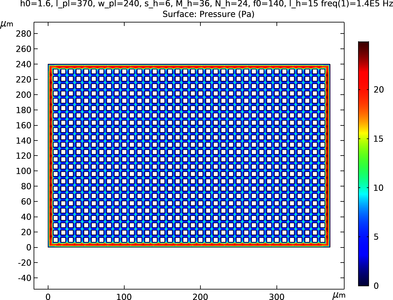
This benchmark model compares the damping coefficients of perforated plates from computation results versus experimental data. The simulation includes 18 different geometric configurations. It uses the Bao's perforation model, which is built-in in the Thin Film Flow physics interface. ... En savoir plus
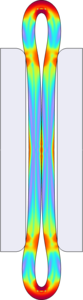
In offshore applications, it is sometimes necessary to quickly seal a pipe as part of the prevention of a blowout. This example shows a simulation, in which a circular pipe is squeezed between two flat stiff indenters until it is almost flat. The model serves as an example of an analysis ... En savoir plus
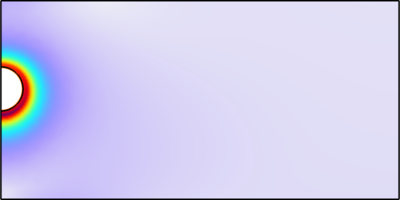
This example models the behavior of soil during a tunnel excavation. The surface settlement and the width of the plastic region around the tunnel are important parameters needed to predict required reinforcements during the excavation. Two study steps are used. The first study computes ... En savoir plus
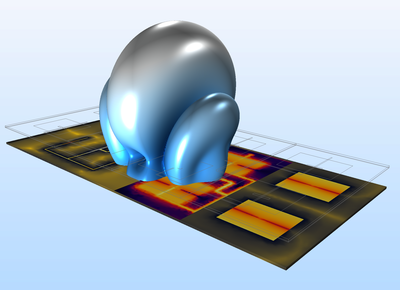
An antenna array is a group of radiating elements. By controlling the phase and magnitude of the input signal assigned to each antenna element and the number of array elements, the radiation pattern can be steered in a desired direction with a preferred level of gain. In this example, a ... En savoir plus

Trusses are structural members that can only sustain axial forces, but no bending or torsion. In the following example you first build and solve a simple 2D truss model using the 2D Truss interface. Later on, you analyze a 3D variant of the same problem using the 3D Truss interface. This ... En savoir plus
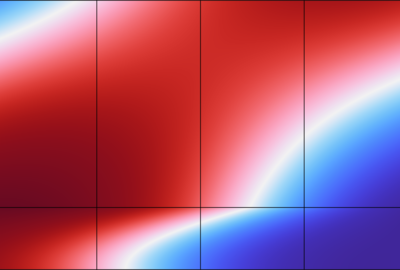
This tutorial investigates the acoustic properties of a porous layer made of glass wool. The porous material has transverse isotropic properties and is modeled with the full anisotropic poroelastic material model. En savoir plus
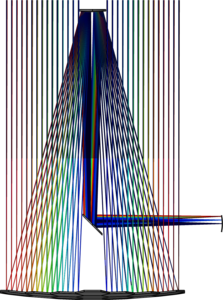
The Keck Telescope is a 10 meter diameter telescope with a Ritchey-Chretien optical design. It is noted for being one of the first large optical telescopes to utilize a lightweight segmented primary mirror. This tutorial demonstrates how to use built-in polygonal mirrors from the COMSOL ... En savoir plus
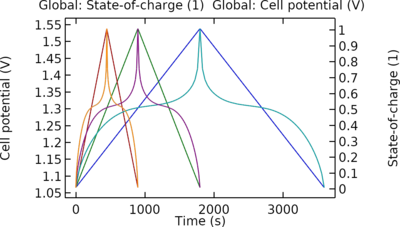
A simple equivalent circuit model approach is presented for Nickel metal hydride batteries. The 0D model consists of resistor, capacitor, current source and state-of-charge based voltage source (SOC). An Arrhenius type dependence is used to account for self-discharge. All model ... En savoir plus

Laminated composite shells made from graphite–epoxy fiber-reinforced plies are widely used in many applications due to their high strength-to-weight ratio. Evaluating their structural integrity under applied loads is essential for ensuring reliable designs. This example demonstrates ... En savoir plus
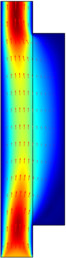
This is a tutorial model of the coupling between flow of a fluid in an open channel and a porous block attached to one of the channel walls. The flow is described by the Navier-Stokes equation in the free region and a Forchheimer-corrected version of the Brinkman equations in the porous ... En savoir plus


