
La Bibliothèque d'Applications présente des modèles construits avec COMSOL Multiphysics pour la simulation d'une grande variété d'applications, dans les domaines de l'électromagnétisme, de la mécanique des solides, de la mécanique des fluides et de la chimie. Vous pouvez télécharger ces modèles résolus avec leur documentation détaillée, comprenant les instructions de construction pas-à-pas, et vous en servir comme point de départ de votre travail de simulation. Utilisez l'outil de recherche rapide pour trouver les modèles et applications correspondant à votre domaine d'intérêt. Notez que de nombreux exemples présentés ici sont également accessibles via la Bibliothèques d'Applications intégrée au logiciel COMSOL Multiphysics® et disponible à partir du menu Fichier.
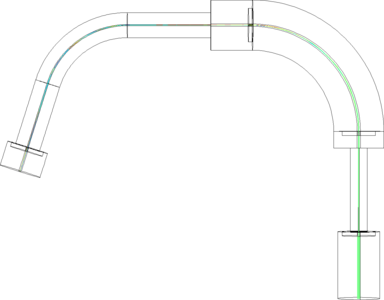
This tutorial utilizes the Particle Beam feature to examine the performance of a high-precision spectrometer. An ion beam is subjected to electric and magnetic forces, and only a fraction of the incoming beam is transmitted to the detector. The Particle Counter feature is used to compute ... En savoir plus

This model demonstrates the path of relativistic protons within Earth's magnetic field. Due to the dipole nature of Earth's magnetic field, charged particles, such as electrons and protons, can get trapped in stable configurations within it for long periods of time. These ... En savoir plus

In this model of a single-beam optical trap, SiO2 nanospheres in streaming water pass by or get captured depending on where they are released from. The electromagnetic force on the particles is calculated in the Electromagnetic Waves, Frequency Domain interface, with a Gaussian ... En savoir plus
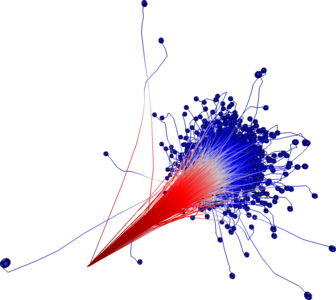
The Ion Range Benchmark model simulates the passage of energetic protons through silicon with both ionization losses and nuclear scattering. The initial energy of the protons is varied using a parametric sweep from 1 keV to 100 MeV. The average path length of the protons is compared to ... En savoir plus
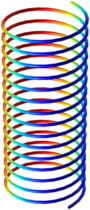
This model computes the trajectory of an ion in a uniform magnetic field using the Newtonian, Lagrangian and Hamiltonian formulations available in the Mathematical Particle Tracing interface. En savoir plus

Opto-acoustophoresis is a term used to describe the interplay between acoustics and optical fields. In most cases (including this) the optical field is heating up the material and therefore affecting the acoustic field. In this example of an acoustic trap a set of particle are trapped ... En savoir plus
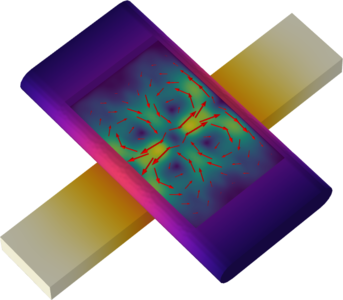
A 3D model of an acoustic trap in a glass capillary actuated by a piezoelectric transducer. The system is actuated by an oscillating electric potential across the piezoelectric transducer inducing mechanical vibrations in the solid and an acoustic pressure field in the fluid. The heat ... En savoir plus
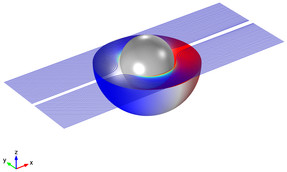
This model demonstrates the use of optical tracing for studying optically large gradient-index structures with anisotropic optical properties. Additionally, the model introduces a smoothing technique for handling discontinuities of refractive index on curved surfaces, which are typical ... En savoir plus


