
La Bibliothèque d'Applications présente des modèles construits avec COMSOL Multiphysics pour la simulation d'une grande variété d'applications, dans les domaines de l'électromagnétisme, de la mécanique des solides, de la mécanique des fluides et de la chimie. Vous pouvez télécharger ces modèles résolus avec leur documentation détaillée, comprenant les instructions de construction pas-à-pas, et vous en servir comme point de départ de votre travail de simulation. Utilisez l'outil de recherche rapide pour trouver les modèles et applications correspondant à votre domaine d'intérêt. Notez que de nombreux exemples présentés ici sont également accessibles via la Bibliothèques d'Applications intégrée au logiciel COMSOL Multiphysics® et disponible à partir du menu Fichier.
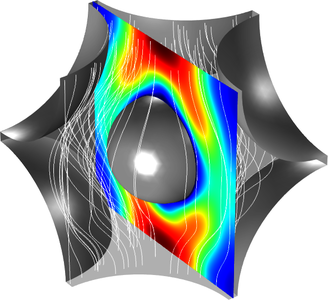
This example shows how to estimate the permeability of a porous material by creating a detailed fluid flow model in a small unit cell. The result of the model is a lumped permeability of the material, which can be used in homogenized models using Darcy's law or the Brinkman equations. ... En savoir plus
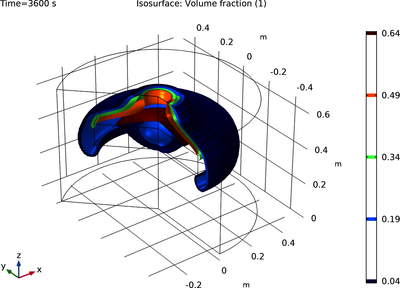
This example demonstrate two-phase flow in a porous medium which contains a low permeable lens. The heavier phase infiltrates the porous medium, so the low permeable lens is infiltrated only when a critical saturation at the outside is reached. En savoir plus
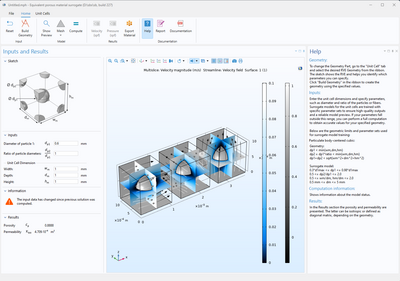
Porous materials are frequently represented through periodically arranged microstructures. To compute porous media flow, the macroscale permeability and porosity is used which can be calculated from the creeping flow results through the microscale unit cell. In this application, various ... En savoir plus
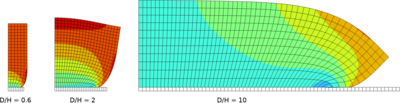
Polymer hydrogels consist of a crosslinked network of long-chained polymers that has imbibed a large number of solvent molecules. Such materials are used in many biomedical applications, such as targeted drug delivery, tissue engineering, and stimuli-sensitive actuators. This benchmark ... En savoir plus
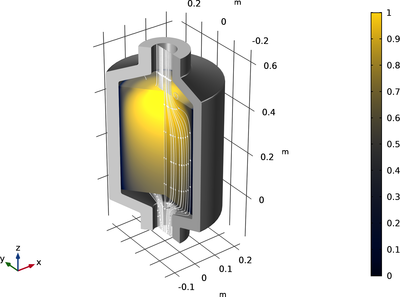
Thermal energy storage units are used to accumulate thermal energy from solar, geothermal, or waste heat sources. The simplest units are built from water tanks, often found in households, where the solar energy is stored as sensible heat. The thermal capacity of these tanks can be ... En savoir plus
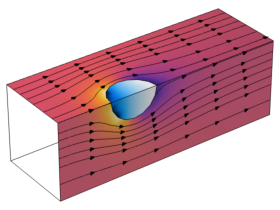
This model demonstrates the use of the Heat and Moisture Flow features for the simulation of superheated steam drying of a wood particle. A nonequilibrium formulation is used to compute the transport of the liquid water and vapor phases in the wood particle. Reference: Le, K. H., ... En savoir plus
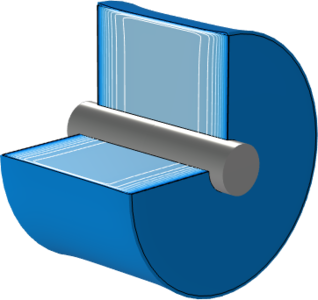
This example demonstrates how to model moisture transfer and induced swelling in a paperboard roll subject to varying ambient conditions. The material properties of the paperboard are anisotropic. En savoir plus
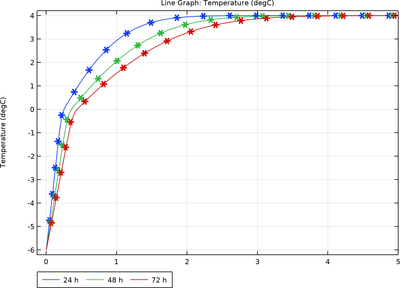
In this example, a heat-conduction problem with phase change in a porous material is solved, and the results are compared with the analytical solution, also known as the Lunardini solution. This is the first benchmark case from the InterFrost project, which was initiated to compare ... En savoir plus


